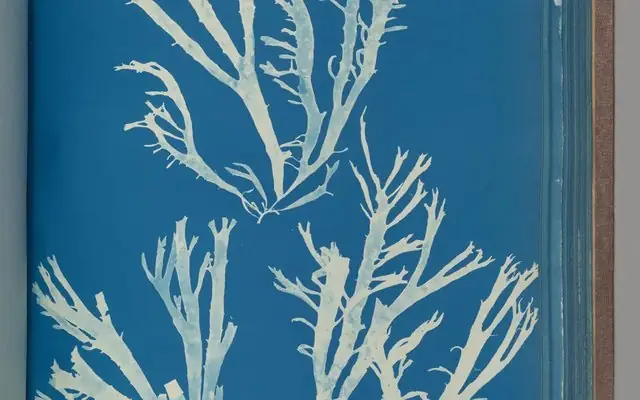
A book made from botanical impressions
A pale, branching seaweed suspended against a blue background can resemble an abstract drawing. Anna Atkins made such images by putting an actual specimen in contact with chemically prepared paper and letting sunlight do part of the work. Beginning in 1843, she distributed Photographs of British Algae: Cyanotype Impressions in installments. The book is recognized as the first illustrated with photographic images. Its novelty was both practical and visual: readers could inspect a plant's recorded outline without having the collected object in front of them.
Atkins already knew the demands of scientific illustration. Born in Kent in 1799, she grew up close to her father, John George Children, a scientist associated with the British Museum. In her early twenties she made 256 drawings of shells for his English translation of Lamarck's work. She later assembled preserved plants and supplied specimens to botanical contacts. Photography therefore entered an established life of observing, collecting, and representing natural things. Her access to knowledgeable people and scientific materials was an important part of that opportunity.
Sunlight replaced the drawing tool
The cyanotype process had been introduced by John Herschel in 1842. It used iron salts to sensitize paper. A specimen placed on the sheet blocked some of the light while the exposed areas reacted; washing in water produced the characteristic blue and pale image. Because the object touched the paper, the result was a photogram made without a camera. Fine divisions and translucent parts could leave surprisingly delicate traces. The process offered Atkins an affordable way to make botanical images, but the exposure and handling still required care.
Her project answered a particular gap in botanical publishing. William Harvey's Manual of British Algae, published in 1841, supplied names and descriptions without illustrations. The Metropolitan Museum of Art explains that Atkins followed Harvey's nomenclature, labeling the plates in her own hand. She used algae she collected and specimens received from other naturalists. The resulting pages joined identification with arrangement. A specimen might be spread to make its branches legible, leaving the blue ground to separate one fine edge from another rather than imitating the underwater setting in which it grew.
Every copy required repeated work
This was not a conventional print run in which a press reproduced a finished illustration thousands of times. Individual cyanotypes had to be made for individual copies. Recipients received installments and assembled their volumes, sometimes incorporating replacement plates sent separately. The Smithsonian's account emphasizes that bindings and plate totals consequently differ. A surviving copy is both a scientific publication and a record of decisions made after its pages arrived. The project continued across a decade, so the familiar date 1843 marks its beginning rather than the completion of every volume.
Distribution also depended on a community rather than a mass market. Getty's account describes unbound installments wrapped in blue cyanotyped paper and sent to botanical friends, including individuals and institutions. Herschel and William Henry Fox Talbot belonged to the photographic networks surrounding the work. Atkins later collaborated with her close friend Anne Dixon on further botanical albums. This history makes the image of a completely isolated inventor misleading. Collecting, technical information, correspondence, and the circulation of finished sheets all helped sustain the achievement beyond the moment when sunlight struck the paper.
A recognizable blue world
The later cyanotypes were not restricted to seaweed. The Victoria and Albert Museum holds studies of grasses, a dandelion, and a poppy associated with her work of the early 1850s. Ordinary plants received the same careful attention as unusual forms. Their actual greens, reds, or yellows disappeared into shades of pale blue and white. That loss of natural color helped produce an unmistakable visual language. The Rhodomenia polycarpa detail accompanying this story, from a plate cataloged by the Met to about 1853, similarly lets branching forms dominate a broad field of blue.
These pictures now move easily between the histories of science, books, and art. Their modern appeal should not hide the material labor behind them: collecting specimens, arranging fragile branches, preparing sheets, making exposures, washing prints, and sending parts to readers. Nor should calling them photographs lead us to imagine a camera aimed into the sea. Atkins made direct impressions from things she could place on a table. The enduring surprise is how that simple contact could become a portable collection, allowing distant readers to look closely at the same intricate natural forms.