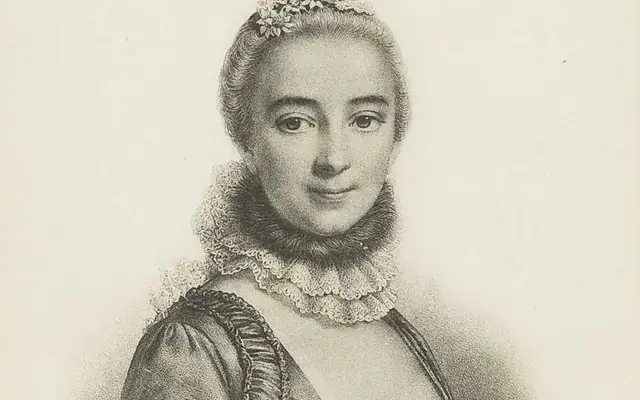
A marquise at work on physics
Translating a great scientific book can mean much more than finding equivalent words. Émilie du Châtelet's French version of Isaac Newton's Principia required an understanding of the mathematics, the arguments and the research that had developed around them. She supplied commentary as well as translation, giving readers tools for working through a demanding account of nature. The full edition appeared in 1759, ten years after her death. Yet this celebrated project was only part of her intellectual life. Before it, she had already written a substantial book of her own and entered disputes with established scholars.
Born in Paris in 1706 into an aristocratic family, du Châtelet had access to private education and resources unavailable to most women. Those advantages did not give her equal standing within the formal institutions of science. She studied with leading mathematicians and built an intellectual network through correspondence, visits and publication. Her country house at Cirey became a place for serious work with Voltaire and other scholars. Treating that setting merely as a fashionable drawing room misses its function as a working environment where reading, calculation and experiments could be organized outside a university appointment.
A book of her own
Her Institutions de physique, published in 1740, makes the independence of her ambitions particularly clear. Often rendered in English as Foundations of Physics, it addressed problems involving space, matter, force and knowledge. It drew on competing traditions associated with Newton, Leibniz and Descartes instead of simply presenting one famous man's system for beginners. That breadth reflected the period's understanding of natural philosophy. Questions later divided between physics and metaphysics still belonged within a connected investigation. A reader expecting only a collection of practical experiments or elementary equations would misunderstand what the book was trying to accomplish.
The book also placed its author in a public controversy about vis viva, or living force. Scholars disagreed over how the force of moving bodies should be understood and measured. Du Châtelet defended her position against Jean-Jacques Dortous de Mairan, an official of the Royal Academy of Sciences. Their exchange circulated in print. The American Philosophical Society preserves a letter associated with that debate, dated April 7, 1741. It offers a concrete reminder that scientific participation could happen through an argument between correspondents even when one participant was excluded from membership in the institution represented by the other.
Translating a mathematical argument
Du Châtelet began translating Newton's Principia in 1745, working from the third Latin edition of 1726. The problem was not that French lacked words for planets or gravity. Newton's demonstrations demanded mathematical expertise, and subsequent work raised questions about how best to explain and extend them. Her project therefore included a substantial commentary and mathematical additions. Alexis Claude Clairaut advised her and checked calculations. Recognizing that assistance describes how the work was produced; it does not turn her into a passive copyist. Scholarly collaboration and individual authorship were both present in the enterprise.
The publication history requires a little care. Material appeared in 1756, while the complete edition followed in 1759. Du Châtelet had died at Lunéville in September 1749 after giving birth. Voltaire supplied a preface to the posthumous publication, and Clairaut helped bring the work into print. The different dates can make short accounts sound contradictory when they are describing different stages. The enduring result was a French translation with explanatory material that continued to be consulted long after the eighteenth century, linking the labor of translation with the development of French mathematical physics.
A reputation beyond the drawing room
Her other activities prevent the Newton project from swallowing her entire biography. An essay on fire entered the Royal Academy's prize competition and was published even though it did not win. She also wrote on happiness and philosophical questions beyond mechanics. These works place her within a wider culture of inquiry in which moral reflection, language and mathematical science could belong to the same life. Voltaire was an important partner, but the publications issued under her own authorship provide direct evidence that she was pursuing a program of thought with its own subjects and priorities.
Du Châtelet's career changes the usual picture of an Enlightenment translator. She did not stand at the end of a pipeline, handing completed discoveries from one language to another. She evaluated arguments, joined debates and helped determine how readers could understand a difficult mathematical system. Her aristocratic circumstances opened doors while the restrictions on women closed others. The resulting body of work is more revealing than a story centered only on romance or exceptional talent. It shows the practical routes through which a woman could become a recognized contributor to eighteenth-century philosophy and science.