A grocer with a wide correspondence
A Westminster shop selling tea, coffee, and groceries might seem an unlikely place to look for a literary life. For Ignatius Sancho, trade and correspondence occupied the same world. Customers, friends, household accounts, music, and politics all entered the record he left. His letters were published in 1782, two years after his death, but the surviving evidence reaches beyond the printed book. A poll book, manuscript letters, tax assessments, and an insurance register help recover a Black Londoner whose interests extended well beyond the boundaries later summaries often place around him.
Sancho worked in domestic service for the Montagu family before becoming a shopkeeper. Accounts of his earliest life describe enslavement and a childhood brought to England, although much of that narrative comes through a later biographical tradition rather than a detailed contemporary record of his birth. His adult London life leaves firmer documentary traces. In December 1758 he married Ann Osborne at St Margaret's, Westminster. Their family and the business they eventually operated belong at the center of the story, alongside the aristocratic connections that made him visible to famous contemporaries.
A household inside public history
The grocery shop in Charles Street placed him close to Parliament and the political life of Westminster. The London Archives identifies him in the manuscript poll book for the 1774 election, described as a tea dealer. This is direct evidence of his participation in parliamentary voting. He is often called Britain's first Black voter, but priority claims depend on which surviving records historians know. The secure point is already remarkable: this particular man can be located by name and occupation in an eighteenth-century electoral document, taking part in a system that admitted only a restricted electorate.
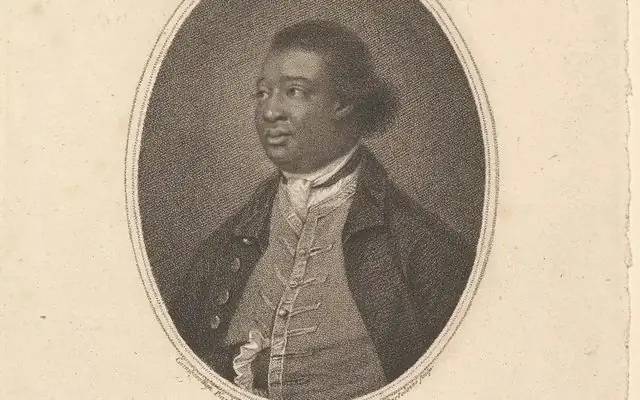
Music and visual art provide other traces of that public presence. Sancho composed and published music, while Thomas Gainsborough painted his portrait in 1768. An engraving after that painting later served as a frontispiece to his collected letters. The Metropolitan Museum preserves an example issued in 1802 and identifies his son William as its publisher. Readers encountering the book therefore met its author through both writing and an image. The surviving print is a material link between Sancho's lifetime reputation and his family's later work to circulate his correspondence.
Letters survive in more than one form
The letters refuse to stay within a single subject. They discuss friendship, illness, bereavement, purchases, public affairs, and literary tastes. The British Library's catalogue of the Stevenson papers identifies fifteen surviving letters from Sancho to William Stevenson and his father, the Reverend Seth Ellis Stevenson. One thanks the older man for settling a bill; another describes family grief. Such details are valuable precisely because they do not reduce their author to a public emblem. They reveal obligations, affection, jokes, and disappointments moving through the same network as books and goods.
Manuscripts also allow the printed collection to be checked. The British Library records a letter dated November 26, 1776, that appeared in print with the year given as 1774. Another manuscript contains lines omitted from its published version. These differences do not invalidate the collection; they show why an edited book and an original letter answer somewhat different questions. Dating, selection, and transcription influence the Sancho a reader encounters. His later reputation was built through acts of preservation and publication that historians can themselves investigate using the surviving papers.
A family business after its founder
Sancho died in December 1780, but his family's commercial life continued. The London Archives notes that an 1802 tax assessment names Ann Sancho as the registered holder of the property associated with the shop. A June 1807 insurance record then locates Ann and William together as booksellers and publishers in Castle Street, Leicester Square. These records challenge the assumption that a business simply passed from father to son. Ann's documented presence shows a woman participating in the enterprise, even when a son's public reputation might otherwise dominate its history.
The grocery counter, election entry, engraved portrait, and annotated letters preserve different parts of one connected life. Together they show how a shop could support intellectual exchange and how a family sustained a writer's presence after his death. Sancho's importance includes his opposition to slavery and his place in Black British history, but his surviving correspondence also invites a more intimate encounter. He was conducting business, raising a family, enjoying music, and thinking about his society. The documents keep those activities together, as they were in the life he lived.