A working life above the crowd
Long before an airline pilot could describe flying as a career, Sophie Blanchard earned money by rising above a paying crowd in a balloon. Her ascents combined aeronautical skill with the demands of public entertainment. Flights could celebrate rulers, draw visitors to a festival or offer a spectacular night display. She became one of the best-known professional women in early aviation. The surviving record includes more than the accident that ended her life. A documented visit to Nantes in 1817 shows the negotiations, advertising, uncertain income and practical problems that surrounded the moment when a balloon finally left the ground.
Blanchard entered ballooning alongside her husband, Jean-Pierre, an established aeronaut associated with the first balloon crossing of the English Channel in 1785. She made flights with him before continuing independently after his death in 1809. The Library of Congress emphasizes the economic importance of that decision: professional ascents gave her a way to support herself and settle debts. She was not the first woman to rise in a balloon. Earlier women had already flown, and separating a professional career from a first ascent avoids erasing those predecessors. Her distinction lies in making repeated public performances a livelihood.
An afternoon in Nantes
On September 21, 1817, people in Nantes gathered along the Loire and in boats to watch her ascend. The city's archival account explains that another aeronaut had originally been expected, but the mayor switched the engagement when the celebrated Madame Blanchard arrived. Competition between performers was therefore part of the story before the flight began. Her equipment had been displayed beforehand, and ticket holders could watch preparations for inflation. The attraction included the technology itself. Even people who would never leave the ground could inspect the apparatus and follow the work that made an ascent possible.
The flight also exposed the difference between a vast audience and a profitable event. Nantes's account draws on surviving records of receipts and expenses, noting municipal disappointment at the financial result. Spectators could watch a rising balloon from many places without entering the paid enclosure. The same visibility that made the performance spectacular reduced the organizer's control over who paid to see it. After traveling westward, Blanchard encountered trouble when descending toward marshy ground; a rope caught, and she ended up in a tree before people following her route helped her. A successful departure did not guarantee an easy landing.
Patrons, pictures and pyrotechnics
Her prominence reached well beyond local festivals. She performed for Napoleon and retained favor under the restored monarchy of Louis XVIII. That continuity is striking in a period of abrupt political change. Aeronautical display could supply a public language of celebration useful to successive regimes. Royal patronage did not remove the physical risk or the need to manage costs, but it added prestige to an already visible occupation. Nor did an official association transform every ascent into a military or scientific mission. Much of her work belonged to the commercial and ceremonial world of entertainment.
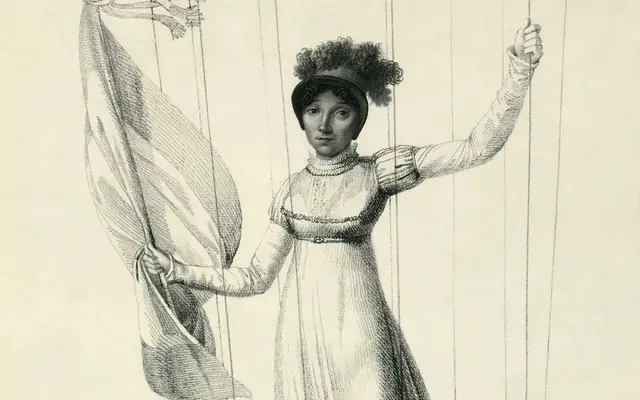
A print preserved by the Library of Congress depicts her during a flight at Milan in 1811. She stands in a small, decorated basket with flags and suspension lines framing her figure. Such images helped make an individual performer recognizable beyond the crowd at one event. They are carefully composed representations, rather than photographs of a passing instant. The delicate basket and elaborate costume also show how theatrical presentation belonged to early flight. Viewers were invited to admire both the technology that lifted a human body and the person willing to make that exposed position her stage.
More than a dramatic ending
Night performances added another attraction through lights and fireworks. On July 6, 1819, during an ascent at the Tivoli Gardens in Paris, fire ignited her hydrogen balloon. As the damaged craft descended, it struck a roof, and she fell to her death. The broad sequence is well documented, although later retellings differ about the precise ignition mechanism and add dramatic details that need separate checking. Hydrogen's flammability made the combination of balloon and pyrotechnics hazardous. The accident ended a professional career; it should not be mistaken for the sole fact that made the career historically significant.
Blanchard's working life reveals how early aviation depended on audiences as well as inventors. There had to be publicity, a venue, financial arrangements, equipment, inflation and an audience willing to pay before the celebrated moment of ascent. Afterward came a landing whose location could not be promised like a train's arrival platform. Her story is therefore part of the history of women's paid work and public identity as well as the history of flight. The Nantes records make that connection unusually clear: behind a figure floating above the city stood an enterprise operating within it.