An imported idea for a riverbank
Washington's cherry blossoms are the result of a long campaign that began with an idea carried home from Japan. Eliza Ruhamah Scidmore wanted flowering cherry trees planted along land reclaimed beside the Potomac River. She first promoted the proposal in 1885. Officials did not immediately share her enthusiasm, and changing officeholders brought repeated opportunities to ask again. Before there was a famous spring landscape, there was a writer describing what an unpromising stretch of ground might become. Persuasion proved at least as necessary as planting.
Scidmore had made a career from looking beyond familiar surroundings. She traveled, wrote books and articles, and worked as a photographer. She joined the National Geographic Society in 1890 and became the first woman on its governing board. The National Park Service also connects her Alaska writing with the development of tourism there. Japan supplied another landscape she wanted American readers to appreciate. Her cherry-tree proposal emerged from these experiences of observation and communication, rather than from an official position in the management of Washington's parks.
Finding allies for a planting scheme
She was interested in more than the appearance of an isolated tree. The Library of Congress explains her ambition in relation to the Japanese custom of viewing spring blossoms. Planted together along water, the trees could create a place people would return to experience at a particular season. Bringing that idea to Washington involved adapting a social activity as well as introducing a plant. The future landscape needed enough trees, suitable public ground, and people willing to imagine a park as an experience that would change through the year.
An important ally was the Department of Agriculture's plant explorer David Fairchild. He experimented with Japanese flowering cherries near Washington and promoted their wider planting, including an Arbor Day effort involving schoolchildren in 1908. Scidmore then approached First Lady Helen Taft with a proposal to raise money for trees. Taft's favorable reply, dated April 7, 1909, supplied influential support. Scientific experience, private enthusiasm, and access to the White House had begun to converge. The plan could finally move beyond a recurring request to successive park officials.
A gift that failed inspection
Japanese participants transformed the scale of the undertaking. Chemist Jokichi Takamine and consul Kokichi Mizuno discussed a gift, and Tokyo's mayor, Yukio Ozaki, supported it. Two thousand trees reached Washington in January 1910. Yet their arrival created a serious problem: inspectors found insects and diseases that threatened American plants. The trees were ordered destroyed. A diplomatic gesture had collided with the practical responsibility to prevent the spread of pests. It was an extraordinary disappointment, but the fact that a gift was well intended could not make its living cargo safe.
The project survived because the Japanese donors prepared a replacement rather than abandoning it. A second shipment contained 3,020 trees representing twelve varieties. Carefully selected and prepared, they crossed the Pacific and continued by rail to Washington in March 1912. The National Park Service's chronology records Helen Taft and Viscountess Chinda, the Japanese ambassador's wife, planting two Yoshino cherry trees beside the Tidal Basin on March 27. Scidmore's long campaign had reached a public result through cooperation among people in two countries, with different roles and resources.
A landscape with many makers
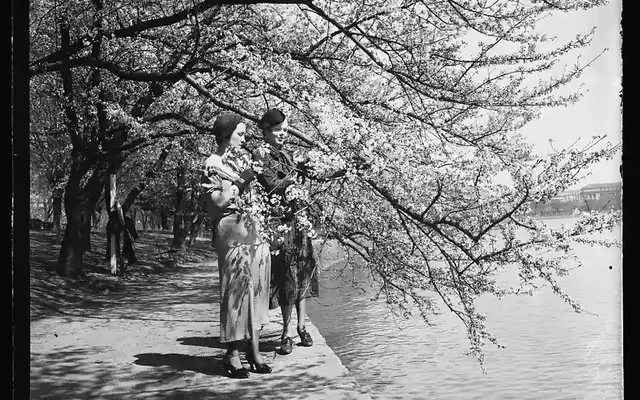
Planting continued after that small ceremony, and the eventual festival developed later. That distinction keeps the familiar celebration from swallowing the earlier history of practical work. The photograph accompanying this story shows Washington cherry blossoms in 1935, when the trees had become part of a recurring public attraction; it does not depict the 1912 planting or identify Scidmore among the visitors. The scene records the kind of shared landscape she had wanted people to enjoy. The trees' seasonal transformation gave a continuing audience to an idea once repeatedly dismissed.
The exchange also continued in the other direction. In 1952 Washington supplied material from descendants of the donated trees to help restore the declining grove along Tokyo's Arakawa River. Living plants had become a means of preserving connections across generations and after war. Scidmore did not create this entire history alone, and credit also belongs to gardeners, scientists, Japanese donors, and political supporters. Her distinctive contribution was persistence: she kept a possible landscape visible in words until enough other people were ready to help make it grow.