A railway without a locomotive
A railway carriage moving through a tunnel usually suggests a locomotive or an electric motor. In Victorian London, a small experimental mail railway depended instead on moving air. The London Pneumatic Despatch Company built tubes containing rails and sent wheeled vehicles through them using pressure or suction. The cargo was supposed to be post, but demonstration visitors sometimes climbed aboard as well. The result was an unusual combination of practical engineering and public spectacle. It promised to move letters away from crowded streets, yet the ability to propel a wagon quickly proved different from creating a durable postal service.
The problem extended beyond the speed of long-distance trains. Mail reaching a London railway station still needed to travel between that terminus and a sorting office. A short surface journey could become a bottleneck in the larger system. Engineers therefore considered taking part of that traffic underground. Small pneumatic tubes for individual messages and larger railway-like tubes for bulk loads were related ideas, but they were not interchangeable machines. A message capsule and a wagon carrying bags imposed different requirements for tunnel size, handling and the amount of air that had to be moved.
From an experiment to postal traffic
In 1863, a short pneumatic railway linked Euston Station with the North Western District Office in Eversholt Street. A surviving car's museum description identifies a roughly 600-yard route and rails set two feet apart. A steam engine drove a fan; the vehicle did not carry its own engine. Blowing or drawing air through the tube supplied the force that moved it. The museum records thirteen journeys a day on this early section. Those details make the invention tangible: this was a working arrangement of iron tubes, railway wheels and machinery, rather than a proposal that existed only on paper.
The terminus was an essential part of the system. Bags still had to enter the vehicle at one end and leave at the other, and an expanding network needed arrangements for transferring loads. The company experimented with different sizes of cars and tubes as it developed its service. A fast run through an isolated section could demonstrate propulsion, but could not by itself settle the economics of repeated loading, unloading, maintenance and staffing. That distinction helps explain why accounts can describe impressive trial speeds while also judging the overall enterprise disappointing. They may be measuring different parts of the postal journey.
A spectacular opening and a difficult business
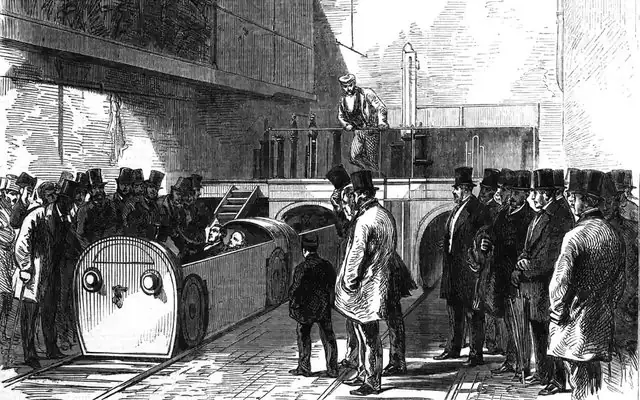
A contemporary engraving in the Illustrated London News captures the Holborn end of the tube on its opening day in 1865. Well-dressed observers stand beside the small wagons, with the apparatus exposed for inspection. The accompanying report describes guests who wanted to ride through the tube despite warnings that it had not been built for passengers. They had to recline inside the vehicles, and reported uncomfortable sensations at departure and arrival. Such demonstration rides helped make the invention memorable. They should not be confused with the opening of a regular underground passenger railway serving London commuters.
Expansion did not solve the financial problem. The Postal Museum's history describes the company operating at a loss by 1866, followed by further development and a route eventually connecting Euston with the General Post Office at St Martins Le Grand through Holborn. The Post Office did not provide the lasting commitment the company needed. The service ended in 1874. The broad lesson is practical rather than mysterious: public interest in a machine and a successful technical trial are not the same thing as a customer agreeing to fund an entire transport system over the long term.
The idea outlived the railway
Pneumatic post nevertheless had a substantial history beyond this particular railway. The Smithsonian's National Postal Museum documents later American networks that carried cylinders of letters through smaller pipes. In New York, an individual cylinder could contain hundreds of letters, and the network eventually extended across many miles. That success should not be projected backward onto the London company's different equipment. It does show why the underlying idea remained attractive. When the load, route, handling arrangements and operating costs fitted together, air could provide a useful means of moving physical messages around a city.
London eventually adopted a different underground postal railway. Mail Rail opened in 1927 using electric, driverless trains, long after the pneumatic enterprise had closed. The later system was not simply the Victorian wagons receiving new motors. The earlier experiment belongs in its prehistory as evidence of a persistent question: how could a city separate urgent mail from the friction of its streets? Surviving cars and the Holborn engraving preserve one inventive answer. They also preserve the gap between an ingenious demonstration and an institution's decision that the machinery was worth maintaining.