The difficulty between a remedy and a treatment
A potentially useful substance is not automatically a usable medicine. The oil from chaulmoogra seeds had a long history in the treatment of Hansen's disease, commonly called leprosy, but getting its ingredients into the body posed serious difficulties. In Honolulu, a young chemist named Alice Augusta Ball approached that obstacle as a problem of separation and chemical transformation. Her work at the College of Hawaiʻi in 1915 helped turn the oil's fatty acids into an injectable preparation. The story concerns an important early treatment, and also the distance that can open between making a discovery and receiving credit for it.
Ball had arrived with unusually strong experience for someone in her early twenties. Born in Seattle in 1892, she studied pharmaceutical chemistry and pharmacy at the University of Washington before moving to Hawaiʻi for graduate research. Her master's work investigated the active constituent of the ʻawa root. In 1915 she became the College of Hawaiʻi's first woman and first African-American graduate to receive a master's degree. She also taught chemistry there. These achievements placed her inside an institution where laboratory skill could be brought to bear on an urgent local medical problem.
Plant chemistry with consequences for patients
Physician Harry Hollmann was interested in making better use of chaulmoogra oil for patients with Hansen's disease. Ball's expertise in plant chemistry helped her tackle the mixture rather than treating the raw oil as a finished product. She isolated fatty acids and converted them into ethyl esters, chemically modified forms suitable for injection. This was not the discovery of the tree or the first attempt to use its seeds. The important change lay in preparing the ingredients in a form the body could receive more effectively, linking careful chemical work to the difficult business of administering a treatment.
The social setting made such an improvement especially consequential. In Hawaiʻi, people diagnosed with Hansen's disease could be sent away from their families to isolation settlements on the Kalaupapa peninsula of Molokaʻi. University accounts connect the improved treatment with the discharge of patients from hospitals and isolation facilities. That does not mean every person treated was permanently cured, or that changing a preparation ended the policy of separation. It means that a laboratory procedure could affect whether some patients remained institutionalized. The history of the method therefore belongs alongside the history of families and enforced distance.
A short life and a disputed record of credit
Ball died on December 31, 1916, aged only twenty-four, before publishing her findings on this treatment. The work continued, but the account of who had made the crucial contribution became distorted. Arthur Dean, the college president and a chemist, published work on the process without crediting Ball. Keele University's account describes the resulting method being associated with the later researcher's name. Ball could no longer write a paper, explain her role publicly, or respond to how the work was presented. Her absence made the surviving testimony of colleagues especially important to the historical record.
In 1922, Hollmann explicitly credited Ball's contribution in a medical paper. The American Chemical Society identifies that publication as essential evidence connecting her name with the esterification method. Reports of improvement encouraged the treatment's use, and it remained important until newer antibacterial therapies emerged decades later. It should be understood within that earlier medical setting rather than presented as an equivalent of modern treatment. Recognizing its limits does not diminish the achievement. Ball had solved a specific chemical obstacle, and remembering that precise accomplishment offers a better tribute than turning an early therapy into an unlimited cure.
Following the oil and recovering the name
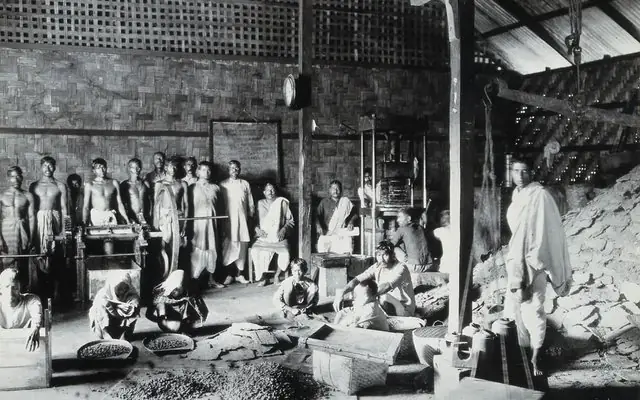
A historical photograph of Prasana Kumar Sen's chaulmoogra oil factory in Chittagong offers a view of the wider material world behind this medicine. J. F. Rock photographed it in 1921, after Ball's death. It does not show her laboratory or establish a direct connection between her work and that particular factory. Instead, the image records the production of the plant oil whose chemistry occupied researchers in Hawaiʻi and elsewhere. The distance between a factory, a laboratory, and a hospital helps explain why improving an existing remedy involved more than identifying a plant with a useful reputation.
Recognition eventually became more visible. The University of Hawaiʻi honored Ball with its Regents' Medal of Distinction in 2007 and established an endowed scholarship bearing her name. In February 2026, a campus ceremony marked the designation of the Ball Method as a National Historic Chemical Landmark by the American Chemical Society. These commemorations rest on the recovery of an earlier record, particularly Hollmann's acknowledgment. Ball's history asks us to look closely at both the practical form of a discovery and the documents that preserve its authorship. A change in chemical preparation reached patients; a change in historical attention restored the chemist's name.