An extraordinary arrival
An eighteenth-century celebrity could travel with an entourage, attract crowds and sell souvenirs without speaking a word. Clara was an Indian rhinoceros. In 1741, the Dutch sea captain Douwe Mout van der Meer brought her from India to Amsterdam. For the next seventeen years he exhibited her around Europe. Paying visitors encountered an animal most had known only through pictures or descriptions. Her tour became an unusual meeting of commercial entertainment, artistic observation and natural history. Looking at the objects made around her reveals how a living creature could become both a scientific subject and a fashionable attraction.
Clara's journey began within the networks of the Dutch East India Company, rather than with a European expedition devoted to zoology. The Rijksmuseum traces her capture to Assam in 1738, after hunters killed her mother. She subsequently lived with the company's local director in Bengal before traveling with Mout. That background matters because her later popularity can make the movement of an animal across an imperial trading network sound like a cheerful adventure. The surviving European record mostly concerns the people who owned, exhibited or observed her. It offers much less access to the experience of the animal herself.
Keeping a celebrity on the road
Keeping a rhinoceros on tour required more than finding the next fair. Mout used a specially built wagon, turning the transport of a very large animal into a recurring logistical undertaking. His itinerary reached places including Vienna, Paris, Naples and Copenhagen. Exhibitions took place at markets, carnivals and royal courts, drawing different audiences into the same enterprise. The geography of the tour also explains why Clara appears in so many collections today. Each stop created opportunities for a local artist to draw her, for a patron to commission a work, or for a visitor to buy a reminder.
Advertising was part of that machinery. Prints announced the marvel on display, while medals let visitors carry away a miniature version of the encounter. One advertisement described enormous quantities of hay, bread and water. Those figures belong to the language of the attraction and should be identified as advertised claims, rather than treated as a modern keeper's feeding chart. The appeal spread into expensive decorative objects as well. Clocks mounted on rhinoceros figures show how an encounter at a fair could be transformed into an ornament for a wealthy household, long after the traveling exhibition had moved elsewhere.
A rhinoceros meets her audience
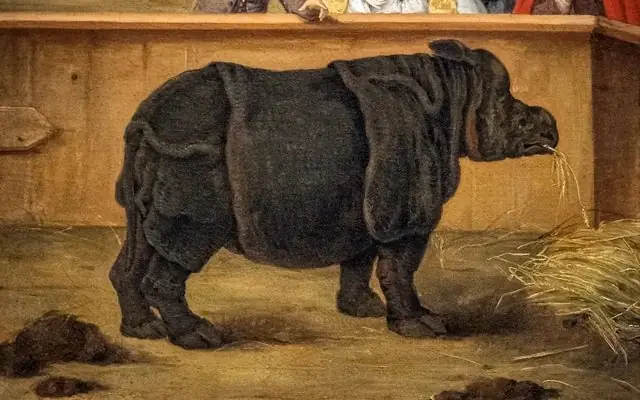
Artists were also confronting an influential inherited image. Albrecht Dürer's famous rhinoceros woodcut of 1515 had been made without his seeing the animal it represented. Clara offered opportunities to compare such pictures with a living body. The naturalist Petrus Camper visited her in Leiden in 1742, examining features including her upper lip. In Paris, Jean-Baptiste Oudry painted a life-size portrait in 1749. Its scale made her physical presence part of the picture's effect. Observation did not suddenly eliminate artistic convention, but it supplied information that a copied print alone could never provide.
Pietro Longhi's Venetian paintings shift attention toward the exhibition itself. In 1751 Clara appeared during the Venice Carnival, and Longhi represented her before spectators in an enclosure. Some visitors wear masks, linking the animal show to the city's festive customs. Hay, wooden barriers and the showman's presence belong to the same scene as elegant clothes. Versions survive in Venice and London. The National Gallery's account emphasizes the subdued mood of its painting: a world-famous attraction still has to stand and eat while strangers inspect her. The picture records a social encounter as well as an animal's appearance.
What the pictures preserve
Clara died in London in 1758. Images and objects continued to circulate after her death, extending the public life of an animal who could no longer be seen. A print, a painting and a decorative clock each preserved something different. The first could advertise; the second could record a body or an audience; the third could turn the animal into a sign of taste and wealth. None should be read as a transparent window onto her entire life. Their purposes help explain both the richness of the surviving evidence and its limitations.
Clara's fame belongs to a time before photographs, cinema or modern mass tourism, yet its commercial pattern feels familiar. A rare appearance generated publicity, the publicity attracted spectators, and objects carried the encounter beyond its original location. What makes her story distinctive is the simultaneous effect on knowledge: the celebrity could be measured, sketched and compared with older images. Her surviving portraits therefore connect two histories that are often told separately. They show how entertainment could support observation, while reminding us that the creature at the center of the excitement remained a captive animal.