A famous name and a difficult attribution
From outside, the small brick building known as the Mausoleum of Galla Placidia offers little warning of its interior. Inside, blue vaults, gold stars, birds, plants, and human figures turn a compact room into an elaborate vision of Christian salvation. The monument belongs to fifth-century Ravenna, then a center of the Western Roman imperial court. Yet its familiar name poses a historical trap. The association with Empress Galla Placidia is traditional, while the building's exact patronage, date, and original purpose have attracted debate. Her burial here should never be presented as an established fact.
Galla Placidia was the daughter of Emperor Theodosius I, sister of Honorius, and mother of Valentinian III, for whom she acted as regent. Ravenna's official heritage accounts associate the building with her patronage in the first half of the fifth century. Those accounts also explain that she died in Rome in 450 and was buried there. A precise modern opening date for the Ravenna building cannot be supplied with comparable confidence. Describing it as a fifth-century monument preserves the chronology without pretending that an exact construction anniversary has survived in the evidence.
A small room within imperial Ravenna
The structure was once attached through an entrance portico to the Church of Santa Croce. Its small cross-shaped plan and central raised tower make more sense when that lost architectural relationship is remembered. Today it is easy to encounter it as an independent treasure, especially because it stands near the later Basilica of San Vitale. The two monuments belong to different building campaigns and should not be blended into one story. UNESCO distinguishes the mausoleum's Western Roman architectural tradition from San Vitale's sixth-century achievement under Justinian. Ravenna preserves several historical moments within a walkable space.
Across the upper interior, mosaic pieces create surfaces that respond to light rather than behaving like flat painted walls. Glass and gold tesserae are set at different angles, so a change of viewpoint alters their appearance. Above, stars gather around a golden cross against deep blue. Beneath the central vault, winged creatures contribute to the imagery of a heavenly realm. The effect connects architecture with belief: the room encloses the visitor physically while its decoration suggests a space extending beyond ordinary surroundings. The small scale intensifies the encounter rather than diminishing the ambition of the imagery.
Shepherds, water and flowering vaults
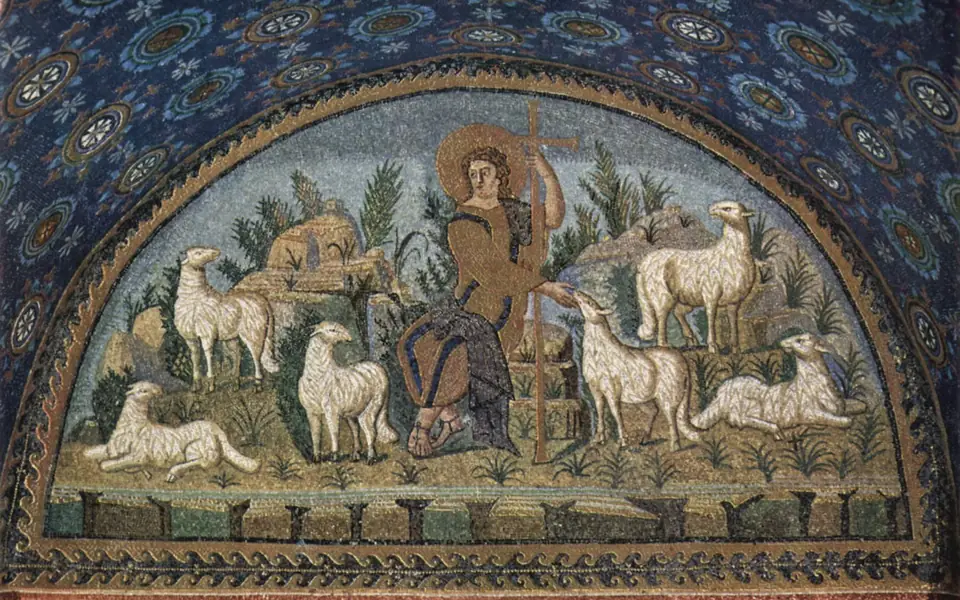
The Good Shepherd mosaic above the entrance offers a particularly memorable example. A youthful Christ sits among six sheep, holding a tall cross, his body turning toward an animal beside him. Rocks, vegetation, and the arrangement of the flock give the scene an inhabited landscape. Rich clothing and the cross distinguish this shepherd from a laborer simply watching livestock. Looking closely at the surviving image shows how familiar pastoral forms could carry Christian meaning. Its visual appeal lies partly in that combination: recognizable animals and terrain organized around a figure who belongs to a sacred narrative.
Other images make the theme of spiritual refreshment more explicit. Doves drink beside a basin, while deer approach water among plants. Ravenna's mosaic heritage account connects the doves with a much older artistic tradition, then explains their Christian funerary significance here. Another lunette shows a figure commonly identified as Saint Lawrence near a flaming gridiron and a cabinet containing the Gospels. These details reward attention beyond the celebrated starry ceiling. The decorative plants and repeated circles also matter: scholars have examined whether their suggestion of perpetual flowering helps construct an image of paradise throughout the room.
Evidence, interpretation and a continuing afterlife
Such readings do not settle every question about the building. In research preserved by Louisiana State University, art historian Lisa Onontiyoh West emphasizes the long debate over its intended function, patron, and dating. Her study interprets the floral and circular patterns as evidence supporting a funerary purpose. That is an interpretation of the visual program, not proof that Galla Placidia's body occupied one of the sarcophagi. The distinction is useful whenever a monument's traditional name becomes more familiar than its evidence. Architecture, later memory, and the actual location of a person's burial are related questions, but they are not interchangeable.
In 1996 the mausoleum joined seven other Ravenna monuments on UNESCO's World Heritage List. Together they document artistic exchange across the late Roman and early Byzantine worlds. Their influence also extends far beyond conservation: the Metropolitan Museum of Art has traced the inspiration of Ravenna's mosaics, including this monument, in Gianni Versace's designs. The little building therefore has several histories at once, from early Christian imagery to later interpretation and modern creative reuse. Its strongest claim on attention is visible without a legendary burial: a remarkably concentrated ensemble in which individual pieces of colored material still organize an entire room around hope beyond death.