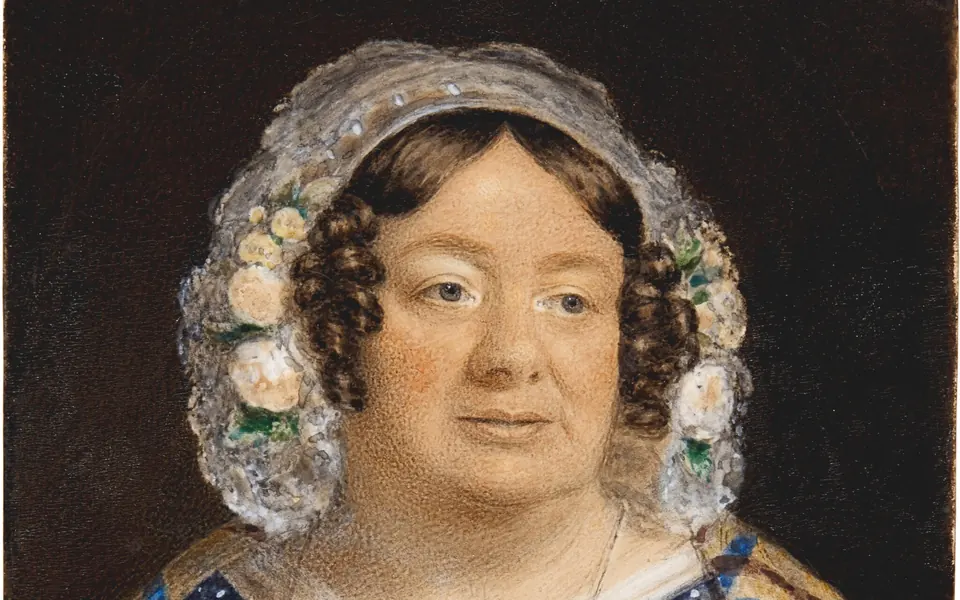
A painter working at miniature scale
A portrait miniature asks its maker to fit a recognizable face into a space small enough to hold in a hand. Sarah Biffin mastered that demanding work using a brush held with her mouth and adapted supports. Born in Somerset in 1784 without arms and with underdeveloped legs, she learned to write, sew, and paint. Her surviving pictures offer more than evidence of an unusual method. They reveal an artist attentive to expression, clothing, fine detail, and the professional image she wanted customers to see.
Biffin came from East Quantoxhead, where her family had limited resources. Her baptismal record described her physical condition in the blunt language of the time. As a girl she developed ways of handling implements with her mouth. Those skills attracted the attention of traveling showman Emmanuel Dukes, who arranged for her to join his exhibitions. The work put her abilities before paying audiences, while also subjecting her body to the curiosity and prejudices that shaped the fairground entertainment business.
The business of being exhibited
From about 1797 to 1813, Biffin traveled with Dukes and demonstrated activities including needlework and miniature painting. Visitors could watch her work and purchase examples. The arrangement gave her experience and public recognition, but its economics favored the showman. The South West Heritage Trust records an annual payment of only five pounds to Biffin while Dukes profited from her performances and portraits. Skill and exploitation could coexist in the same booth; the presence of admiring customers did not automatically give the artist control over her career.
Support from the Earl of Morton helped change her opportunities. He encouraged her artistic development and financed lessons with William Marshall Craig, a painter associated with the royal household. Biffin subsequently established herself as an independent miniature painter, including at a studio in London's Bond Street. Royal patronage enhanced her reputation, while exhibitions offered access to audiences who came to judge paintings rather than simply witness a fairground attraction. In 1821, the Society of Arts awarded her a silver medal, and her work reached the Royal Academy.
Tools, training, and a studio
Her equipment deserves as much attention as the apparent difficulty of the task. A portrait discussed by the National Portrait Gallery shows a brush supported at her right shoulder and an angled surface positioning the work near her face. These arrangements helped make precise movements possible. Miniature painting depended on extremely fine brushes and close observation, so the relationship between body, implement, and surface mattered. Biffin's practice involved designing a workable method, then refining the same visual judgments required of other professional portraitists.
A June 1821 engraving by Robert William Sievier, made after one of her miniatures, provides another carefully staged view of her practice. The Wellcome Collection identifies the setting as her studio, with the painting slope turned toward her. She faces the viewer as though receiving a sitter. The print also advertised her name and royal connections. It was therefore both a representation of an artist and an instrument of business: a way of informing potential clients who she was and why they might commission her.
Looking at the artist she presented
Biffin married in 1824 and sometimes exhibited under her married name, Mrs Wright. She continued working in different towns, but recognition did not ensure permanent financial security. In Liverpool, Richard Rathbone helped raise money for an annuity in 1847. She died there in 1850. These later circumstances complicate an easy tale in which one patron's discovery permanently solves an artist's difficulties. Her career depended on the continuing availability of commissions, supporters, suitable working conditions, and an audience willing to value what she produced.
The contrast between contemporary caricatures and her own portraits is revealing. Other writers frequently treated her as a curiosity; her pictures present a composed professional in fashionable dress. Modern collections preserve both kinds of evidence, allowing viewers to compare the person advertised by others with the artist she portrayed herself to be. Looking closely at the miniatures restores the central achievement: Biffin made finely controlled pictures for clients and exhibitions over decades. Her technique is remarkable, and so is the sustained artistic labor visible in the work.