An unexpected encounter with war
On June 24, 1859, Henry Dunant encountered the consequences of a battle he had not come to fight. The Genevan businessman was in northern Italy on commercial business when French and Piedmont-Sardinian forces fought the Austrian army near Solferino. Thousands of men were wounded or killed. Military victory did not provide the survivors with adequate transport, dressings, water, or trained attendants. Dunant's response eventually helped create the Red Cross, but its beginnings were much less orderly than an international institution: a civilian joining other civilians in an overwhelmed town.
At nearby Castiglione delle Stiviere, churches and other buildings became improvised places of treatment. The town's main church sheltered hundreds of wounded men. Local women were already caring for soldiers when Dunant helped organize relief. This matters because the familiar founder's story can conceal the people whose work made rescue possible. He brought resources and later publicity to an effort that depended on residents carrying water, preparing supplies, and attending to strangers. The emergency made nationality a practical question: would a thirsty Austrian receive help alongside a French or Italian soldier?
From emergency relief to a written proposal
Dunant's answer was care across the lines of battle. The ICRC's historical account describes him dressing wounds, supplying food and sheets, offering water, and recording messages from dying men for their families. He also appealed for captured Austrian surgeons to be released so that they could treat the wounded. These were concrete responses to shortages, rather than a claim that goodwill alone could make war humane. A person able to help might lack equipment; supplies might exist elsewhere without reaching a patient. The crisis exposed failures of preparation as well as individual suffering.
Back in Geneva, Dunant turned his experience into A Memory of Solferino, published at his own expense in 1862. The book did more than describe a terrible battlefield. It proposed organizing voluntary relief societies during peacetime, so that trained helpers would be ready before the next campaign. It also sought international agreement to protect the wounded and those caring for them. These proposals linked two different problems. Volunteers needed organization and preparation, while armies needed recognized obligations that would survive hostility. Sympathy was the starting point; a durable system required institutions and rules.
A committee and a convention
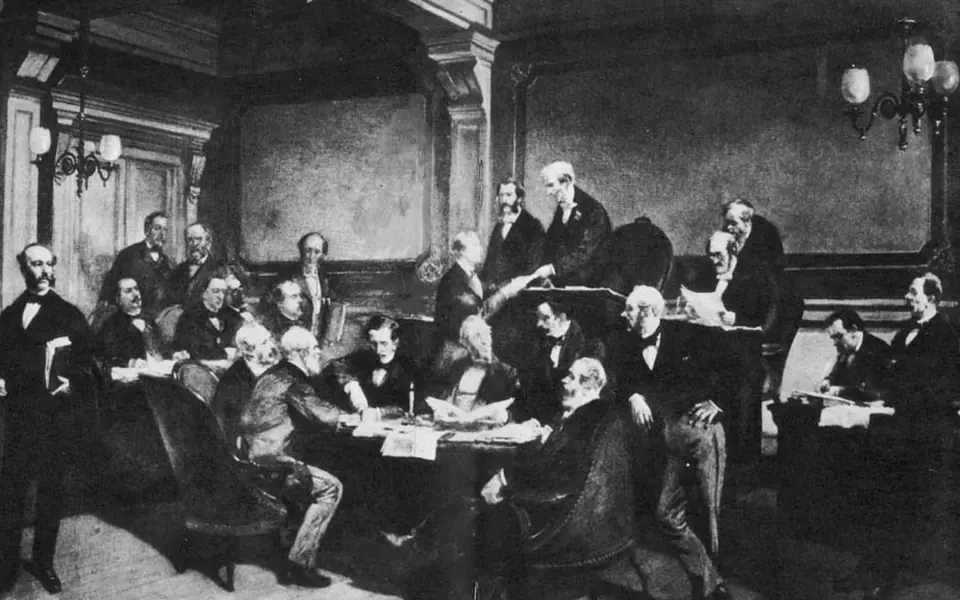
A five-man Geneva committee took up the project in 1863. Dunant worked alongside Gustave Moynier, physicians Louis Appia and Theodore Maunoir, and General Guillaume Henri Dufour. Their different backgrounds helped move the campaign between philanthropy, medicine, military practice, and diplomacy. An international conference in October supported national relief societies and a common identifying emblem, a red cross on a white background. The committee became the ancestor of today's International Committee of the Red Cross. Its formation shows why credit belongs both to Dunant's initiative and to the colleagues who helped translate it into an organization.
On August 22, 1864, representatives of twelve states signed the first Geneva Convention. Its provisions addressed military hospitals, medical personnel, civilians assisting the wounded, and evacuation. Article 6 required care for wounded or sick soldiers regardless of nationality. Article 7 specified the red-cross flag and armband. Reading the short treaty reveals the practical architecture behind a famous symbol: people had to recognize protected services, and commanders had responsibilities for applying the agreement. This was the original convention of 1864, subsequently replaced by later agreements; it should not be confused with the four Geneva Conventions adopted in 1949.
An institution beyond its founder
The emerging organization soon faced the difficulty of putting principles into practice. In 1864, during the conflict involving Denmark and German powers, delegates worked on both sides of the front. The ICRC later extended its activities to prisoners and the exchange of information for families. Dunant's personal fortunes moved in the opposite direction. Business failure drove him away from Geneva and an active role in the organization, and he spent later years in reduced circumstances. Institutional success did not mean a comfortable life for the man whose campaigning book had helped set events in motion.
In 1901, Dunant shared the first Nobel Peace Prize with the French peace campaigner Frédéric Passy. The award recognized humanitarian work whose significance had grown beyond its founder's immediate circumstances. Solferino is remembered because an encounter with suffering became a proposal for organized assistance and international commitments. It is also worth remembering the less ceremonial part of the story: residents caring for unknown men in makeshift wards. The later conferences and treaties sought to make such help less dependent on chance, giving a spontaneous response a structure that could be prepared before another battlefield filled with casualties.