A naturalist behind the stories
Before Beatrix Potter became famous for illustrated animal stories, she spent years looking closely at fungi. Her subjects included the large structures visible in the woods and the minute behavior of spores under a microscope. The work brought together two abilities that also informed her books: patient observation and precise drawing. In 1897, a paper reporting her investigations reached the Linnean Society of London. Its history is more complicated than the familiar story of a talented woman whose scientific manuscript was simply rejected.
Potter's interest developed through contact with Charles McIntosh, a knowledgeable Scottish naturalist. He helped identify specimens, supplied material, and encouraged her to make her pictures scientifically informative. An attractive view of a mushroom was not always enough for identification. Drawings could also show sections, the attachment of the gills, and the inside of a stem. Those details turned an illustration into a record that another observer could compare with an actual specimen, rather than merely an appealing representation of its general appearance.
Drawing what a mushroom conceals
Her studies moved beyond the shapes and colors of mature fungi. She experimented with germinating spores and followed the growth that resulted. The Australian National Botanic Gardens' account emphasizes that she was not the first researcher to investigate this process: continental scientists had already developed experimental methods for fungal life cycles. Potter's achievement belongs within that broader field. She pursued demanding observations independently, read technical work, and tried to make her results clear enough for specialists to examine. Giving her an invented scientific first would obscure the work she actually did.
Her uncle, chemist Sir Henry Roscoe, helped her make contact with Kew. Its archives preserve a particularly concrete trace of the encounter: the Herbarium Visitors' Book records her visit on May 20, 1896, following an introduction to senior staff the previous day. She returned during the following year. A surviving December 1896 letter asked director William Thiselton-Dyer to look at her drawings and paper. It also referred to disagreement with mycologist George Massee. The evidence shows active scientific conversation, including friction over observations and their interpretation.
A paper in the meeting book
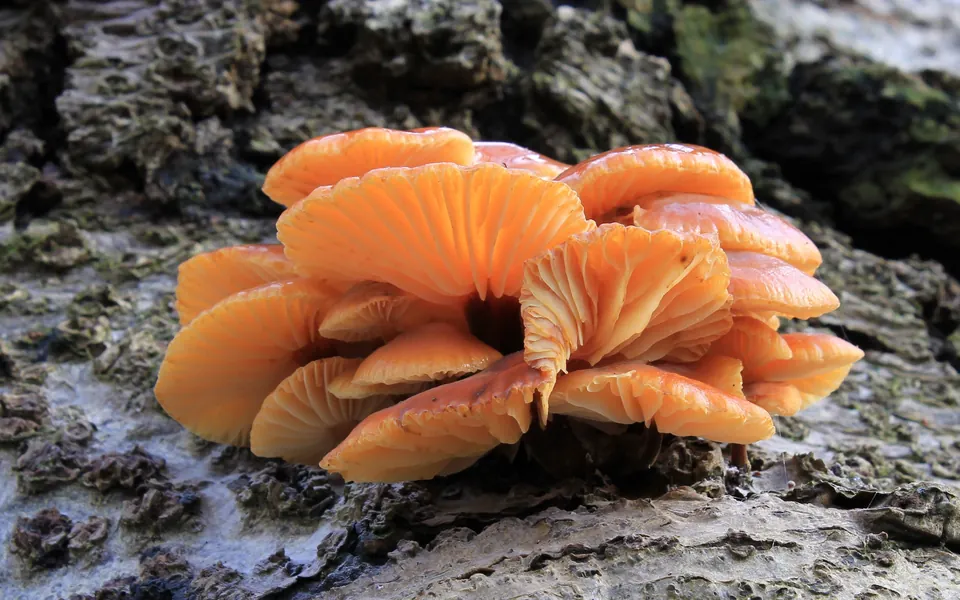
Massee nevertheless brought her paper to the Linnean Society. The title concerned the germination of spores of the Agaricineae, a historical grouping of fungi. Her experiments included the mushroom now called Flammulina velutipes, commonly known as velvet shank. The Society's minute book records that it was read and discussed on April 1, 1897. Potter withdrew it a week later and did not submit a revised version. Further work had been requested before publication. No copy of the manuscript survives in the Society's archives, which limits what can responsibly be said about the exact argument, methods, and conclusions presented at that meeting.
Women faced institutional barriers: the Society did not admit female Fellows until 1905. But the absence of Potter's own voice at the reading is not, by itself, evidence of a special rejection procedure. The Society explains that papers were ordinarily read by someone other than their authors. Keeping those facts together produces a more accurate account. Potter worked within an unequal scientific culture, while the documentary record describes discussion and withdrawal of this particular manuscript. Neither fact needs to be erased to make the other visible.
What the surviving evidence shows
Her fungal work also continued after the meeting. The Australian account records further microscope drawings and correspondence about germination, challenging the claim that the episode immediately ended her scientific interests. It notes that her first Peter Rabbit story already existed in 1893 as a letter for a child. The two activities therefore overlapped. Scientific disappointment did not suddenly manufacture the fictional rabbit. The drawings, letters, and dated records instead reveal a person pursuing several kinds of observation and storytelling during the same period of her life.
Many of Potter's fungal pictures are preserved at the Armitt Museum, while other scientific drawings survive in additional collections. They allow modern viewers to judge her attention to structures that a casual walker might miss. The missing paper cannot be reconstructed merely from admiration for its author. What remains is substantial enough: repeated experiments, technically useful illustrations, and a sustained effort to discuss evidence with specialists. Behind the familiar rabbits and gardens stands a naturalist who found another absorbing world in the gills of a mushroom and a germinating spore.