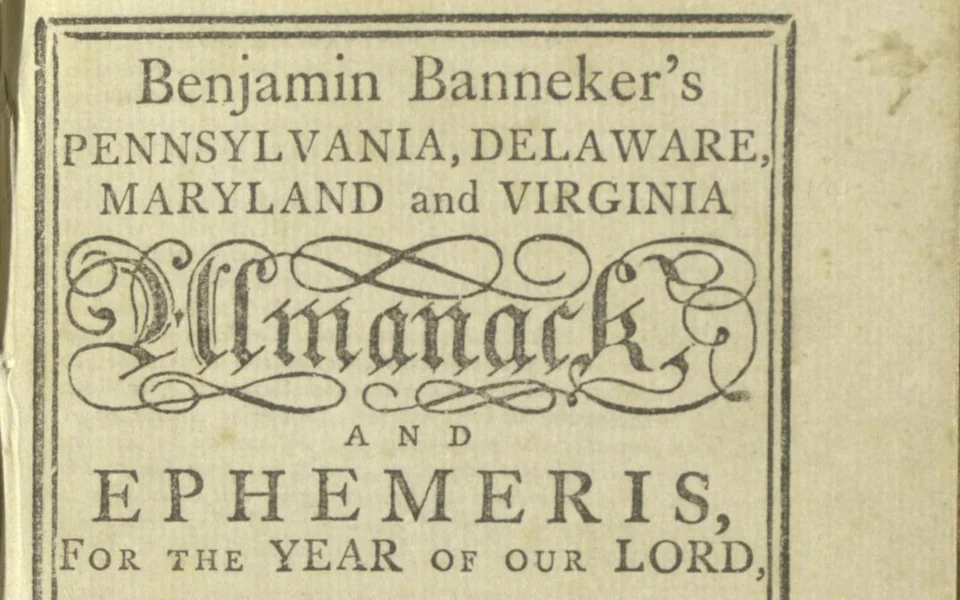
A calendar with an argument attached
An almanac can look like a modest collection of dates and tables. For Benjamin Banneker, it was also evidence of intellectual work that challenged the prejudices of his era. On August 19, 1791, the Maryland farmer and astronomer sent Thomas Jefferson a manuscript of his calculations for the coming year. The accompanying letter went well beyond a request for recognition. Addressing the secretary of state, Banneker connected his scientific abilities with a direct moral challenge to slavery and the denial of equal human rights.
Banneker had been born free in 1731 and spent most of his life in Baltimore County. His formal schooling was limited, but he continued learning mathematics and astronomy. His neighbor George Ellicott provided access to books and instruments. Those connections were valuable because celestial calculation demanded both methods and reference material. Banneker's work is often described as self-education, but that need not imply complete isolation. He pursued knowledge through his own efforts while participating in a local network that made tools, reading, and encouragement available.
Putting the sky into tables
In 1791, Andrew Ellicott employed him on the survey of the new federal district along the Potomac. That assignment concerned the boundaries of the district, rather than authorship of the capital's street plan. Banneker contributed astronomical expertise during the early portion of the project before returning to Maryland. Distinguishing these tasks matters: survey observations, boundary measurements, and urban design were connected activities but were not interchangeable. His documented contribution is significant without turning him into the sole creator of a city planned and measured by many people.
His almanac supplied information that readers could actually use. An ephemeris sets out the expected positions or appearances of celestial bodies at particular times. The Smithsonian's description of his 1792 publication highlights predicted sunrises, sunsets, lunar progress, and eclipses. Annual almanacs joined such calculations to calendars and other material. Their usefulness depended on careful numerical work carried out before the events occurred. Banneker was converting knowledge of the sky into a portable reference that people could consult far from the place where he made his observations.
Science meets the secretary of state
The first of his published almanacs covered 1792 and was issued in 1791. Surviving editions identify different places and printers, reminding readers that an almanac was also a commercial object. Banneker prepared the astronomical material, while publishers assembled and distributed the volume. Later issues combined tables with politically engaged writing. The Smithsonian's 1793 copy includes material on slavery and a proposal for a federal peace office. The presence of a text in the volume does not mean Banneker personally wrote every selection its printer included.
His own letter to Jefferson, however, makes its authorship and purpose unmistakable. Banneker asked Jefferson to recall the colonists' resistance to British oppression and the principles proclaimed in the Declaration of Independence. He then confronted the contradiction between those principles and the continued enslavement of African people. The almanac accompanied the argument as a practical example of the abilities racial prejudice denied. Banneker did not ask only for an exception to be made for one accomplished individual. His reasoning insisted on the humanity and rights of others as well.
The evidence on a printed page
Jefferson replied on August 30, thanking Banneker and saying he would send the almanac to the French intellectual Condorcet. The exchange subsequently appeared in print, including a 1792 Philadelphia pamphlet preserved by the Library of Congress. Publication allowed an argument initially directed to one powerful officeholder to circulate among many readers. Jefferson's courteous response did not end slavery or resolve his own contradictions. The surviving correspondence instead records Banneker making those contradictions explicit in a form that could be read, quoted, and assessed beyond the original exchange.
Banneker's almanacs continued through the volume for 1797. Their remaining copies preserve more reliable evidence than the many embellished anecdotes later attached to his reputation. A dated title page, a table of celestial events, and a letter with a named recipient each show a different aspect of his work. Together they reveal an unusually effective combination of calculation and public argument. The same package that helped readers anticipate the movement of the heavens asked a statesman to examine the distance between his declared principles and the world around him.