An invitation with an unusual address
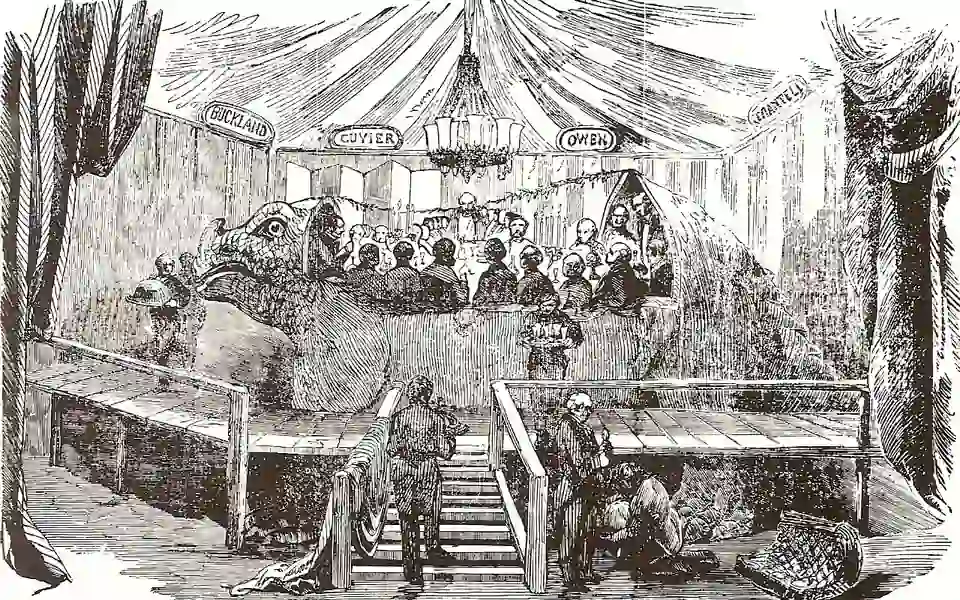
An invitation to dinner usually explains where the table will be. Benjamin Waterhouse Hawkins offered his guests an address few could have encountered before: inside an Iguanodon. On December 31, 1853, he hosted a banquet within a huge reconstruction being prepared for the grounds of the relocated Crystal Palace at Sydenham, south London. Scientists and company representatives gathered around a table enclosed by the unfinished animal. The setting made an excellent publicity story, but it also expressed the ambition of a project that was turning fragmentary fossils into creatures the public could imagine meeting.
The event belonged to the preparations for a new educational attraction. After the Great Exhibition of 1851, the Crystal Palace was rebuilt at Sydenham with extensive grounds. Hawkins was commissioned to create sculptures of extinct animals, working with scientific advice from Richard Owen and others. Owen had introduced the group Dinosauria in 1842, bringing together Iguanodon, Megalosaurus, and Hylaeosaurus. For visitors in the early 1850s, dinosaurs were a recently established scientific category. A full-scale body supplied something that isolated bones and technical descriptions could not easily provide: an immediate impression of an enormous living animal.
Making extinct animals visible
That impression required many decisions for which the available evidence was incomplete. Hawkins could not consult the abundance of articulated skeletons, tracks, and comparative studies accessible to later researchers. He and his advisers drew on the animals they knew, including large reptiles and heavy land mammals, to fill gaps between fossil fragments. The resulting Iguanodon looked bulky and stood on four substantial legs. Its resemblance to a gigantic lizard or rhinoceros was a reasoned nineteenth-century reconstruction, rather than a careless failure to copy a skeleton that was already understood.
At the dinner, this solid-looking body became a remarkably practical enclosure. The contemporary Illustrated London News account, published on January 7, 1854, described Hawkins bringing twenty-one guests together and placed Owen at the head of the table within the animal's head. An engraving showed diners, waiters, a canopy, and a chandelier. Reaching the table required a raised approach because of the sculpture's height. Descriptions call the setting a model or a mould; either way, the meal took place within the construction, rather than inside an actual fossil skeleton or a living animal.
A horn finds its proper place
The sculptures reached the public in 1854, carrying assumptions that would later change. The most memorable example sits on the Iguanodon's nose. A pointed fossil had been interpreted as a horn and placed there, giving the reconstruction an especially rhinoceros-like profile. Later discoveries showed that the spike belonged to the hand. The mistake is easy to recognize once a more complete animal is available. Earlier investigators had to decide how a puzzling piece fitted into a largely missing body, and the dramatic nose horn made their provisional answer unusually visible.
The history of Iguanodon also illustrates how a scientific name can outlive revisions to the evidence behind it. Gideon Mantell described the animal in 1825 using fossil teeth from Sussex. Subsequent finds revealed that material historically grouped under the name did not all belong together. More complete skeletons from Bernissart in Belgium transformed its reconstruction, and a specimen from that material eventually became the reference point for the familiar species. The changing anatomy therefore was not simply a matter of an artist moving one decorative feature. It reflected a much larger reassessment of the fossils themselves.
A banquet preserved in print
The banquet engraving preserves another sort of reconstruction: an artist's organized view of a social event. It shows how the dinner was presented to readers, not a photographic record of each guest's exact position. Historians can compare it with the written report and Hawkins's later recollections, which do not agree on every seating detail. Its theatrical qualities helped advertise both the sculptures and the authority of the scientists associated with them. The unusual dining room made serious claims about the ancient world memorable through an evening of food, conversation, and spectacle.
The Crystal Palace building burned in 1936, while the prehistoric sculptures survived in the park. Their importance now includes the history of science as well as the animals they attempted to portray. They make earlier knowledge unusually tangible, including its gaps and the confidence with which those gaps were filled. The dinner captures that moment with exceptional economy: guests trusted a reconstructed dinosaur enough to sit inside it, even though later discoveries would reorganize its body. The model's anatomy changed in scientific understanding; the evidence of Victorian curiosity remains visible in the scene around the table.