A project that outlived its designer
Clifton Suspension Bridge is closely associated with Isambard Kingdom Brunel, but its opening in December 1864 came five years after his death. That interval matters. The completed crossing was not simply the delayed unveiling of a design left entirely unchanged. Other engineers revised it, a new effort secured its completion, and much of its ironwork arrived with a history of previous use. The bridge across Bristol's Avon Gorge is consequently a monument to persistence and adaptation as well as to an individual designer. Its familiar outline conceals a story that extends beyond the gorge itself.
The ambition for a crossing was much older than the eventual structure. In 1753, William Vick left money intended to support a toll-free stone bridge. By the nineteenth century, the available resources did not match that original ambition, and an iron suspension crossing funded through tolls became the practical alternative. Design competitions and Brunel's involvement followed. The project then suffered interruptions and financial difficulties. It is useful to distinguish proposing a crossing, choosing a design, beginning construction, and completing a usable bridge. Those activities occupied different moments rather than one smooth campaign toward an inevitable result.
Chains with a previous address
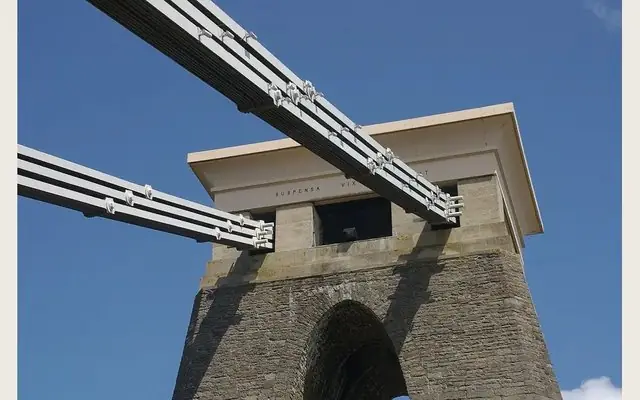
After Brunel's death in 1859, fellow engineers supported completing the bridge as a memorial. William Henry Barlow and John Hawkshaw revised the scheme. The finished arrangement used three chains on each side of the deck rather than the earlier double-chain conception. Its design also departed from some of the decorative intentions attached to Brunel's proposal. Attributing the bridge only to its first designer obscures these decisions. Recognizing the later engineers does not diminish Brunel's contribution; it makes the surviving structure more accurately understandable as the product of an enterprise that continued after him.
The chains introduce another journey. A large proportion of their links came from Brunel's Hungerford suspension footbridge in London, which was removed to make way for a railway crossing. The links were transported to Bristol in 1862. The Trust's detailed account explains that two-thirds of the links in the Clifton structure were reused from Hungerford, with additional links manufactured for the renewed project. This was more than a symbolic connection between two works by the same engineer. Material that had carried one crossing became a working part of another, subject to the different arrangement and requirements of its new site.
Building the connection across the gorge
Reusing components did not mean simply hanging the old bridge over a new valley. The engineers had to integrate links from different manufacturing periods into the revised chain system, connect them to the towers and anchorages, and support a new deck. The bridge's arrangement gives each link a role within a larger structure. Its previous service was part of its history, but its suitability depended on the new task. That distinction helps make the episode more useful than a simple anecdote about recycling: the reuse involved engineering judgment, assembly, and coordination rather than merely finding a convenient stock of old iron.
Construction across the gorge required temporary works before the permanent chains could be completed. Cables and platforms supported the movement and placement of individual links. The Trust's account of 1864 records the chain assembly, installation of girders, deck construction, and load testing as successive activities. The opening on December 8 followed those practical stages. A finished suspension bridge makes its roadway appear continuous, but achieving that continuity required workers to operate above an open space before the permanent crossing existed. The temporary arrangements were essential even though they were not intended to become the lasting public image of the bridge.
A monument made from several moments
Later inspection has added another layer to the material story. In 1983, one chain link was removed for testing and replaced, following earlier investigations into the behavior of the ironwork. The Trust explains the research context and the care involved in deciding to remove an original component. Such work shows how knowledge of a historic structure can change after its construction. Preservation is not only a matter of keeping an attractive silhouette. It also depends on understanding materials whose manufacture and service history may differ from those familiar in modern construction.
The bridge can therefore be read as several histories held in one structure: an eighteenth-century bequest, Brunel's nineteenth-century ambition, the completion campaign led by other engineers, the earlier life of London chain links, and later investigation and care. None of those stages makes the monument less coherent. Together they explain how it became possible. The reused links are especially revealing because they give a physical connection between places that might otherwise seem separate. Clifton's celebrated crossing carries a Bristol roadway, but part of the iron that supports it remembers a previous purpose above the Thames.