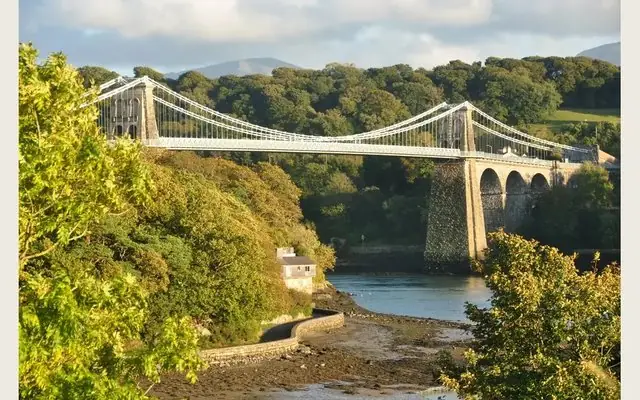
A narrow strait in a long route
The Menai Strait was a relatively short obstacle in a much longer journey. Travellers following the road toward Holyhead still had to reach Anglesey before continuing by sea to Ireland. A fast road on either side could not remove the uncertainty of the water crossing between them. Thomas Telford's suspension bridge addressed that interruption. Completed on January 30, 1826, it joined the island to mainland Wales and made the crossing part of a continuous road. Its importance came from that relationship between one difficult place and the larger network that depended on passing through it.
The strait also mattered to people whose journeys were more local. Ferries carried passengers, and cattle moving toward mainland markets faced dangerous currents. The Institution of Civil Engineers records that animals were sometimes lost while being swum across. A bridge changed those movements as well as the strategic route to Holyhead. This combination is easily missed when the structure is presented only as a national engineering achievement. The same deck that advanced a long-distance road also connected neighboring communities, making it possible to cross without organizing a separate operation on the water every time.
Iron chains above a navigable channel
Work began in 1819. Telford used stone towers and a suspended roadway rather than placing a succession of ordinary arches across the navigable channel. The principal span stretched roughly 176 metres, with space beneath for tall sailing vessels. Shipping and road traffic therefore shaped the solution together. A bridge that obstructed the waterway would have solved one transport problem by creating another. Suspension allowed a long span with its principal supports outside the central opening, while the towers raised the chains above the level of the deck they were required to carry.
The chains consisted of wrought-iron bars joined through their enlarged ends. Sixteen main chains supported the roadway, their manufacture and assembly turning many separate components into a continuous load-bearing system. William Hazledine's works supplied the ironwork, and testing formed part of preparation. The structure depended on more than the apparent strength of a single bar. Connections, anchorages, and the organization of the suspended deck all belonged to the load path. The sweeping line seen from the shore was therefore the visible result of a large number of carefully related material decisions.
Wind revealed another engineering problem
Material protection mattered alongside strength. Ironwork needed attention before and after being installed in an exposed marine setting. The ICE account describes the use of linseed oil during preparation. Such details help restore the practical character of an undertaking that can otherwise seem almost abstract: towers, curves, and a span on a drawing. Workers had to move and connect real components whose condition affected their usefulness. Manufacturing and handling were part of the engineering process. A design could only become a dependable crossing if those less conspicuous activities supported what the calculations and plans required.
The original roadway also exposed the difficulty of designing a suspended structure for wind. Its relative flexibility became a problem in service, and the deck was strengthened in the nineteenth century. Later work included a steel deck associated with Benjamin Baker in 1893. Those interventions are important to the story because they distinguish opening a major bridge from possessing a final solution to every demand it would encounter. Experience revealed behavior that required further attention. The survival of the crossing records a continuing engineering response rather than proof that every feature of the first arrangement was permanently sufficient.
A crossing with several histories
The neighboring Britannia Bridge belongs to a different chapter. Built for the railway and opened in 1850, it should not be confused with Telford's earlier road bridge. Together, the crossings show how an important transport corridor could acquire different structures for different technologies. A road link did not automatically supply a railway link, and the arrival of rail did not erase the uses of the road. Reading the strait as a landscape of connected routes makes the individual bridges more intelligible. Each answered a particular set of requirements within an evolving network.
Menai's historical significance lies in both its structural ambition and its ordinary purpose. The bridge helped establish long-span suspension as a practical means of carrying road traffic, but users encountered that achievement as a simpler journey. A dangerous transfer across water became a crossing on a deck. Its subsequent alterations remind us that dependable infrastructure is sustained through observation, repair, and adaptation. The graceful outline is an important part of the monument, yet its deeper story is about continuity: between island and mainland, between short trips and international routes, and between an original design and generations of engineering care.