Two waterways at different heights
At Anderton in Cheshire, two waterways passed close to one another without providing a simple continuous journey for a boat. The Trent and Mersey Canal lay about fifteen metres above the River Weaver Navigation. Goods could be transferred between them, but moving cargo was not the same as moving the vessel that carried it. When the Anderton Boat Lift opened in 1875, it addressed that difference directly. Boats could pass between the upper canal and the lower river inside water-filled tanks. Instead of descending through a sequence of locks, a vessel travelled vertically with part of the water around it.
The need for a connection came from a working industrial landscape. The Weaver Navigation supported the Cheshire salt trade, carrying salt outward and coal inward for processes that required fuel. The Trent and Mersey Canal brought another transport route into the area in the eighteenth century. At Anderton, basins, cranes, chutes, and other arrangements allowed goods to change levels between waterways. That system involved handling and organization at the point of transfer. A direct connection offered a different possibility: a boat could continue its journey, reducing the need to unload and reload its cargo simply because the routes met at different heights.
A boat carried inside a water tank
A flight of conventional locks was considered but presented difficulties at the site, including space and water requirements. The lift offered a compact alternative. Edward Leader Williams, associated with the Weaver Navigation's engineering, played an important role in planning the connection, while Edwin Clark designed the hydraulic lift. Distinguishing those responsibilities is more useful than attaching the entire undertaking to a single inventor. The solution combined decisions about the transport network with the detailed mechanics of moving a heavy water-filled container. A successful machine had to answer both sets of requirements, not merely demonstrate that a platform could be raised.
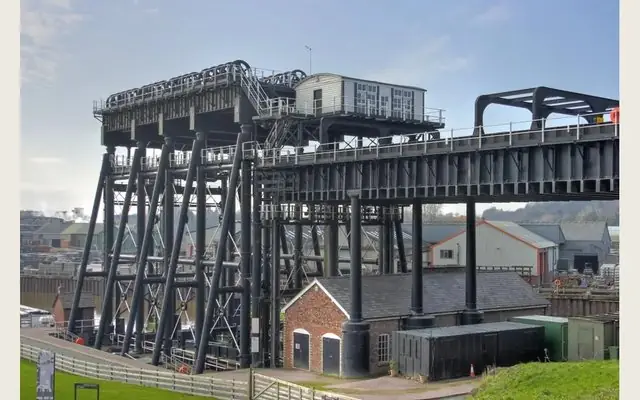
The lift used two caissons, each a tank large enough to carry vessels. Hydraulic machinery supported their movement between the canal and river levels. Because the boat floated inside its caisson, the tank-and-water system provided a controlled environment for the transfer. The principle is easier to understand by thinking of a moving section of waterway than of a crane lifting a bare hull. Gates and connections had to allow a vessel to enter at one level, travel within the tank, and leave at the other. The vertical movement was only one part of a sequence that had to work reliably for navigation.
New machinery for an old connection
Operating experience exposed problems as well as advantages. Corrosion affected the original hydraulic machinery, and the lift underwent a major conversion in 1908. Electric machinery and counterweight arrangements replaced the earlier means of operation, with substantial new steelwork changing the structure's appearance. This was not simply a replacement of a worn component with an identical one. It was a different technical answer to the same geographical task. The waterways remained at different heights; the mechanism chosen to connect them changed as engineers responded to condition, experience, and the possibilities of another period's equipment.
The conversion makes Anderton particularly interesting as industrial heritage. A photograph can preserve the visible outline of one stage while suggesting, misleadingly, that the machinery has always worked in the same way. At this site, the structure records more than one generation of engineering decisions. Its history includes a hydraulic beginning, an electrically operated phase, closure caused by structural deterioration in 1983, and a later restoration. Describing all those stages does not weaken the importance of the original design. It explains how the lift acquired the physical complexity that distinguishes it from an untouched demonstration model.
Restoring movement and preserving change
Restoration led to reopening in 2002, with hydraulic operation returned in a modern form and significant elements of the 1908 superstructure retained. Preserving those later elements acknowledged that the conversion had become part of the monument's history. Restoration therefore involved choices about which functions to recover and which material evidence to keep visible. Returning every part to a hypothetical first-day appearance would have erased an important chapter. The result illustrates a broader problem in conserving machinery: an operating historic site must balance movement, safety, maintenance, and evidence of change rather than assuming those aims automatically point toward the same treatment.
Anderton's story is not a claim about whether a particular visitor service is operating today; that depends on current maintenance and management. Its historical significance is the repeated attempt to solve one enduring transport problem. A short distance across a map concealed a substantial difference in height, and the lift converted that obstacle into a mechanical journey. The tanks, supports, and successive power systems reveal how infrastructure develops through use. What began as an alternative to locks became a record of adaptation, showing that an engineering landmark can be most informative when its later changes remain part of the explanation.