A pilgrimage opens into a much longer journey
A journey and a book about a journey are related achievements, but they are not the same event. Ibn Battuta left Tangier in 1325 with the intention of making the pilgrimage to Mecca. The travels associated with his name eventually extended across decades and far beyond that initial destination. The Rihla made those experiences available to later readers, yet it was assembled after the journeys through recollection and literary work. Its fascination lies partly in that distance: a moving life had to become a narrative that could be heard, copied, and read by people who had not traveled with its teller.
The early stages, preserved in translated excerpts in Fordham's Medieval Sourcebook, make the experience more human than a line drawn across a map. The account describes illness, bad weather, the need to join companions, and the loneliness of arriving where nobody knows the traveler. Such passages reveal a world of dependence as well as mobility. Knowledge of a route did not eliminate the practical need for shelter, protection, money, introductions, and assistance. The person later remembered for astonishing geographical range could still encounter the uncertainty of being an unknown newcomer in a crowded place.
Travel depends on people as well as roads
Religious travel created connections that helped movement continue. Pilgrimage routes brought people into contact with fellow travelers, teachers, officials, and hosts. The Berkeley ORIAS itinerary follows the journey from North Africa through Egypt and onward toward the holy cities, then into further regions. A route through those places was also a route through relationships. Shared practices could make an unfamiliar setting partly recognizable, while differences in politics, local custom, and circumstance continued to matter. Describing the journey as if one determined individual simply walked through an empty world would conceal much of what enabled it.
The account also connects distant cities through comparison. In the translated passages, ports, buildings, hospitality, and public occasions are measured against things seen elsewhere. Those comparisons are part of the source's value and part of its difficulty. A traveler notices selectively, carries expectations, and interprets what appears before him. The narrative can therefore reveal both a place and the terms in which its visitor understood that place. It does not become less interesting when that point of view is acknowledged; it becomes possible to ask more precise questions about what a particular description actually tells us.
Making a literary account in Morocco
After Ibn Battuta returned to Morocco in the 1350 s, the ruler Abu Inan commissioned an account of his travels. He dictated material to Ibn Juzayy, who helped give it literary form. The Library of Congress's description of a later Arabic printing makes this collaboration explicit. The resulting work is commonly called the Rihla, meaning a journey or travel account. A listener or reader encountered not a modern daily log delivered unchanged from the road, but a composed work connecting remembered experiences to a recognized way of writing about travel and the wider world.
Berkeley's account of the writing process explains that recollection, reported information, and material adapted from earlier travel literature could appear together. Ibn Juzayy drew on descriptions associated with Ibn Jubayr for some places. This does not supply a simple rule by which every passage can be accepted or discarded. It supplies questions for reading: is the writer describing a personal encounter, repeating something learned from another person, or using an established literary description? The distinction between those possibilities is essential when the book is used as evidence for a particular event or location.
Reading the journey through later books and translations
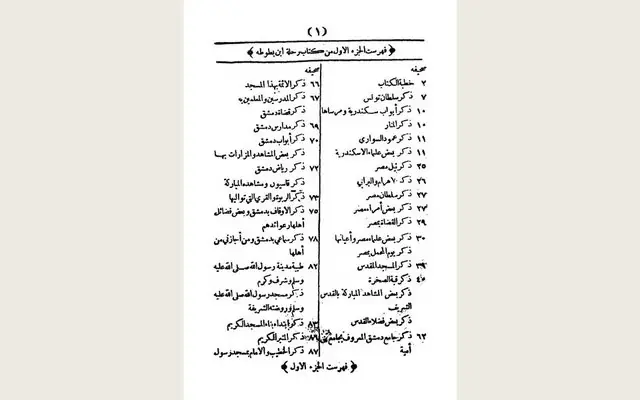
The image accompanying this story comes from a 1904 Arabic printing preserved through the World Digital Library and the Library of Congress. It shows a printed contents page, not Ibn Battuta's own handwriting and not a manuscript made during the journeys. That later object belongs to the work's history of transmission. Copies, editions, and translations made the account available to new audiences while placing additional people between an original telling and a modern reading. The physical book reminds us that even an apparently direct traveler's voice reaches us through material and linguistic forms.
The Rihla remains remarkable without requiring every detail to have the certainty of a contemporary travel record. It preserves encounters, ambitions, dependencies, and comparisons across a vast connected world, while also preserving the traces of how those experiences were shaped into a book. Reading it carefully means keeping those achievements together. Ibn Battuta traveled; Ibn Juzayy helped compose; later copyists, printers, and translators carried the work onward. The journey that interests us today therefore includes not only movement between places but the much longer passage from lived experience to historical evidence.