Two pictures and a pair of eyes
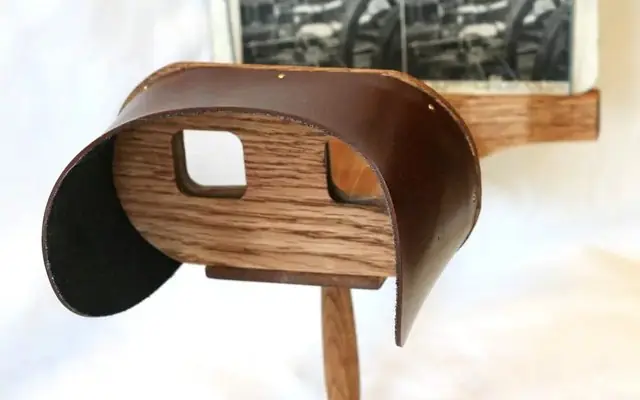
A person lifting a wooden viewer to the eyes could make two small photographs appear to open into a single scene with depth. The nineteenth-century stereoscope offered this effect without a screen, a motor, or moving pictures. Its companion was the stereograph: two views of the same subject taken from slightly different positions and mounted together. Through the viewer, those differences could produce the impression of distance between foreground and background. The device turned an investigation of vision into a household pastime, and created a market in images that people could collect, exchange, arrange, and revisit.
The principle preceded photography's great commercial expansion. The National Portrait Gallery traces Charles Wheatstone's investigation of stereoscopy to the early 1830s, before the public announcement of photography in 1839. Photographic processes subsequently supplied an unusually convincing kind of paired image. Each eye received a slightly different view, echoing a difference involved in ordinary binocular vision. The illusion therefore depended on the relationship between two pictures and the observer, rather than on a miniature sculpture concealed inside the instrument. Its history belongs to experimental science as well as photography, even though many buyers encountered it chiefly as entertainment.
An optical effect becomes a market
Different instruments helped move the effect beyond a scientific demonstration. The National Science and Media Museum describes the interest in a stereoscopic viewer at the Great Exhibition of 1851 and David Brewster's presentation of a stereoscope to Queen Victoria. The Library of Congress, meanwhile, associates Oliver Wendell Holmes with a handheld design that widened access to stereographic viewing. These were developments within an existing field, not grounds for assigning every stage to one inventor. As paper photographs became easier to reproduce than earlier formats, viewers and paired prints could circulate together through a much broader commercial network.
That network became an industry of portable experiences. Founded in 1854, the London Stereoscopic Company commissioned pictures of distant places alongside familiar buildings, humorous arrangements, and everyday scenes. According to the museum's history, by 1858 the company claimed a catalog of one hundred thousand views. The word claimed matters: it records the scale the company advertised rather than a modern independent inventory. The enormous selection was part of the attraction. Owning the viewer was only the beginning; a household could keep acquiring new scenes without replacing the instrument through which it encountered them.
A collection assembled one view at a time
The card itself carried more than the two photographs. Library of Congress and National Park Service descriptions identify captions, publishers' names, photographers' credits, numbers, and sometimes series information on the mounts or their reverse sides. Such details helped purchasers organize a collection and helped sellers encourage another purchase. They also guided interpretation. A pictured street or landscape arrived with a name and an explanation chosen by someone else. The sense of looking directly into a place could be powerful, but its title, selection, framing, and distribution were still products of a photographic business.
Families bought views of destinations they knew and places they might never visit. Minnesota Digital Library describes stereographs being traded, shared, organized, and displayed in middle-class homes, with purchases made through studios, mail order, and traveling salesmen. The range included architecture, natural scenery, public celebrations, and disasters. A collection could therefore move between pleasure, curiosity, and news. Unlike a projection shared by an entire room, the handheld instrument gave one viewer at a time a close encounter with the image. Other people could wait for a turn, recommend another card, or discuss a detail the last observer had noticed.
Travel, teaching, and a changing audience
The same format entered education and helped publicize landscapes. The National Park Service records that stereograph publishers marketed sets to schools, while photographers produced views of the places becoming national parks. Carleton Watkins carried a stereograph camera as well as a plate camera into Yosemite Valley in 1861. The NPS collection connects such images with the wider recognition of these landscapes, while also preserving later commercial park views. A classroom or parlor could thus become a place for studying distant geography. The pictures offered access, but their apparent immediacy did not remove the need to ask who made them and why.
Popularity changed rather than ending in one dramatic moment. The National Park Service describes competition from postcards, radio, and motion pictures, along with companies selling their stock and image rights to other publishers. Some boxed park sets continued into the middle of the twentieth century. The earlier viewer survives as evidence of an important habit: people built personal libraries of experiences around a reusable optical device. A stereograph's paired images still look oddly repetitive on a flat page. That repetition was once the working material of the surprise, becoming convincing depth only when a viewer and a pair of eyes completed the arrangement.