A journey can work and still be uncomfortable
A train can arrive on time while giving its passengers a thoroughly uncomfortable journey. Olive Dennis made the gap between those two facts an engineering concern. Working for the Baltimore and Ohio Railroad, she investigated the experience of riding rather than treating it as something separate from the technical performance of the railway. Seats, air, lighting, and facilities could all reveal problems that a timetable would not record. Her career is an unusually clear example of a designer taking ordinary complaints seriously enough to turn them into questions about how a system should be built.
Dennis entered the railroad after a substantial education and an earlier career in teaching. She earned a civil engineering degree at Cornell in 1920 and initially worked in the B&O's bridge engineering department. Her later position as engineer of service directed that technical preparation toward passengers' needs. The job joined observation to practical responsibility: noting a difficulty was not the end of the assignment. Recommendations had to become workable changes in railway vehicles and service, within a business seeking to compete for travelers who could increasingly choose other ways of making a journey.
Passenger observations become design evidence
Riding was part of the method. The National Inventors Hall of Fame describes Dennis traveling on B&O and competing trains, observing inconveniences and interviewing passengers before preparing reports. Repetition helped expose conditions that might disappear during a brief inspection of a stationary carriage. A seat could seem acceptable for a moment and become troublesome after hours. A lighting arrangement could work for one activity and interfere with another. Treating travel itself as an investigation connected technical judgment with the duration, variation, and practical compromises of a passenger's actual experience.
The Colorado Railroad Museum identifies uncomfortable seats as one recurring problem, particularly for shorter passengers whose feet could not reach the floor comfortably. Changes in seat design and support addressed the relationship between a vehicle's dimensions and the bodies using it. Ventilation posed another difficulty. Closing a window could make a carriage stuffy, while opening it could admit an unpleasant draft and material from outside. These were not merely aesthetic complaints. They asked how a passenger might obtain useful control over an immediate environment without creating a new problem for someone nearby.
A patent with ordinary needs at its center
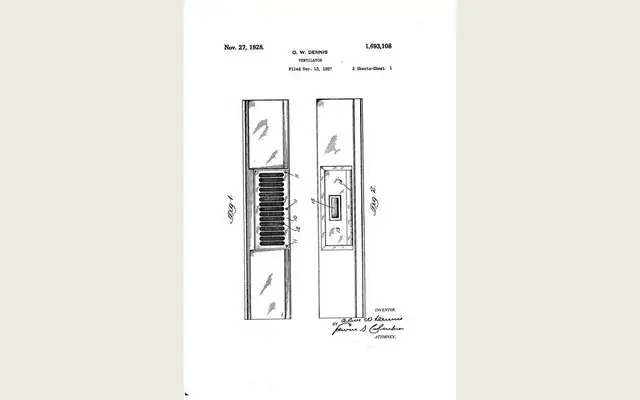
Dennis's ventilator patent gives that question a precise documentary form. US 1693108 A, filed in 1927 and published on 27 November 1928, describes a device primarily intended for railway cars. Its stated aims include admitting air while limiting cinders, preserving the view, allowing easy operation, and making cleaning possible. The drawing reproduced with this story is the first drawing sheet of that patent, not a portrait of Dennis or a photograph of an installed carriage. Reading it alongside the written description shows how an everyday inconvenience was translated into parts, relationships, and requirements that could be communicated technically.
Maintenance is particularly revealing in the patent. A screen was meant to limit unwanted material while remaining removable for cleaning, and the description considered access without unnecessary interference with the finished interior. Those concerns extend design beyond the moment when a device first functions. Something useful must continue working after use, dirt, and routine handling. Passenger convenience and the needs of people responsible for maintaining the carriage could therefore shape the same object. The patent records an attempt to coordinate those needs, rather than simply adding a new attachment wherever space happened to be available.
Comfort as a connected engineering problem
Dennis's wider work included amenities and the appearance of railway interiors as well as individual mechanisms. The Colorado museum connects her with dining-car china and the Cincinnatian, introduced in 1947. Such projects involved many contributors, even when an influential designer helped coordinate the result. They show why comfort cannot be reduced to one patented component. A passenger experiences the combined effects of furnishings, cleanliness, food service, air, and light. A successful change in one area may be less useful if the surrounding arrangements continue to make the journey difficult.
The importance of Dennis's approach lies in making that combined experience worthy of technical attention. A passenger's problem could supply evidence instead of being dismissed as a matter of taste. Her work did not abolish the practical constraints of running a railway, but it broadened what an engineer could investigate within them. The question was no longer only whether a train could carry people between places. It was how those people would sit, breathe, read, rest, and use the facilities while the movement was taking place, hour after ordinary hour.