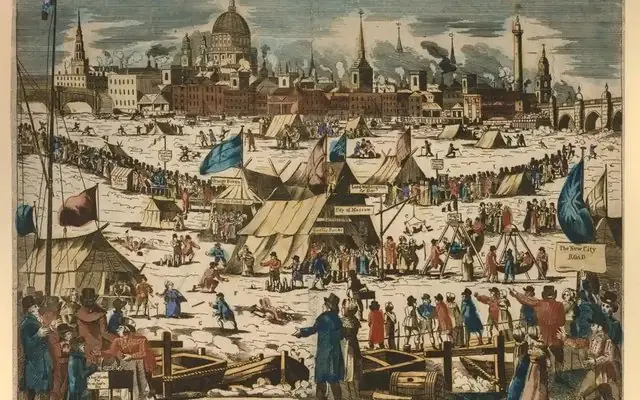
A river becomes a place to visit
A small printed slip could make an extraordinary claim in London: it had been produced on the River Thames. During the great freezes, printers carried presses onto the ice and sold keepsakes to visitors wandering among stalls and entertainments. London Museum preserves a keepsake printed on the ice on February 5, 1814. Such pieces of paper outlasted the temporary streets and booths that surrounded their production. The river eventually resumed its movement, but a visitor could keep a portable record of having stood where boats would ordinarily pass.
A frozen Thames created a disruption before it created a holiday. The river carried people and goods, and thick ice interrupted that work. London Museum describes boatmen finding alternative employment guiding visitors onto the frozen surface. Traders also moved onto the ice, making the interruption into a marketplace. The resulting frost fair combined practical adaptation with entertainment. Food sellers, drinking booths, games, and spectators shared a space whose availability depended on the weather. A temporary piece of usable ground had appeared in the middle of the city, and Londoners quickly found ways to occupy it.
The conditions beneath the carnival
Cold weather was only part of the explanation. The historic river differed from the more regulated channel familiar today. London Museum emphasizes that it was wider and shallower, with slower flow, while the closely spaced arches of old London Bridge obstructed the movement of water and ice. These conditions made severe freezing more likely. The fairs were exceptional events rather than a dependable annual season. Their history belongs to the physical arrangement of a river and its bridges as well as to colder winters, and cannot be explained simply by imagining that London was always uniformly frozen in the past.
The winter of 1683–1684 produced one of the best-known fairs. Cambridge's account describes a temporary street between the banks, with booths offering coffee, tavern drinking, and puppet shows. John Evelyn recorded the fashion for having a name printed with the date, creating a personal connection to the remarkable setting. The printer's product required little space in a visitor's pocket, yet distinguished one person's experience from an anonymous crowd. It combined an ordinary commercial service with an unusual place of manufacture. A few words gained value because of the ice beneath the press.
A fair recorded in several kinds of print
Surviving images of the 1814 fair show how varied the attractions became. A print in the British Museum, engraved by George Cooke after Luke Clennell, depicts people among tents and entertainments, with St Paul's visible beyond them. Another contemporary view, held by the Government Art Collection, represents the frozen river near Three Cranes Wharf. Its publication was advertised in the Morning Chronicle. The fair thus circulated through two kinds of print: souvenirs made on the ice and illustrated views sold afterward to people who wanted to remember, inspect, or imagine the spectacle.
The printers' output could be more elaborate than a name on a slip. Cambridge University Library identifies Frostiana, a book published by George Davis during the 1814 freeze, as part of the fair's printing history. London's surviving keepsakes also include verses and playful messages about the approaching thaw. The British Museum records one addressed to an imaginary personification of melting weather, while another tells the frost to leave the river. These objects turned a threatening change into a joke, although the humor depended on a real uncertainty: the surface supporting the entire enterprise could not remain a market indefinitely.
The ice disappeared and paper remained
The fair of 1814 was London's last great frost fair. Replacement of the medieval bridge, together with dredging and embankment construction during the nineteenth century, changed the channel and its flow. London Museum connects those alterations with the disappearance of conditions that had supported the earlier events. The end of the fairs therefore reflects an altered city as well as changes in climate. A piece of urban culture vanished partly because the infrastructure underneath it had changed. The river became less available for the unexpected conversion from transport route into temporary public square.
Paper gives this vanished landscape an unusually intimate afterlife. A grand view can show crowds, tents, and the skyline, but a little keepsake can preserve the decision of one visitor to buy proof of being there. Cambridge's examples entered collections by different routes, including material later attached to books or cards. Their survival was contingent, much like the fairs themselves. Reading them now joins the history of weather to the history of ordinary purchases. A printer briefly working above frozen water produced something fragile that could survive long after the much heavier ice had disappeared.