A winter harvest bound for India
In 1833 a ship carried a winter harvest from Boston toward Calcutta: not grain, wool, or timber, but blocks of ice. The Tuscany reached India after a voyage of roughly four months, with a substantial part of its frozen cargo still intact. Merchant Frederic Tudor had helped turn New England's cold weather into an export. The surprising part was not that ice could melt, a difficulty everyone understood. It was that enough could be preserved, transported, and sold to make shipping frozen pond water across an ocean commercially worthwhile.
Tudor's earlier attempt had been discouraging. In 1806 he sent ice to Martinique aboard the Favorite. The Antique Ice Tool Museum describes a cargo gathered from his family's Massachusetts property and from local farmers, followed by failure because suitable storage was missing at the destination. Moving the ice was only one stage of the enterprise. A vessel could arrive successfully and still deliver a financial disaster if its cargo disappeared while waiting for customers. Tudor needed a system extending from the frozen pond to the place where someone finally used the product.
Keeping the cargo long enough to sell it
Insulation bought time at every stage. Large blocks packed closely together exposed less surface to warm air than the same ice broken into scattered small pieces. Sawdust helped shield the cargo from heat, and insulated icehouses extended storage beyond the voyage. Historian Devika Shankar's study of the trade emphasizes how cheap harvesting, transport, and storage worked together. The business was never simply a contest between a cold substance and a hot climate. It also depended on the price of freight, access to buildings, and the costs that merchants could persuade others to reduce.
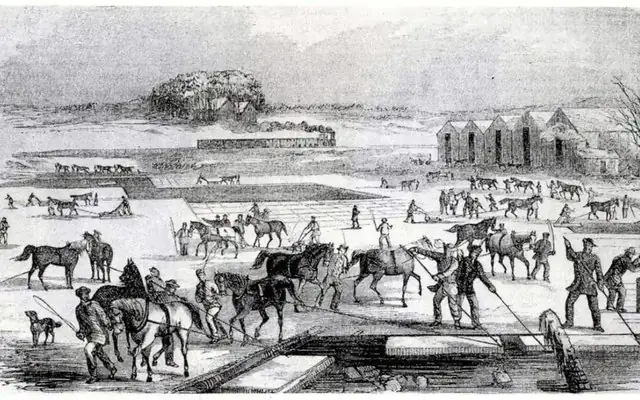
The winter harvest itself was an organized industrial operation. Workers cleared snow, marked regular divisions across a pond, cut blocks, and moved them toward storage or transport. Nathaniel Wyeth helped improve this process with horse-drawn cutting equipment. Boston University's account of historian Andrew Robichaud's research stresses Wyeth's importance to Tudor's eventual success. The famous merchant did not personally invent every useful tool or perform every stage of the work. His reputation rested partly on skilled organization and partly on labor and technical improvements supplied by people whose names became less familiar.
Ponds joined to distant ports
The Indian route greatly extended the distances involved. Shankar describes an inaugural cargo of about 180 tons, with approximately 100 tons reaching Calcutta. Those figures make the accomplishment more revealing than a claim that no melting occurred. Loss was expected and had to be allowed for in the calculation. Closely packed blocks and accumulated experience kept enough of the shipment available for sale. The route also crossed a world of changing trade regulations and expanding private commerce. A remarkable cargo traveled within ordinary shipping networks, rather than escaping the political and economic conditions of its destination.
By the 1840s, Massachusetts ponds had become connected to distant cities through this trade. Henry David Thoreau watched ice workers at Walden Pond during the winter of 1846–1847. His account brought an industrial workforce into a landscape later associated with solitude. Freedom's Way National Heritage Area describes crews arriving with tools and extracting ice that could travel far beyond Concord. The pond supplied a seasonal crop, harvested by people rather than grown by them. Its winter surface briefly became a workplace before being divided into blocks and carried into a much larger commercial geography.
When machines replaced the harvest
Natural ice also served markets closer to home. It cooled food and drinks and helped preserve perishable goods as transportation and urban consumption expanded. Icehouses and household ice storage made winter cold useful in warmer months. Freedom's Way traces the industry's decline as mechanical ice production and electric refrigeration spread during the early twentieth century. The transition removed much of the dependence on a local pond freezing deeply enough for a harvest. What had once required a favorable season, a crew, and a storage building could increasingly be supplied through machinery.
Tudor became known as the Ice King, but that memorable title compresses a complicated enterprise into one personality. Robichaud cautions that family advantages, workers, and associates all belonged to its history. The ocean voyage remains astonishing without turning the merchant into a solitary magician. Its success lay in coordinating many practical arrangements around a perishable commodity. For a time, the cold locked inside a Massachusetts pond could become a saleable part of daily life thousands of miles away, leaving a warmer coast with a very tangible piece of another region's winter.