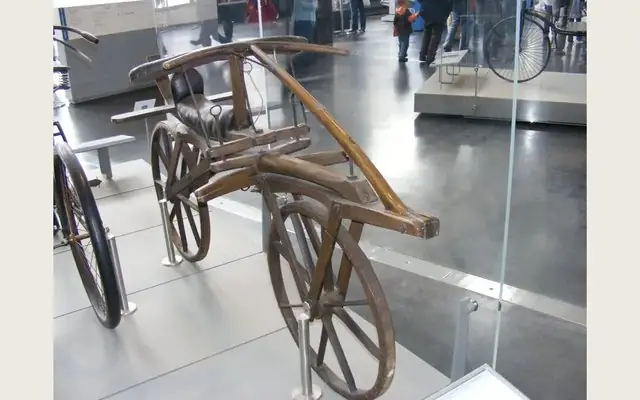
A vehicle missing the part we expect
A bicycle without pedals can initially look as if its essential mechanism has been removed. Karl Drais's running machine invites the opposite interpretation. It asks what a rider could gain before that later mechanism existed. Sitting astride a vehicle with two wheels in line, the user pushed against the ground with the feet and allowed the wheels to carry the resulting motion. In 1817, Drais demonstrated a way of moving that stood between walking and the later bicycle. The apparently missing component helps make the machine's actual proposition easier to see.
The arrangement changed the rider's relationship to the ground. Feet still supplied propulsion, but the seat and wheels could support movement between successive pushes. This was not a miniature horse and not a cart requiring an animal in front. It combined a human action with a wheeled structure organized around one rider. Describing it in those terms avoids making the invention depend on what later bicycles added. Its historical interest lies in a usable arrangement of existing possibilities, not in somehow containing a complete modern cycle in an unfinished disguise.
A public experiment in movement
The Stadtmuseum in Karlsruhe connects Drais's machine with public demonstrations in 1817. Its account reproduces a contemporary newspaper report discussing a journey from Mannheim on 12 June and a later demonstration of travel on a hill route. Such reports help establish how the invention was presented to observers: it needed to show that movement on wheels could offer an advantage over proceeding on foot. The reported performance belongs to that historical evidence. It should not be converted without qualification into a modern standardized speed trial with conditions the report does not document.
Direction was as important as propulsion. A rider needed a means of guiding a narrow vehicle rather than merely making it roll forward. The Deutsches Historisches Museum uses a model to explain the development from an early form with arm supports to a version with a turning front wheel. That record directs attention toward design changes instead of treating every object called a draisine as identical. Different versions can embody different answers to the practical question of control. Names are useful for grouping inventions, but the details of a particular construction still matter.
Originals, models, and what each can show
Museum evidence requires another distinction: an original and a reconstruction do not answer the same historical questions. Karlsruhe identifies its machine as a rare surviving example from the inventor's estate and notes its use for demonstrations later in his life. The Berlin museum's object, by contrast, was made by Hermann Ranft in 1960 after an early design. The model can clarify form and arrangement, while the older object can preserve traces of historical manufacture and survival. Understanding those differences makes both more informative than an undated illustration labeled simply as the first bicycle.
A more recent reconstruction adds an experimental question. The Museumsstiftung Post und Telekommunikation records a running machine built in 2017–18 using examples in museum collections as references. Its makers used it for a Mannheim-to-Paris journey in 2018 to explore whether a proposed early multi-day journey was practically feasible. A successful reconstruction ride can test possibilities under specified conditions. It does not, by itself, prove that a particular person made a particular journey two centuries earlier. The experiment and the documentary history are complementary forms of inquiry with different evidential limits.
A beginning rather than a finished bicycle
Pedals and chain drive belong to later stages in the bicycle's development. Karlsruhe's account places those transformations in the second half of the nineteenth century, particularly in France and England. This longer sequence makes a simple inventor's portrait insufficient as the whole history. Drais's machine provided an important beginning, while other designers addressed propulsion, construction, and riding arrangements afterward. The photograph accompanying this story shows a running machine on museum display. It is an illustration of a historical vehicle type, not a photograph of the 1817 demonstration or of a modern reconstruction journey.
The running machine is most rewarding when it is allowed to remain strange. Its rider still has to push with the feet, and its possibilities depend on the relationship among body, seat, wheels, and steering. That strangeness reveals how inventions can change a familiar action without immediately replacing every part of it. Drais did not need a modern bicycle to ask whether walking effort could be reorganized through wheels. His experiment opens a longer history in which an ordinary journey became a problem that could be redesigned, demonstrated, copied, and tested again.