A discovery with an unread message
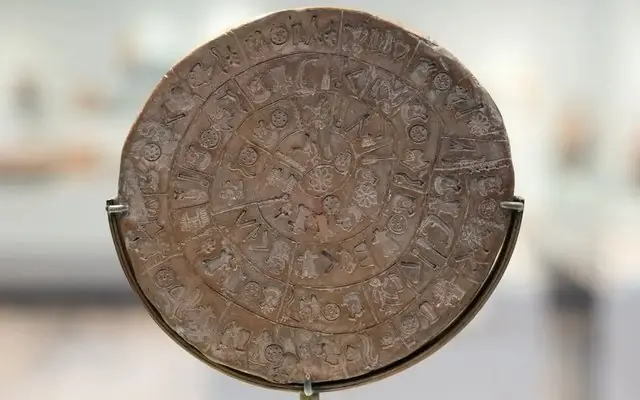
The Phaistos Disc offers a peculiar invitation: its signs are easy to inspect, while its message remains beyond a verified reading. Italian archaeologist Luigi Pernier discovered it in a room of the Palace of Phaistos on Crete on 3 July 1908. The Heraklion Archaeological Museum, which keeps the object, dates it approximately to 1700–1650 BCE. People, birds, plants, and ships appear among its stamped images. Recognizing those pictures, however, has not produced an agreed understanding of what their combinations were intended to communicate.
The palace belongs to a larger Cretan landscape. The Ashmolean Museum explains that major palaces rose at Phaistos in the south, Knossos and Mallia in the north, and Zakros in the east during the centuries after 1900 BCE. Arthur Evans named the culture Minoan after the legendary King Minos. That modern label gives the disc a cultural setting without identifying the individual who made it or the people expected to understand it. Its archaeological home is more secure than any proposed biography of its writer.
A visible method and a difficult date
The physical process is unusually legible. Tiny seals were pressed into wet clay on both faces before the disc was fired. The signs follow spirals, with incised lines dividing them into sixty-one groups, which the Heraklion museum cautiously treats as possible words. A boundary marked with five dots helps indicate the starting point, and the museum describes the text as proceeding from the outer edge toward the center. The maker therefore left visible instructions about arrangement even though the meanings of the arranged signs remain uncertain.
Dating the object requires a different kind of reading. Maurizio Del Freo's entry for Mnamon, the ancient-writing resource of the Scuola Normale Superiore, stresses that its excavation context was disturbed. Material associated with the find includes pottery from widely separated periods. Comparisons with Minoan pottery and seals nevertheless support a date in the eighteenth or seventeenth century BCE. That assessment explains why a museum date should be read as an archaeological estimate. The discovery supplies a definite day in 1908; the manufacture belongs within a reasoned ancient range.
Why a plausible reading needs a test
Mnamon identifies forty-five different signs and considers a syllabic writing system a plausible explanation. It also warns that similarities to other Cretan scripts do not establish a definite relationship. Proposed religious readings and calendar interpretations face the same central obstacle: without comparable inscriptions, a suggested decipherment cannot be checked. This makes repetition valuable evidence without making it a translation. A convincing interpretation must explain the patterns consistently, but an ingenious story about those patterns does not by itself demonstrate that an ancient reader would have understood the same story.
The neighboring scripts show why that distinction matters. In her account of pre-alphabetic writing, Cambridge scholar Philippa Steele explains that the shapes and probable sound values shared by Linear A and deciphered Linear B allow scholars to attempt readings of Linear A signs. Understanding the language remains a separate problem. Linear B benefited from a larger body of surviving inscriptions and from recording a recognizable language, Greek. The lesson for anyone looking at the disc is methodological: a familiar-looking shape, a possible sound, and an intelligible sentence represent different stages of evidence.
Copies carried the puzzle abroad
The disc also entered a modern history of copying. The Metropolitan Museum of Art owns a reproduction made by the Swiss artist Emile Gilliéron père in 1910 or 1911. Gilliéron and his son built a business supplying copies of newly excavated Aegean antiquities. Met curator Seán Hemingway describes how their painted plaster replicas, electrotypes, and watercolors helped museums present a civilization whose objects were scattered among excavation sites and collections. Between 1906 and 1932, the Met acquired hundreds of their reproductions and displayed them alongside original antiquities.
Copies were therefore part of how the new archaeological discoveries reached an international public. Hemingway notes that the Gilliérons' replicas could document color and detail in ways contemporary photography could not, and sometimes reached museums before the originals were fully published. Their Phaistos reproduction belongs to that educational enterprise. A copy can make the spirals available for looking, comparison, and teaching without supplying the lost knowledge necessary to understand them. The disc's enduring appeal lies partly in that separation: its maker's deliberate work survives in clear view, while the intended message still awaits verification.