A ship before it became a grave
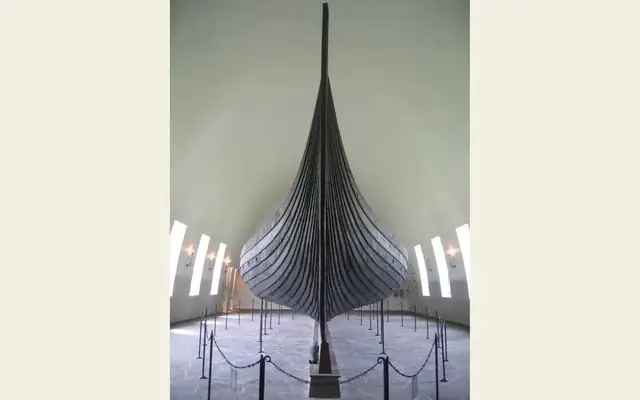
Before the Gokstad ship became a famous burial, it was a vessel made for use on the sea. The Museum of the Viking Age dates its construction to around 890 and its conversion into a grave to around 900. Its surviving hull measures approximately twenty-three meters long and five meters wide. Those dimensions belong to a working technology as well as an impressive monument. Looking at the ship as both transport and burial changes the questions it invites. A plank, a fitting, or an opening for an oar could have a practical purpose before acquiring a place in a funerary display.
The vessel was clinker-built, with overlapping planks forming its sides. Sixteen oar holes on each side allowed rowing, while a sail provided another source of propulsion. The museum describes a flexible, sturdy ship suited to open water and several kinds of activity, including travel and trade. These are capacities, not a recovered itinerary. The hull cannot tell us every journey it made or which cargo occupied it on a particular day. Its shape and construction provide evidence about what its builders made possible, while leaving much of its individual working history beyond direct recovery.
The damaged chamber and its unnamed occupant
The grave was disturbed long before archaeologists arrived. The museum’s account of the burial explains that robbers damaged furniture and cut through the bottom of the ship. Archaeological absence therefore needs interpretation. A missing object might never have been placed in the chamber, or it might have been removed. The damage itself belongs to the history of the site, rather than merely obstructing access to a supposedly untouched original scene. The people who broke into the mound changed the collection of evidence available to everyone who later tried to understand its occupant and the ceremony around him.
That occupant is conventionally called the Gokstad man. His remains and the scale of the burial indicate an important person, but they do not supply a securely established personal name. The museum emphasizes his place among the social elite while acknowledging uncertainty about his precise role. It is tempting to complete a rich grave with a famous ruler from a written tradition. The temptation should remain distinguishable from identification. Furniture, animal remains, and a ship can demonstrate the resources invested in a burial without proving which remembered individual received that investment or how he understood his own position.
An excavation that continued to raise questions
The modern investigation began in 1880, after local digging in the mound prompted archaeologist Nicolay Nicolaysen to undertake an excavation. Finds went to the University of Oslo’s antiquarian collection. Its later research account explains that Nicolaysen’s publication of 1882 was largely a catalogue and that subsequent work often concentrated on selected objects or attempts to identify the deceased. Attention also shifted toward the spectacular Oseberg discovery. The Gokstad material thus survived without receiving one final, comprehensive explanation. Excavation had opened access to the collection, but collecting and publishing objects were only stages in a much longer investigation.
New questions and methods brought it back into focus. The museum’s research history records a 1993 tree-ring dating result that separated the ship’s construction in the late ninth century from the burial in the early tenth. A project initiated in 2009 sought to study the wider landscape and the grave as an interconnected whole. That change of emphasis mattered. Animals, small boats, equipment, and the mound’s surroundings could be considered together rather than as isolated curiosities. The aim was to reconstruct a social setting from converging evidence, while accepting that some questions about the buried man might remain unresolved.
A reconstructed vessel becomes a fragile collection object
The ship’s museum life also changed its material history. A conservation account explains that it was once divided during transport and was reconstructed in the hall where it would be displayed. The Gokstad wing opened in 1932. Planning its 2025 relocation required attention to weight, supports, and a vulnerable forward stem. An ancient vessel that could once flex at sea had become an object requiring carefully controlled movement. The preservation problem was therefore not the same as the original shipbuilding problem. Surviving timber, earlier interventions, and the reconstructed form all had to be considered together.
The museum reports that roughly eighty-five percent of the ship consists of original wood. That substantial survival does not turn the displayed vessel into an untouched snapshot. Its history includes sailing, burial, robbery, excavation, reconstruction, and conservation. Each stage altered the relationship between material and meaning. Following those stages makes the object more informative than a simple illustration of Viking achievement. The Gokstad ship preserves evidence of skilled construction and exceptional funerary resources, while its modern study demonstrates how archaeological knowledge grows through reconsideration of objects that have already spent many years in a collection.