Saving water for the dry season
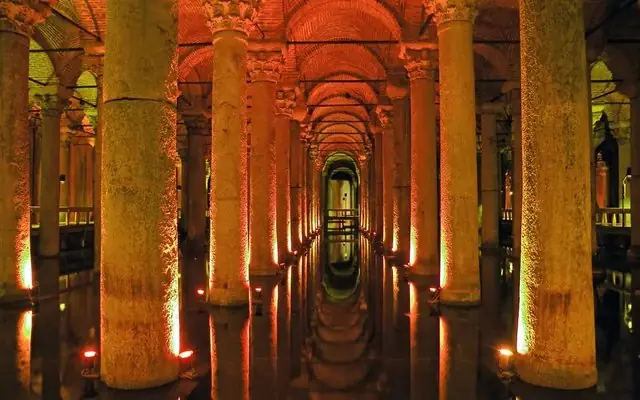
The columns of Istanbul’s Basilica Cistern create the impression of an underground palace. Their reflections and repeated arches can make it easy to forget what the structure was designed to hold. Its most important contents were water, stored beneath a busy capital until the city needed it. Known in Turkish as Yerebatan Sarnıcı, the surviving reservoir belongs to the sixth-century building program of Emperor Justinian. It is an impressive monument to construction, but also to a less visible kind of planning: carrying resources from a season of relative abundance into a season when supply became uncertain.
The contemporary writer Procopius explains the problem in a passage of Buildings traditionally connected with this cistern. Summer drought reduced the flow of the springs feeding Constantinople’s conduits, while other seasons brought more water than could immediately be used. He describes Justinian excavating beneath a large court and part of a portico to create a reservoir for the overflow. Stored water could then serve people when the incoming supply weakened. The account praises the emperor, as the work repeatedly does, but its practical explanation matters. A water system required a way to manage time as well as a route across the landscape.
A reservoir built from ordinary materials
The Istanbul Provincial Directorate of Culture and Tourism describes the surviving structure through materials that made that storage possible. A brick floor, walls coated with waterproof mortar, and a vaulted covering formed an enclosed reservoir supported by 336 columns. Seen together, these parts explain why the room could remain useful below ground. The columns helped carry the roof; the lining helped contain the water. Architectural ornament and hydraulic work occupy the same space. What a visitor now approaches as a remarkable interior was also a constructed container, dependent on the performance of ordinary building materials.
Its outline is clearer than every detail of its beginnings. Institutional descriptions agree on Justinian’s sixth-century involvement, while differing over earlier construction and giving different measurements. A broad date is therefore more responsible than a supposedly exact foundation day. The story also reaches beyond one ruler. The provincial directorate records the cistern’s later role in distributing water around Sarayburnu and Bahçe Kapısı during the Ottoman period. Political changes above the reservoir did not erase the usefulness of stored water below it. The building’s continuing history involved adaptations and maintenance rather than a single moment frozen intact.
A boat journey becomes a discovery story
A much later account brings an individual journey into view. In The Antiquities of Constantinople, Pierre Gilles, known in Latin as Petrus Gyllius, describes entering through a house and taking a small boat between columns standing deep in water. His host lit torches and speared fish while rowing. Wells connected the occupied ground above with the reservoir below. The familiar modern story of a traveler discovering a hidden chamber consequently rests on an encounter with someone already able to enter it, navigate it, and draw upon its resources. The place was concealed without being wholly unused.
Gilles nevertheless presented the encounter as his own discovery and criticized the inhabitants for failing to recognize the antiquity around them. That judgment needs to remain attached to its author. His account, read here in John Ball’s English translation published in 1729, records both an architectural investigation and a visitor’s assumptions about who understood the city. Residents could know a useful well without describing its reservoir in an antiquarian book. A historian gains more by distinguishing these forms of knowledge than by repeating a dramatic claim that the entire cistern had simply vanished from local memory.
A monument renewed through care
Later repairs changed the way people encountered the structure again. The provincial directorate records restoration in the 1980s followed by public access, while Istanbul Metropolitan Municipality lists the cistern among heritage sites whose completed works and reopening belonged to its 2022 program. These records concern different interventions, rather than competing dates for one universal restoration. The reservoir experienced successive campaigns of care. Today’s visitor route and presentation belong to that continuing history, alongside earlier repairs that allowed the roof, walls, and supports to survive. Preservation requires new decisions even when its purpose is to retain old fabric.
The cistern’s appeal therefore lies in more than an atmospheric view. Procopius helps explain why a capital needed storage; the surviving masonry shows how that need acquired physical form. Gilles records a journey that later became a discovery story, even as his own description preserves evidence of local use. Modern institutions add another layer through conservation and public access. The columns connect these histories without making them identical. Looking beneath their reflections reveals a durable piece of urban infrastructure, whose changing reputation can be studied alongside the practical work of keeping a city supplied with water.