One cargo kept together by a shipwreck
A shipment that never reached its destination can preserve information a successful delivery would have scattered. The Uluburun wreck, off the Mediterranean coast of Turkey near Kaş, brought raw materials, containers, and personal objects into one archaeological site. A sponge diver reported the discovery in 1982. The Institute of Nautical Archaeology subsequently excavated it over eleven seasons between 1984 and 1994, making more than twenty-two thousand dives. The wreck belongs to the Late Bronze Age. Its significance lies less in a dramatic final moment, which cannot be reconstructed securely, than in the many forms of evidence carried together on one vessel.
Copper and tin formed a substantial part of the cargo, in proportions suitable for producing bronze. Pottery, ivory, glass, and luxury objects enlarged the picture beyond metal transport. The excavators also recovered stone anchors and small portions of a cedar hull joined with pegged mortise-and-tenon connections. These finds answer different questions. Metal describes part of the shipment’s economic value; hull fragments reveal construction; objects used aboard may suggest something about the people traveling. No single category can stand for the whole voyage. Their value increases when material, position, and function are examined in relation to one another.
Glass as a traded material and a fragile survivor
Glass was traveling as material for further work, not only as finished ornaments. In their 2010 research abstract, C. M. Jackson and P. T. Nicholson describe elemental analysis of three blue and turquoise ingots. Their compositions were consistent with an Egyptian origin and resembled glass known in the Mycenaean world. The claim concerns the analyzed samples, rather than proving that every piece aboard came from one workshop. Such distinctions let scientific evidence refine a trade history without making it unnaturally uniform. A collection assembled for transport could unite materials that had already passed through several locations and exchanges.
The glass also preserved a difficult problem for conservators. Amandina Anastassiades and Lisa Ellis describe ingots ranging from comparatively sound objects to fragments crossed by fissures and fragile corrosion layers. Appearance alone did not reveal how safely a piece could be handled or dried. Water had altered the material during its long burial. Some glass retained recognizable color and solidity, while other portions survived in much weaker forms. Recovery was therefore not the end of preservation. Bringing an object out of the sea introduced a new setting in which existing damage could become more consequential.
Conservation and reconstruction as research
The conservators reviewed earlier treatments rather than assuming that one established procedure had solved every case. Their study compared records with the condition of previously treated ingots, considering desalination, drying, consolidation, and reconstruction. The work illustrates a less visible stage of archaeology: decisions made after excavation can affect what remains available for future research. Documentation allows later specialists to distinguish original material from repair and to reassess past choices. A museum object may appear stable and complete, but its survival can depend on a carefully recorded sequence of interventions that the visitor does not immediately see.
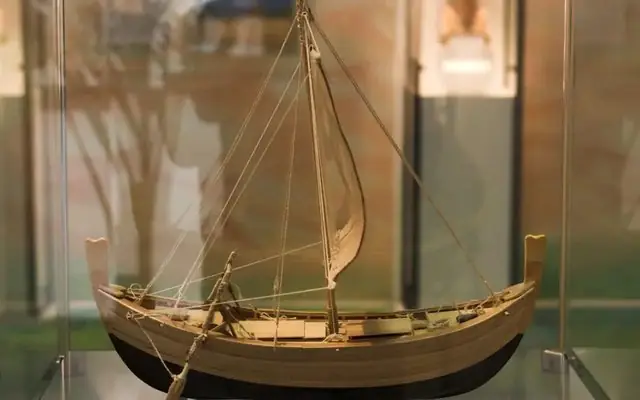
Reconstructing the vessel required another kind of reasoning. Shih-Han Samuel Lin’s Texas A&M research used the remaining timbers and the distribution of objects to test possible hull shapes and arrangements of cargo. The study’s abstract lists hundreds of metal ingots, jars, anchors, and ballast among the materials considered. A three-dimensional model was used to examine how a proposed vessel would float under different loads. This was a guided hypothesis, not the discovery of a complete original ship. It asked whether a reconstruction could physically accommodate the evidence rather than merely resemble a plausible ancient boat.
Testing a vessel without inventing a complete original
The same abstract reports that a modeled hull measuring fifteen by five by two meters could carry an estimated twenty tons of cargo and shipboard items under the tested conditions. Those figures describe a particular reconstruction and its assumptions. They should not silently become exact measurements of a fully preserved hull. A wooden model, such as the one illustrated here, can help viewers imagine the relationship between ship and cargo while retaining that qualification. Reconstruction is most useful when it makes the reasoning visible and leaves room for another arrangement to be tested against the surviving evidence.
Uluburun consequently links several histories of work. Ancient producers prepared materials, sailors managed a vessel, divers recorded a submerged site, and specialists studied its recovered contents. The source of an ingot, the treatment of damaged glass, and the stability of a hypothetical hull are distinct questions, each requiring appropriate evidence. Together they make the Mediterranean’s Bronze Age connections tangible without pretending to recover every person or transaction behind them. The wreck’s richness is not a license to finish its story by imagination. It is an opportunity to see how much a carefully studied shipment can reveal while keeping its remaining uncertainties in view.