A city recovered through its written records
A small clay tablet can preserve the order in which a Bronze Age scribe learned the signs of writing. At Ugarit, on the Mediterranean coast of modern Syria, such objects belong to a much larger recovery of a city's written life. Excavations at Ras Shamra began in 1929, following the discovery of an ancient tomb the previous year. The site occupied a valuable position between a harbor and routes reaching inland Syria, Anatolia, and Egypt. Its tablets reveal what a trading city recorded, circulated, and taught during the closing centuries of the Bronze Age.
The marks look familiar to anyone who has seen Mesopotamian cuneiform: little wedges impressed into clay. Their appearance, however, does not determine what the signs represent. Ugarit's local script used an alphabetic system with a standard repertoire of thirty signs, chiefly recording consonants. Akkadian cuneiform employed a different combination of syllabic and word signs. As the Scuola Normale Superiore's Mnamon guide explains, Ugaritic writing probably adapted an existing alphabetic approach to the wedge making techniques of an established writing culture. A familiar material practice could serve a different way of organizing speech.
The order that scribes learned
The order of those signs is also part of the evidence. Several tablets list an alphabetic sequence, allowing researchers to study what scribes were taught instead of reconstructing the order from scattered words alone. Much of that sequence resembles the order found in later Phoenician writing. Mnamon also records rarer alternatives, including a shorter alphabet and an example with a different arrangement. Ugarit therefore preserves a particular branch of a wider history, with variation inside it. Calling the system alphabetic does not make the city the single starting point of every alphabet used afterward.
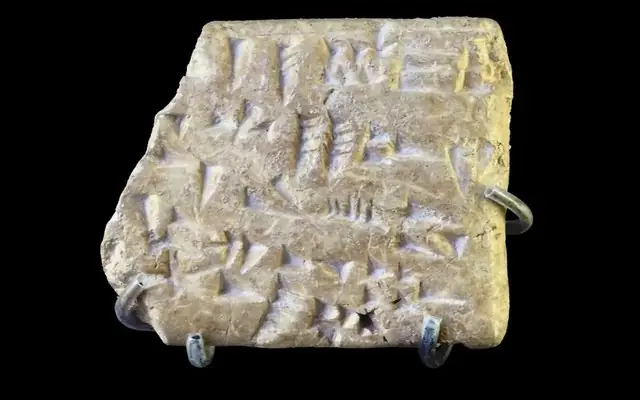
One surviving witness is especially modest. The Louvre's tablet AO 19992, also identified by its excavation number RS 10.087, was found at Ras Shamra in 1938. The museum dates it broadly to about 1400–1200 BCE and describes it as an incomplete cuneiform abecedary missing seven letters. Its small surface carries evidence of learning despite that loss. An archaeological date range, a modern discovery year, and an inventory number answer different questions. Keeping them separate prevents an attractive photograph of an alphabet tablet from becoming a misleading illustration of one supposedly exact moment of invention.
An alphabet within a social world
A small repertoire of signs also leaves an important social question unanswered: who actually had access to writing? Archaeologist Philip Boyes, reporting research associated with Cambridge's CREWS project, emphasizes the settings in which Ugarit's documents were stored and used. Many private tablet collections belonged to prosperous men involved in business or administration, and their locations could limit access. His interpretation presents writing largely as an elite activity. The existence of an alphabet is therefore evidence about a system of signs; the buildings, owners, and users are needed to investigate its place within society.
The archives range beyond exercises. Administrative, legal, economic, and literary texts connect decisions about goods and obligations with stories and religious traditions. Other languages also occur, reflecting the city's participation in international exchange. These records survive from a world that suffered severe disruption near the end of the Bronze Age. Late letters describe seaborne attacks, but the Metropolitan Museum cautions against treating the destruction of Ugarit as an event with one securely identified explanation. Evidence of danger in a document is valuable; assigning every part of a regional collapse to one named group requires a different argument.
An archive of the excavation itself
Modern research has its own archive beside the ancient one. The French Ministry of Culture's account describes the records of Claude Schaeffer's early excavations preserved at the Collège de France, where he later taught. Scientific files sit alongside administrative documentation, linking discoveries to the circumstances in which they were recovered. Researchers revisit this material to publish previously unedited evidence and develop archaeological and epigraphic maps. A tablet removed from the ground retains its marks, but field records can preserve relationships that the object alone cannot show: where it lay, what surrounded it, and how its context was understood.
The Maison de l'Orient et de la Méditerranée describes the practical difficulty of bringing that evidence together. Photographs, negatives, drawings, plans, notebooks, and correspondence are distributed among institutions in Syria and France. Its digitization project aims to make these records easier for researchers to consult and compare. The small alphabet tablet consequently belongs to two connected histories of keeping information: the Bronze Age practice of recording words in clay, and the modern work of preserving the circumstances of their discovery. Reading the wedges begins one investigation; recovering the people and places around them gives that investigation its depth.