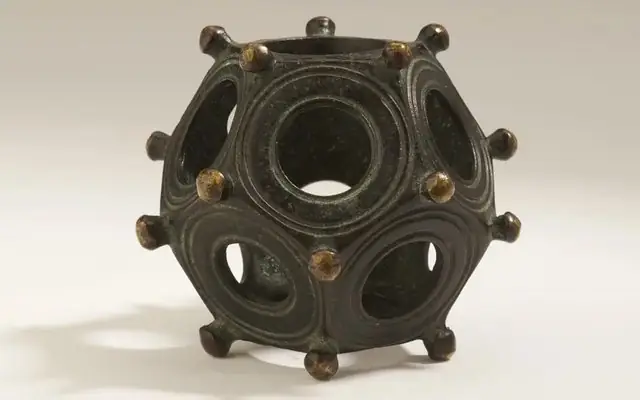
A complete shape with an absent explanation
A hollow metal object can be perfectly recognizable and still refuse to explain itself. Roman dodecahedra have twelve pentagonal faces, round openings of different sizes, and small knobs projecting from their corners. Incised decoration often surrounds the holes. Their makers clearly intended this complicated arrangement, yet the people who used the objects left modern archaeologists without an agreed explanation of its purpose. At Corbridge in northern England, a complete example belongs to a collection full of more readily identifiable Roman possessions. Its survival has preserved a design while losing the activity that made that design useful.
Making such an object required considerable skill. English Heritage emphasizes both the craftsmanship involved and the quantity of copper alloy, suggesting that these were expensive pieces, probably commissioned rather than casually improvised. Their distribution also creates a puzzle. The institution's exhibition account locates finds across the former Roman Empire but notes their absence from Italy, Spain, Africa, and the Mediterranean. They therefore resist the tempting assumption that anything called Roman must have been familiar throughout Roman territory. A shared imperial setting could contain strongly regional habits that written sources do little to explain.
Why the surroundings matter
Dating depends on archaeological surroundings rather than a date engraved on each face. English Heritage places securely contextualized examples between the second and fourth centuries CE, while stressing how few have clear find settings. A precise location within a particular building could change the argument considerably. Repeated discoveries in temples, for instance, would strengthen a religious interpretation. An attractive object removed from its surroundings cannot supply that pattern by itself. This is why a new excavation can matter even when a museum already possesses a visually impressive example of the same general form.
The known settings do not, however, identify a single obvious category of user. English Heritage describes urban and rural finds, objects associated with living people and objects placed with the dead, without a consistent division between military and civilian life. Proposed functions range from candle holders and ceremonial heads to surveying equipment, agricultural calendars, toys, and knitting aids. The variety demonstrates how many actions a pierced shape might accommodate. Showing that a replica can perform one of them is a useful experiment, but the historical question remains whether ancient users actually chose that action.
A complete example in a Lincolnshire pit
In summer 2023, volunteers excavating at Norton Disney near Lincoln uncovered another complete dodecahedron. Lincolnshire County Council's museum announcement describes a hollow copper-alloy object around eight centimeters high and weighing 245 grams, provisionally assigned to the third or fourth century. Its condition made it especially striking beside damaged examples and fragments. The announcement also records a substantial gap in the evidence: no Roman textual references or depictions identify these objects. Without an ancient scene showing one at work, a modern explanation has to draw its strength from materials, measurements, and archaeological associations.
The Norton Disney find came from a large pit on a hilltop. In the council's account, the group's secretary, Richard Parker, suggested that it appeared to have been deliberately placed there, and raised the possibility of ritual significance. That is an interpretation of the setting, not the discovery of an ancient label. The same account reports the varied, contradictory suggestions sent to the excavators after publicity spread. The contrast is instructive: an object can generate international confidence about its purpose while the people recording its actual surroundings continue to ask careful, limited questions.
An excavation that keeps the question open
Parker's subsequent firsthand report in the Royal Archaeological Institute's Spring 2025 newsletter gives the investigation a firmer sequence. The dodecahedron had appeared on the penultimate day of the 2023 dig, leaving little time to extend the work. The team returned in June 2024 with assistance from Allen Archaeology. They investigated a backfilled sand quarry pit, excavating one quarter to a depth of about 2.8 meters and part of another quarter. The fill contained Roman building material, third-century pottery, animal teeth, and surviving bone. A coin of Claudius II in an upper layer supplied another chronological clue.
Those discoveries expanded the problem instead of closing it. Parker asked why so much building material had entered the pit and whether buildings had stood nearby. He also left open whether the dodecahedron was deposited ritually or simply discarded in the fill. An archaeological context therefore provides constraints, not an automatic solution. The object remains an achievement of metalworking whose social meaning is uncertain. Its twelve faces invite us to invent instructions; the excavation asks a more productive question about which proposed instructions the surviving evidence can actually support.