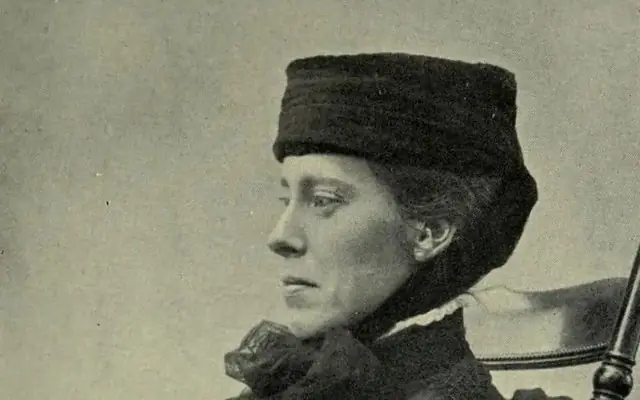
An explorer’s unusual measure of success
Mary Kingsley offered an unusual account of what made her proud. In Travels in West Africa, she singled out approval of her fish specimens by zoologist Albert Günther and her ability to paddle an Ogowé canoe. The pairing is characteristic: scientific work beside practical competence, delivered with humor. Her book appeared in 1897 after journeys along the West African coast and inland waterways. It describes places in what are now several different countries, rather than a single expedition across an undifferentiated continent.
That distinction matters particularly on the Ogooué River in present-day Gabon, called the Ogowé in her book. Kingsley's narrative follows canoe travel, river conditions, collecting, and conversations, alongside visits to trading and mission stations. The river was a working route for people who already lived there. Calling her an explorer describes her relationship to British geographical knowledge; it does not mean she entered an empty landscape awaiting discovery. Her own account repeatedly depends on other people's knowledge of water, routes, commerce, and local circumstances.
From a home library to river collecting
Born in 1862, Kingsley acquired much of her education through reading at home. Her father's books introduced her to travel and natural history, while family care occupied much of her early adult life. After both parents died in 1892, she gained room to travel. She first visited West Africa in 1893 and undertook a more extensively prepared journey beginning in late 1894. A near-contemporary biography records that the British Museum supplied collecting equipment. Preparation connected a private traveler with a scientific institution before her journeys became a publishing success.
Fish collecting required more than a taste for adventure. Specimens had to be obtained, preserved, transported, and identified by specialists. Kingsley thanked Günther for treating her work seriously; that encouragement linked field collecting with the museum expertise that could assess it. Her journeys also included collecting reptiles and insects. The resulting specimens entered systems of scientific comparison and naming. This helps explain why a canoe skill could stand beside a zoologist's approval in her account of success: moving effectively through the environment was part of getting the scientific work done.
A travel book with a particular viewpoint
Kingsley's writing is memorable because she often makes herself the subject of the joke. At the start of her narrative, a veteran of the coast advises her to reconsider and go to Scotland instead. She describes practical inconveniences, awkward equipment, uncomfortable nights, and the difference between imagining a journey and carrying it out. Such passages create an approachable narrator, but they remain a shaped literary performance. A funny episode in a published travel book is evidence of what its author chose to tell readers, not an unedited recording of everything that happened.
The same caution applies to her descriptions of African societies and religion. Her language and categories belong to the colonial world in which she traveled. She criticized European ignorance and some missionary and administrative practices, yet she was not writing from outside imperial assumptions. Reading her work critically means retaining both its observations and its limits. Her accounts preserve interactions, judgments, and exchanges; they do not substitute for the voices or histories of all the people she encountered. An engaging narrator can be informative without being a neutral authority.
Beyond the solitary adventurer
The second journey also included an ascent of Mount Cameroon. On returning to Britain, Kingsley became a lecturer and author, speaking to scientific societies and other audiences. West African Studies followed in 1899 and developed her arguments about trade, government, and local institutions. Her public career was brief. In 1900 she went to South Africa during the war between Britain and the Boer republics and nursed sick Boer prisoners at Simon's Town. She contracted enteric fever and died on June 3, 1900; she was buried at sea.
The fish and the canoe remain a useful starting point for remembering her. They bring attention back to work: learning movement on a river, handling specimens, seeking information, and turning experience into prose. They also complicate the portrait of a lone Victorian adventurer. Museum specialists, boat crews, hosts, traders, and local guides made the journeys possible. Kingsley's lively book allows readers to investigate those relationships as well as the traveler herself. Its most rewarding stories begin with her curiosity and continue by asking whose knowledge helped that curiosity travel.