A contest on three rows of squares
Thirty squares could hold both a contest and an image of a journey beyond death. Senet, a board game played in ancient Egypt, used three rows of ten spaces. Its rectangular pattern survives alongside pictures of people playing. The game endured for many centuries. Its history raises an appealing question: how did a form of everyday entertainment become useful for imagining a passage through dangers that no living player could personally describe?
The Metropolitan Museum describes movement along an S-shaped route, with decorated squares near the end. Egyptian players could use throw sticks as randomizers, instead of the familiar numbered cube of many modern games. Chance therefore belonged to the material equipment of play. Yet recognizing a board and understanding the broad direction of movement are different from recovering every rule. A surviving track can show where pieces traveled without preserving all the agreements that made an actual match fair, difficult, or exciting.
What an incomplete set can preserve
A small group of pieces from the family tomb of Neferkhawet provides a quieter view than a royal monument. During excavations at Thebes in 1934–1935, the Met's team found five conical and three spool-shaped counters lying beside the outline left by an insect-damaged game box. The set was incomplete and mismatched. Its modest irregularity matters: archaeological gaming equipment need not resemble a pristine modern boxed set. People can keep replacements, lose parts, and continue using things whose histories are more complicated than their original design.
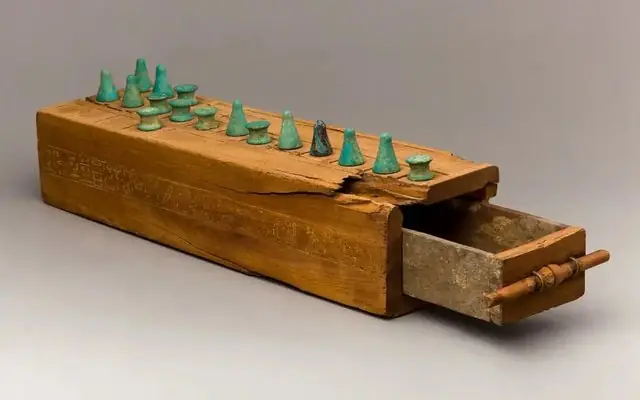
The museum associates those two simple forms with both senet and Twenty Squares, games sometimes combined on opposite faces of one box. That shared equipment makes interpretation a careful exercise. A cone alone does not announce which game last employed it, and an empty space where wood decayed does not restore every missing component. The surviving pieces nevertheless reveal how much depended on portable, vulnerable materials. A museum label can name a game, while excavation records explain why that name is an informed association rather than a message written on the counter.
Two games inside a family possession
A better-preserved wooden box made for the overseer of works Taia offers a different kind of evidence. The Met dates it to approximately 1396–1347 BCE. One surface carries Twenty Squares and the other the thirty spaces of senet. A sliding drawer stores accessories. The arrangement keeps equipment and alternative games together. The photograph shows Twenty Squares; the senet board is on the reverse.
Taia's box also belongs to a family. Funerary texts name him, his father, and his mother, while a scene at one end places him and his wife beside an offering table facing her mother. These details change how we see the object. Its owner did not necessarily divide leisure, household relationships, and preparation for death into separate categories. The box could retain a recognizable pastime while carrying requests for offerings and remembrance. Both playing faces belong within that personal and religious world.
Playing against an unseen opponent
The tomb of Queen Nefertari supplies a striking image of that transformation. A scene copied by Nina de Garis Davies in 1921–1922 shows the queen at a senet table with no visible opponent. The Met explains the painting through the game's association with passage into the afterlife: obstacles encountered in play could represent dangers on that journey. The image is thus more than a snapshot of a queen filling an afternoon. Within a tomb, a familiar activity could express hopes about continued existence and successful movement into another state.
Modern players can make reconstructed versions of senet, but a playable modern rulebook should not be presented as an intact ancient instruction manual. The Met's earlier Egyptian Art bulletin explicitly notes that the rules have never been fully recovered. Objects, excavation contexts, texts, and paintings preserve different parts of the puzzle. Their incompleteness leaves room for research without erasing what is clear: this was a real game with practical equipment, and its language of movement acquired a spiritual purpose. The same squares could connect competition among the living with expectations for the dead.