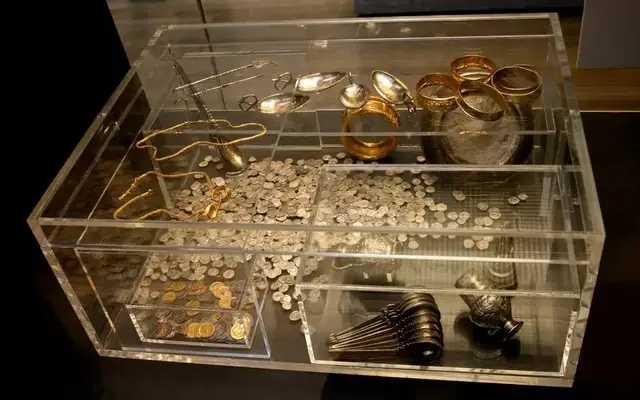
A useful accident in a Suffolk field
A missing farm tool began an encounter with Roman wealth. In 1992, a search with a metal detector in a Suffolk field revealed the Hoxne Hoard: coins, jewelry, and silver utensils that had remained underground for centuries. The object being sought was a modern hammer. The British Museum even preserves that hammer, carefully identifying it as associated with the discovery rather than part of the ancient deposit. Putting an ordinary iron tool beside precious metal captures the wonderful accident of the find without confusing two very different periods of its history.
Discovery, however, is only the opening of an archaeological story. The University of Kent's Britain's Last Roman Hoards project explains why finders are advised to leave a hoard together for professional excavation. The relationships between objects can retain evidence that separate cleaned treasures cannot: what was packed first, what containers held, and whether textile survives between surfaces. A scattered pile of saleable pieces would answer fewer questions. The useful historical value of a hoard therefore includes its arrangement and fragile surroundings, alongside the metal that makes the discovery appear spectacular.
A packed deposit and a date boundary
The Suffolk Historic Environment Record describes the main deposit as a compact rectangle, roughly fifty-seven by thirty-six centimeters. Although some objects had entered the ploughsoil, much remained in place. Nails and other fittings indicated a principal container, probably wooden, while small locks, hinges, and decorative fittings suggested smaller boxes. These details make the collection look less like loose treasure poured into a hole and more like possessions deliberately organized for storage. A chest is itself a technology of keeping things together, even after most of its timber has disappeared.
Coins help establish when that storage could have happened. Suffolk's record identifies examples of Constantine III dated to 407–408 among the latest issues. Such evidence supplies a boundary, not a witnessed burial date: the deposit cannot be earlier than a coin it contains, but coins can remain in use. The distinction prevents a precise-looking number from becoming an invented account of one particular emergency. Hoxne belongs to the turbulent closing period of Roman rule in Britain, yet neither the coins nor the chest tell us exactly why its owners never recovered it.
An ingenious vessel for the dining table
One small silver vessel makes that distant household remarkably tangible. The British Museum's Hoxne pepper pot resembles a richly dressed woman's upper body. Gilding picks out details of her clothing and jewelry, and a scroll rests in one hand. Beneath the figure is an ingenious rotating mechanism. Different positions close the container, open it for filling, or expose holes through which a diner could sprinkle its contents. This elaborate object combined decoration with an ordinary table action: controlling the amount of seasoning added to food.
The familiar nickname ‘Empress’ should not be mistaken for a secure identification. The museum cautions that comparable late-antique female images probably expressed a general imperial appearance rather than portraying a particular ruler. Nor does an elegant face provide the name of the woman who owned this pot. It is one of four pepper containers in the find, giving us evidence for costly dining equipment rather than a complete guest list. Recognizing what the mechanism certainly did and what the portrait cannot establish makes the object more informative, not less interesting.
Names that resist a simple family story
Names survive elsewhere, but they create another puzzle. Research presented by the Kent project notes several personal names on the silver spoons, with Aurelius Ursicinus recurring on ten. A pierced gold bracelet addresses a woman called Juliane and wishes her good fortune. These inscriptions suggest histories of ownership and gift-giving before the objects entered the ground. They do not prove that one named person assembled or buried everything. A collection can pass through hands, accumulate within a family, or gather objects whose earlier owners are no longer present.
Scholars have consequently proposed different ways of understanding the group, including wealth accumulated over time and belongings held by a single family. Those possibilities cannot be reduced to a confident story about a known couple fleeing a known attack. The most compelling biography of Hoxne is distributed across its evidence: a tool that led to discovery, a packed container, dated money, an adjustable spice pot, and names scratched into valued possessions. Together they reveal practices of keeping and using wealth, while leaving the final decision to hide it beyond our reach.