A book among the ashes
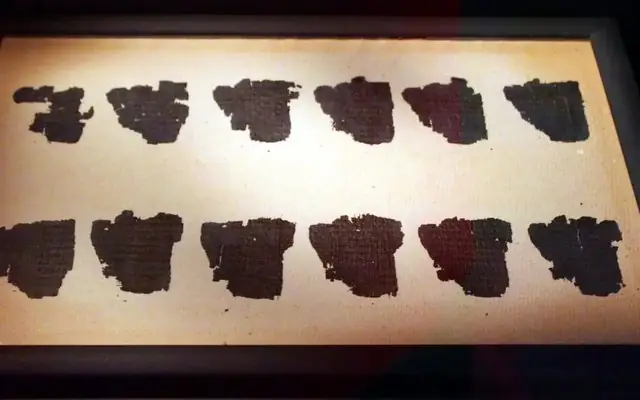
A damaged roll of papyrus survived at Derveni because a funeral fire failed to consume it completely. The surviving fragments are dark, fragile, and incomplete, yet they carry an ancient discussion about gods, ritual, and the structure of the world. They came to light in 1962 during work near the road between Thessaloniki and Kavala in northern Greece. Their setting was a wealthy burial, not the shelves of an excavated library. What appears at first to be the wreckage of a book has become an exceptional witness to how some Greek readers interpreted religious poetry.
The burial is conventionally called Tomb A. The Archaeological Museum of Thessaloniki describes its discovery during road widening on January 15, 1962, and dates the burial to the late fourth or early third century BCE. Weapons and numerous fine objects suggest an owner of high status, although they do not reveal his name. Remains of the pyre lay over the tomb, and the papyrus was recovered from that burnt material. Its context connects a philosophical text with funerary practice. It does not, by itself, tell us precisely what its owner believed or why this particular roll accompanied the ceremony.
The age of a copy and its contents
The museum dates the handwriting to approximately 340–320 BCE. That is the date of the surviving copy, not necessarily the composition of the work it contains. The underlying writing is generally placed much earlier, near the end of the fifth century BCE. Keeping those dates separate prevents a familiar mistake: treating the age of a manuscript and the age of its contents as the same thing. A copy can preserve an older argument while also telling us about the interests of the later reader who acquired or commissioned it.
This was a roll with writing arranged in columns, not a bound volume with turning pages. Only the upper portions survived; lower sections were destroyed by the fire. Scholars have reconstructed twenty-six columns from the fragments, but reconstruction should not be confused with complete restoration of every sentence. Gaps remain part of the document. The surviving physical shape explains why editors must piece together both material and language. Before anyone can debate a philosophical argument, small scraps must first be placed in a defensible order and damaged letters assessed with care.
Reading poetry as an account of the world
The text brings together religious instruction and interpretation. Its opening portion concerns rites associated with souls and their fate after death. A much longer section comments on a poem attributed to the legendary singer Orpheus, discussing divine figures and the beginnings of the cosmos. The commentator reads the poem as conveying meanings beyond a straightforward tale about gods. In that sense, the roll preserves more than a religious story. It offers evidence for an ancient reader explaining how a difficult inherited text should be understood, and for the intellectual labor of interpretation itself.
The nomination submitted to UNESCO emphasizes the combination of theology and an account of nature associated with early Greek philosophy. It also highlights a contested reference to ritual specialists called magoi. Scholars differ over how directly this term should connect the passage with Persian religious traditions. The word cannot settle the identity of the practitioners on its own. Such disagreements are useful warnings against turning a fragmentary commentary into a single, uniform statement of ancient belief. Religious vocabulary traveled, and a surviving word can pose a historical problem rather than provide a simple solution.
An ancient interpreter and modern readers
The writer's identity is also disputed. The Center for Hellenic Studies at Harvard lists several proposed authors, rather than presenting an agreed name. Its research project draws attention to the extensive work behind the edition published in 2006 and to digital tools that let readers distinguish the preserved text from editorial readings. That separation is especially valuable here. A smooth modern translation can hide the effort needed to establish a broken line. Displaying uncertainty helps readers see which conclusions rest on visible letters and which depend on reconstruction or a choice between scholarly alternatives.
UNESCO entered the Derveni Papyrus on its Memory of the World register in 2015. It is often described as Europe's oldest surviving book, a phrase best understood as recognition of this rare literary manuscript rather than a claim that no earlier writing existed. Its importance reaches beyond a competition for age. The roll preserves a meeting between ritual, poetry, and arguments about nature, while its burnt edges preserve the circumstances of its survival. A text intended to explain hidden meanings has itself become a lesson in careful reading: the strongest historical account respects both what remains and what the fire took away.