A Bronze Age sky recovered from illicit trade
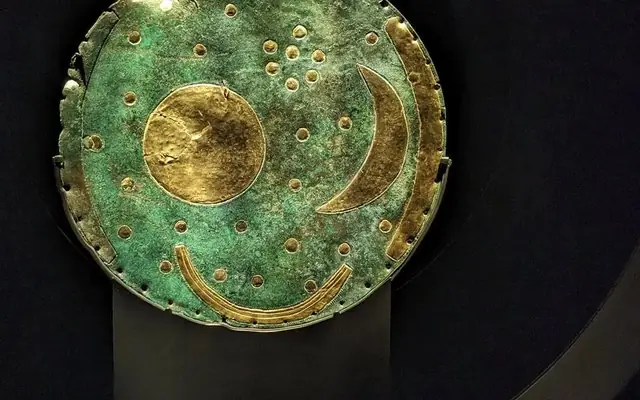
Gold stars shine against the green surface of a bronze disc in the State Museum of Prehistory in Halle, Germany. A crescent and a larger round shape make the object look immediately celestial, even to someone who knows nothing about its makers. Yet the Nebra Sky Disc is not a modern star chart translated into metal. It is a Bronze Age object that was altered several times, used in ways researchers still debate, and finally buried with weapons and ornaments around 1600 BCE. Its fascination lies in the combination of recognizable heavenly forms and meanings that cannot be recovered with equal confidence.
Its modern discovery was far from an orderly archaeological excavation. Germany's nomination document for UNESCO records that treasure hunters illegally dug up the hoard on the Mittelberg near Nebra on July 4, 1999. The objects passed through dealers before police secured them in Basel on February 23, 2002. They then entered the care of the museum in Halle. That sequence matters because the find was initially removed from its setting without proper documentation. The story of the disc includes the work needed to reconstruct its circumstances, as well as the far older question of why people placed it beneath the ground.
The craft beneath the stars
Before it could carry an image of the heavens, the disc had to be made. A study published in Scientific Reports in 2024 examined its metal structure and compared it with experimental replicas. The investigators concluded that the bronze was worked from a cast preform through repeated heating and forging. This was not simply a matter of pouring liquid metal into the final, thin shape. A smith had to spread the material while managing its changing ability to deform. The object thus records considerable knowledge of metalworking before any of its golden symbols are considered.
The replica work also shows how archaeologists can investigate actions that left no written instructions. Heating and hammering change the internal structure of metal, creating traces that can be compared under a microscope. Experimental pieces do not replay every original hammer blow, and the researchers explicitly caution against reconstructing every detail of the ancient process. Instead, similarities help identify the broad sequence that could produce the surviving material. This distinction is useful: a successful experiment can support a plausible method without proving that an ancient craftsperson followed an identical schedule, temperature, or number of operations.
An image that changed over time
The museum identifies several phases in the image itself. The earliest arrangement had thirty-two stars, a crescent, and a large circular form commonly interpreted as a sun or full moon. Two curved gold strips were subsequently added near opposite edges. Their placement covered some stars and required another to be moved. A further curved strip, usually interpreted as a boat, was added later. Its different decoration and position distinguish it from the original sky image. Finally, holes were punched around the perimeter, suggesting a new way to attach or display the object. The familiar design is the accumulated result of changes.
Astronomical readings seek to explain those choices. The museum's interpretation links the small cluster of stars with the Pleiades and the edge arcs with the Sun's changing positions over the year. It also proposes that the relationship between a crescent and the Pleiades could help reconcile lunar months with the solar year. These are interpretations of an arrangement of symbols, rather than instructions written by its maker. They nevertheless point toward a society in which observations of the sky could matter to the calendar, ceremonies, and authority. The disc brings practical observation and religious imagery into the same small space.
Burial, preservation, and unanswered questions
One of the edge arcs had already been removed before the disc was buried. The hoard also contained two swords, two axes, two spiral arm-rings, and a chisel. The museum interprets this carefully assembled deposit as an intentional farewell to a powerful object, comparing its equipment with the furnishings of an important person's burial. No surviving statement identifies the owner, the participants, or their motives. Nor can researchers say exactly how much time separated every alteration. Calling the deposit ritual describes a reasoned archaeological interpretation; it does not allow us to invent the words spoken when the objects disappeared underground.
UNESCO added the Nebra Sky Disc to its Memory of the World register in 2013. That recognition emphasizes its value as a record of human knowledge, even though it is not a book and contains no decipherable written explanation. Its surface preserves decisions about what to depict, move, conceal, and attach. Its metal preserves evidence of skilled work. Its recovery exposes the damage that illicit digging can do to historical understanding. Seen together, those layers make the disc more compelling than a claim that every symbol has been solved. It is a remarkable surviving conversation between the heavens, human craft, and the limits of interpretation.