Beyond the famous moth
A moth taped into a computer logbook is one of the best-known objects in the history of programming. In September 1947, engineers working on Harvard's Mark II found the insect in a relay and recorded their discovery with a joke about finding an actual bug. Grace Hopper worked with the Mark II team and helped make the story famous. She did not invent the engineering meaning of bug, which was already decades old, and the Smithsonian cautions that the notebook probably was not hers. Understanding that distinction brings a more interesting career into view: her work changed how people gave instructions to computers.
Born in New York City on December 9, 1906, Grace Brewster Murray studied mathematics and physics at Vassar College before completing graduate degrees in mathematics at Yale. She taught at Vassar while pursuing her doctorate, awarded in 1934. During the Second World War, she sought entry into the Navy despite initially encountering objections to her age and size. She joined the Naval Reserve in December 1943 and, after training and commissioning, received an assignment at Harvard. An experienced teacher and mathematician was about to enter a field whose familiar professional titles and working routines were still being invented.
From notebooks to reusable programs
The Harvard Mark I was an enormous electromechanical calculator serving wartime needs. Under Howard Aiken, Hopper and her colleagues developed instructions for calculations, operated the machine, and learned how to describe procedures precisely enough for it to follow. Her responsibilities also included writing its manual. In her 1980 oral history, she remembered colleagues keeping notebooks of useful pieces of coding and copying one another's routines. Sharing a reliable calculation saved effort, but copying introduced fresh opportunities for mistakes. The habit contained the outline of a future software library before that idea had acquired its later technical vocabulary.
In 1949, Hopper moved to the Eckert-Mauchly Computer Corporation, where work on UNIVAC carried computing toward commercial customers. Her interest in reusable routines continued. She saw that people were spending time copying instructions and adjusting their positions in larger programs, although the computer itself could perform repetitive copying and arithmetic. Her A-0 system, completed in 1952, helped gather existing routines into a usable program. It became an important early milestone in compiler history. The achievement concerned transferring part of the work of programming to the machine, rather than merely making a person type the same instructions faster.
Words, business users, and a shared language
Her next ambition involved the form those instructions could take. Many potential business users were comfortable with words describing accounts, inventories, and transactions, while dense mathematical symbolism remained unfamiliar. Hopper and her team developed FLOW-MATIC, running by 1956, to express data-processing operations through English word commands. The computer did not suddenly understand ordinary conversation: a language still needed defined instructions and rules. The change made it easier for people with a different professional vocabulary to approach programming. Her 1980 interview presents that broader access as a central purpose, rather than a decorative convenience added to an otherwise finished technology.
The same concern helped shape her involvement with COBOL, the common business-oriented language developed through CODASYL beginning in 1959. FLOW-MATIC supplied an influential precedent, and Hopper promoted compilers and adoption. COBOL was a collaborative undertaking involving many contributors, rather than a language created by one person alone. Its promise included making business programs less dependent on a particular manufacturer's machine. That required agreement about meaning as well as vocabulary: instructions needed to produce consistent results across systems. A readable program could still become expensive to move if competing implementations interpreted it differently or required extensive rewriting.
Standards, service, and teaching
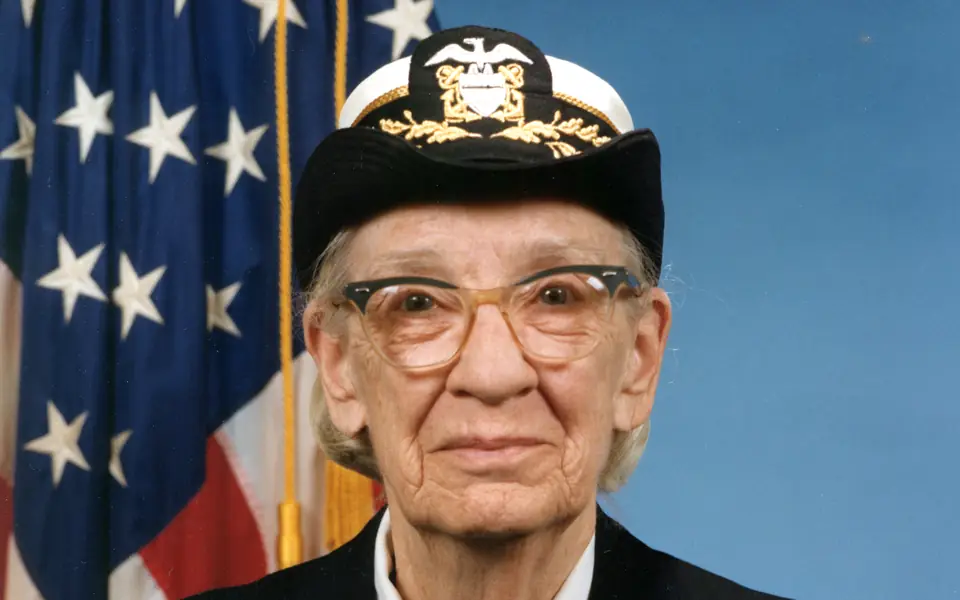
That practical difficulty followed Hopper back into naval service. After retirement from the Naval Reserve at the end of 1966, she was recalled to active duty in 1967. Work on language standards and validation addressed the cost of incompatible computer systems. Testing whether a compiler met an agreed standard was less picturesque than discovering an insect in a relay, but it mattered to institutions trying to preserve their software investment. She continued serving until 1986, retiring as a rear admiral at seventy-nine. Her long career linked wartime calculations to a world in which large organizations depended on programs that had to survive changes in equipment.
Teaching remained part of that work. In lectures, interviews, and technical discussions, Hopper translated difficult ideas for audiences with different backgrounds. Her oral history also makes room for colleagues, notably Betty Holberton, whose earlier programming work encouraged her own experiments. Such acknowledgments resist the temptation to turn computing into a succession of solitary discoveries. The moth survives because it is memorable; manuals, shared routines, language committees, and compiler tests explain more of the transformation. Hopper's lasting contribution joined technical invention to a sustained effort to help more people use computers and to make their instructions travel beyond a single machine.