A cyclist invents a traveling name
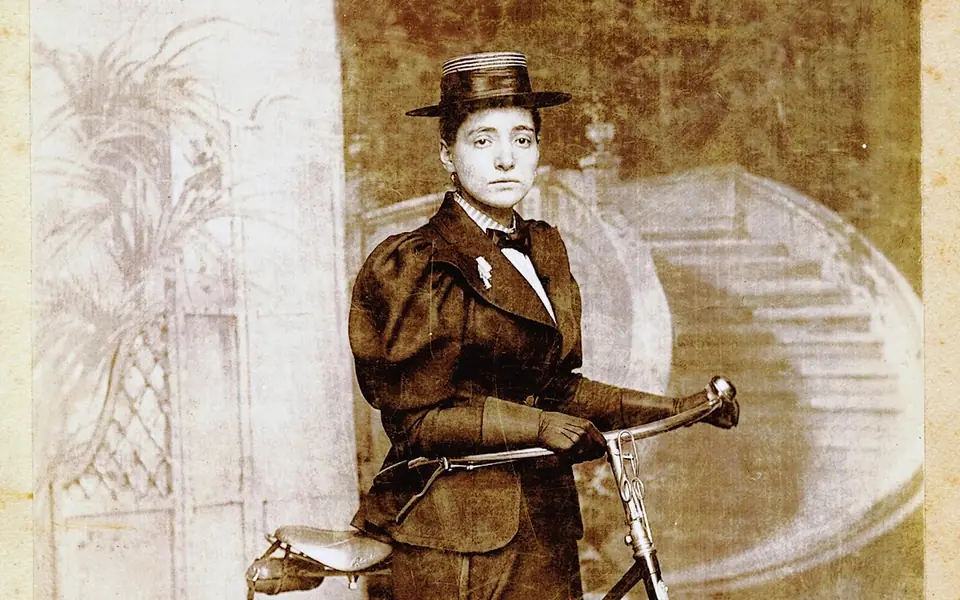
In June 1894, Annie Cohen Kopchovsky left Boston on a bicycle and began transforming herself into Annie Londonderry. The young mother of three would become celebrated as the first woman to travel around the world by bicycle. The phrase needs explanation: she crossed oceans on steamships and used trains as well as pedals. Her story remains remarkable when those qualifications are included. The journey combined physical effort, commercial sponsorship, public performances, and an adventurous challenge to expectations about how a woman should appear and move through the world.
Kopchovsky belonged to a Jewish immigrant family living in Boston's West End. Her traveling name came from a sponsor, the Londonderry Lithia Spring Water Company, which paid her to advertise its product. A sign on the bicycle made the connection visible. Other accounts presented the expedition as the result of a rich men's wager: she supposedly had to circle the globe within fifteen months and earn money along the way. The wager should be treated cautiously. The West End Museum notes that contemporary observers already suspected a publicity invention. An appealing origin story helped sell the journey, whether or not that story was literally true.
Clothes, equipment, and advertising
Equipment and clothing also became part of the adventure. She initially rode a heavy Columbia bicycle in a skirt. Later she adopted a lighter Sterling machine and clothing better suited to riding, including bloomers and a masculine riding suit. Those choices had practical consequences, but audiences could also read them as statements about femininity. A woman riding in public was visible in a way that made ordinary decisions about fabric and bicycle frames culturally charged. The rider who changed her outfit for mobility also supplied newspaper editors with another reason to discuss her.
She financed her progress through more than mileage. Biographer Peter Zheutlin's account describes sales of photographs, paid appearances, and advertising space rented on her bicycle and clothing. Her body and machine became moving publicity surfaces. Stories about exotic adventures added entertainment value, and her public persona did not always match her private circumstances. Describing that self-promotion honestly avoids confusing historical evidence with every claim made by an accomplished storyteller. The reliable achievement is not that all the tales were true. It is that she found ways to sustain an international journey and keep audiences interested in a woman traveling independently.
The journey and the public voice
Her route carried her through Europe and onward by ship through parts of Asia before a Pacific crossing to San Francisco. Back in the United States, she rode substantial distances while also using rail transport. In 1895, a reporter in Stockton, California, heard her argue that cycling could improve women's physical health and that restrictive corsets made exercise harder. The League of American Bicyclists preserves that episode as evidence of a growing public commitment to women's freedom of movement. She had become a speaker about the meaning of cycling, not merely someone passing through town with a wheel and a destination.
The expedition ended in 1895 after roughly fifteen months. Its reputation spread through newspaper coverage, while the woman behind the celebrity eventually receded from popular memory. Kopchovsky died in New York in 1947. Her rediscovered story invites two kinds of reading at once: admiration for the journey and curiosity about how it was packaged. Neither requires pretending she pedaled continuously around the planet. The combination of bicycles, steamships, advertising, and newspapers belongs to the history itself. Londonderry showed how a traveler could use those systems together to claim a larger public life than convention had prepared for her.