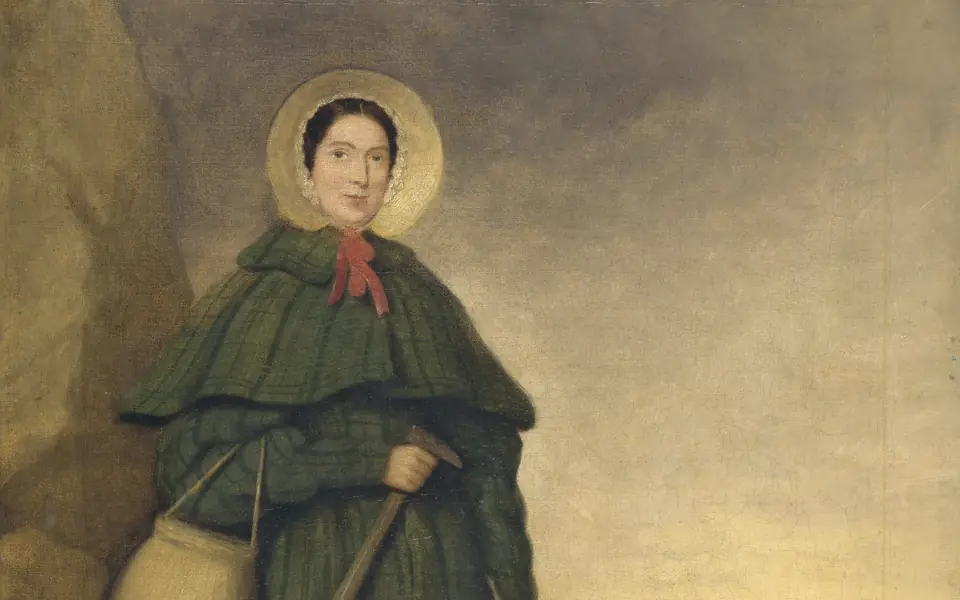
A livelihood among the fossils
On the coast of Dorset, a remarkable scientific collection began with objects that a family could sell to visitors. Mary Anning became an expert at finding and preparing fossils around Lyme Regis, where ancient marine animals lay inside the rocks. The specimens passed through shops, private collections, scientific meetings, and eventually museums. That journey sometimes made the people who described a fossil more visible than the person who uncovered it. Following Anning's work brings the practical knowledge of a collector back into the history of discovery.
Born in 1799, Anning grew up in a poor family. Her father Richard combined cabinetmaking with collecting fossils, teaching her to recognize and clean finds. After his death in 1810, selling specimens helped support the household. She had limited formal schooling but studied anatomy and geology herself. Visitors seeking curious objects were therefore buying the results of considerable experience. Finding something in a cliff was only the beginning: recognizing its importance and separating fragile bones from surrounding stone required judgment that could not simply be purchased with a museum admission ticket.
Skeletons that challenged familiar animals
One spectacular early specimen joined the work of two siblings. Joseph Anning discovered an unusual skull, and Mary subsequently excavated more of the skeleton. Museum accounts differ over the precise chronology of the earliest finds, but agree on their shared involvement. The animal belonged to the ichthyosaurs, marine reptiles whose bodies could resemble those of fish. It was neither a crocodile nor a dinosaur. A second outstanding discovery followed in 1823: an unusually complete plesiosaur with a small head and extraordinary neck. Its connected bones offered much stronger evidence than an isolated tooth or vertebra could provide.
Reconstruction depended on networks of collectors and researchers. The Geological Society records that an ichthyosaur found by Anning was bought through subscriptions and presented to the Bristol Institution in January 1823. William Daniel Conybeare used it as a principal basis for a reconstruction published the following year. Henry De la Beche and Conybeare compared material in different collections as they worked out the anatomy of extinct marine reptiles. A fossil's scientific value thus grew through comparison, illustration, and argument, with Anning's discoveries supplying essential physical evidence for those activities.
Small traces and lasting expertise
Her range extended beyond large sea creatures. William Buckland's research drew repeatedly on her finds, and a three-part paper presented to the Geological Society in February 1829 addressed discoveries she had made. The subjects included a flying reptile, fossil ink, and coprolites, the preserved remains of animal droppings. These less glamorous objects opened other questions about ancient life. Bones could suggest a creature's shape; traces associated with digestion or soft tissues could help researchers imagine its behavior and surroundings. Anning's importance lay partly in noticing evidence that a collector interested only in impressive skeletons might overlook.
Recognition remained uneven. Anning dealt directly with prominent geologists, yet her sex prevented her from joining the Geological Society. Its own historical exhibition now examines her influence through the collections and relationships that survived that exclusion. Her discoveries also continued to have lives beyond their first descriptions. Scientists revised classifications as comparisons improved, and museums preserved specimens for new generations to examine. Anning died in 1847, but the fossils still connect visitors with both an ancient sea and a nineteenth-century working woman. Their enduring usefulness makes a fitting measure of expertise developed far from a university lecture hall.