A peace prize with roots in Kenyan communities
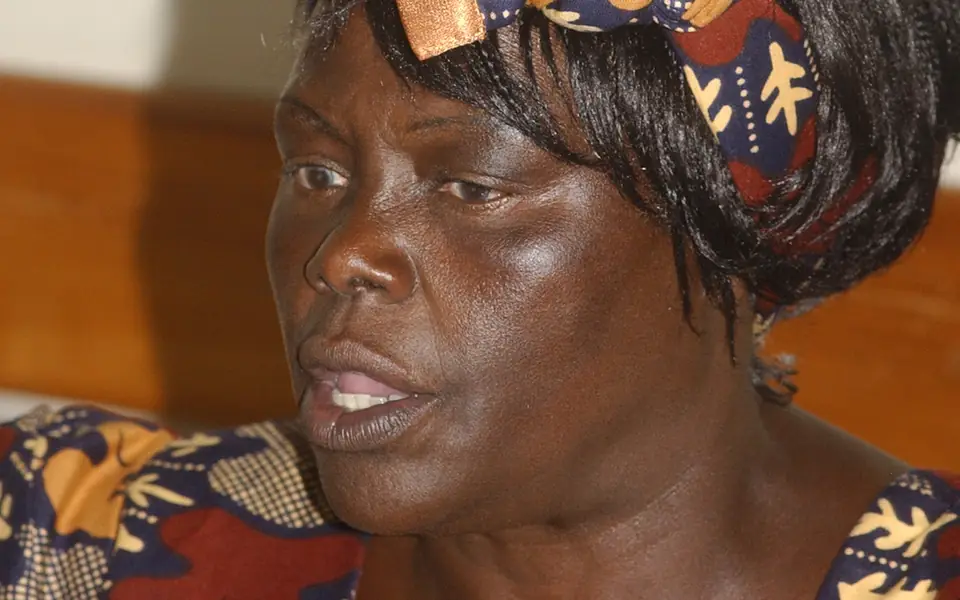
When Wangari Maathai received the Nobel Peace Prize in 2004, the recognition carried an unusual image into discussions of peace: women planting trees. The Kenyan biologist had helped make a familiar agricultural activity part of a wider struggle over livelihoods, public land, and political rights. She became the first African woman to receive the prize. Its recognition of sustainable development alongside democracy and peace reflected the connections she had spent decades pursuing. The Green Belt Movement showed how environmental history could also be the history of women gaining a public voice.
Maathai was born in Nyeri, Kenya, on April 1, 1940. Her education took her far beyond the countryside where she grew up. She completed a biological sciences degree at Mount St. Scholastica College in Kansas in 1964, followed by a master’s degree at the University of Pittsburgh in 1966. Doctoral studies included work in Germany and Nairobi, where she received her PhD in 1971. She taught veterinary anatomy at the University of Nairobi and later became a department chair and associate professor. Scientific training became one foundation of a career that would increasingly extend beyond university classrooms.
Listening to the women who gathered fuel and water
In 1977, Maathai founded the Green Belt Movement under the National Council of Women of Kenya. The starting point was practical testimony from rural women: streams were drying, food supplies were becoming less dependable, and collecting firewood required longer journeys. These were environmental changes experienced through everyday work. A shortage of nearby trees could mean more hours spent finding fuel, alongside anxiety about water and food. The movement connected those experiences instead of treating each complaint as an isolated household difficulty. Women who carried much of that work became central participants in the response.
Tree planting offered a task communities could undertake themselves. In her later Nobel lecture, Maathai explained how trees supplied fuel, food, shelter, and income while helping soils and watersheds. The significance extended beyond the materials a tree could provide. Women involved in the work gained greater influence over their social and economic circumstances. She also recalled an obstacle: people had been encouraged to believe that poverty meant they lacked the knowledge to solve their own problems. A movement built around achievable local work could begin to challenge that assumption through experience rather than through promises alone.
From community meetings to the defense of public land
The organization’s education work made the connections more explicit. Its community seminars asked why poverty, environmental damage, and food insecurity persisted, drawing attention to exclusion and the misuse of political power. UNESCO’s historical account describes meetings conducted in local languages and using familiar concepts, enabling rural women to explain their concerns and suggest responses. This was a different setting from a university lecture delivered to specialist students. Knowledge of damaged land and scarce water belonged to the people living with those conditions. Their participation helped turn the movement’s environmental program into an exercise in public decision making.
Public land soon brought those questions into direct conflict with government plans. In 1989, Maathai opposed a proposed tower development involving part of Nairobi’s Uhuru Park. In 1998, she and her partners mobilized against the proposed transfer of land in Karura Forest to private individuals. UNESCO records that public opposition helped force abandonment of both plans. Protecting a park or forest required more than planting replacement trees elsewhere. It involved asking who could dispose of a shared resource, whose interests counted, and whether citizens could challenge decisions made by powerful officials. Conservation and political accountability had become inseparable in these campaigns.
Public office, international recognition, and a remembered stream
In December 2002, Maathai was elected to Kenya’s parliament. She subsequently served as an assistant minister responsible for the environment, natural resources, and wildlife. A campaigner who had challenged public authorities now held public office herself. The Nobel award two years later recognized the broader relationship between her environmental work and the struggle for democratic rights. It also brought international attention to an effort that depended on many participants beyond its founder. Maathai’s prominence should not obscure the women’s groups and other local organizers whose repeated, practical work had made the movement possible.
Her Nobel lecture ended with a childhood memory of collecting water from a clear stream and trying to lift fragile strands of frogs’ eggs from it. Decades later, she recalled, that stream had dried up. The small scene gave a tangible scale to the losses discussed at an international ceremony. In the same lecture, she treated the prize as recognition of countless people working for the environment, equality, and democratic rights. Maathai died in 2011, but that record remains distinctive: scientific knowledge, women’s experience, and civic organizing had met around something as ordinary as a tree.