The historical setting
A dabbawala (also spelled dabbawalla or dabbawallah, called tiffin wallah in older sources) is a worker who delivers hot lunches from homes and restaurants to people at work in India and Pakistan, especially in Mumbai and Karachi. The dabbawalas constitute a lunchbox delivery and return system for workers in Mumbai and Karachi. The lunchboxes are picked up in the late morning, delivered predominantly using bicycles and railway trains, and returned empty in the afternoon. In the late 1800s, an increasing number of migrants were moving to Bombay from different parts of the country, and fast food and canteens were not prevalent. All these people left early in the morning for offices, and often had to go hungry for lunch. They belonged to different communities, and therefore had different preferences, which could only be satisfied by their own home-cooked meals.
Colour-coding system
A colour-coding system identifies the destination and recipient. Each dabbawala is required to contribute a minimum capital in kind, in the form of two bicycles, a wooden crate for the tiffins, white cotton kurta-pyjamas, and the white Gandhi cap (topi). Each month there is a division of the earnings of each unit. Fines are imposed for alcohol and tobacco use, being out of uniform, and absenteeism. A collecting dabbawala, usually on bicycle, collects dabbas either from a worker's home or from the dabba makers. Because the average literacy of dabbawallahs is that of 8th grade, the dabbas (boxes) have some sort of distinguishing mark on them, such as a colour or group of symbols.
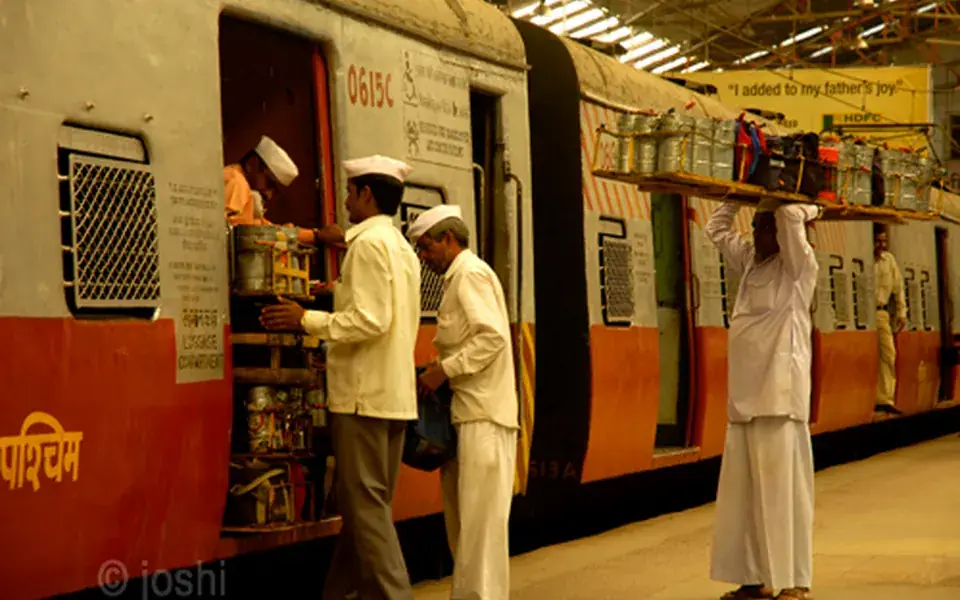
The dabbawala then takes them to a sorting place, where they and other collecting dabbawalas sort the lunch boxes into groups. The grouped boxes are put in the coaches of trains, with markings to identify the destination of the box (usually there is a designated car for the boxes). The markings include the railway station to unload the boxes and the destination building delivery address. Some modern infrastructure improvements such as the Navi Mumbai Metro are not used in the supply chain, as cabins do not have the capacity for hundreds of tiffins.
Association
Most dabbawalas are related to each other, belong to the Varkari sect of Maharashtra, and come from the same small village near Pune. Tiffin distribution is suspended for five days each March as the dabbawalas go home for the annual village festival. Dabbawalas have traditionally been male, but in recent years a few women have joined the profession. A dabbawala can be either a foreman, mukadam, or a simple delivery man, gaddi. Typically, they begin between the ages of 15 and 20. While they take pride in their freedom and the fact that they work in a network of their relatives, the relatively low compensation provided for their physical exertion makes them discourage their own children from joining the profession.
In a typical day, a dabbawala picks up tiffins every morning and then sorts them once before they are loaded onto the morning train (at approximately 10 a.m.). The tiffins are sorted another time in the luggage compartment of the train. At the destination station, the tiffins are loaded into carts and deposited in stacks at the entrances of the various workplaces. Following lunch, the same procedure is carried out in the reverse order with the empty tiffins.
Economic analysis
Each dabbawala, regardless of role, is paid around 8,000 rupees per month (about US$131 in 2014). Between 175,000 and 200,000 lunch boxes are moved each day by 4,500 to 5,000 dabbawalas. Dabbawalas are self-employed. The union initiation fee is 30,000 rupees, which guarantees a 5,000-rupee monthly income and a job for life. The 150 rupee a month fee provides for delivery six days a week. (2002) The New York Times reported in 2007 that the 125-year-old dabbawala industry continues to grow at a rate of 5–10% per year.