Engineering a mountain landscape
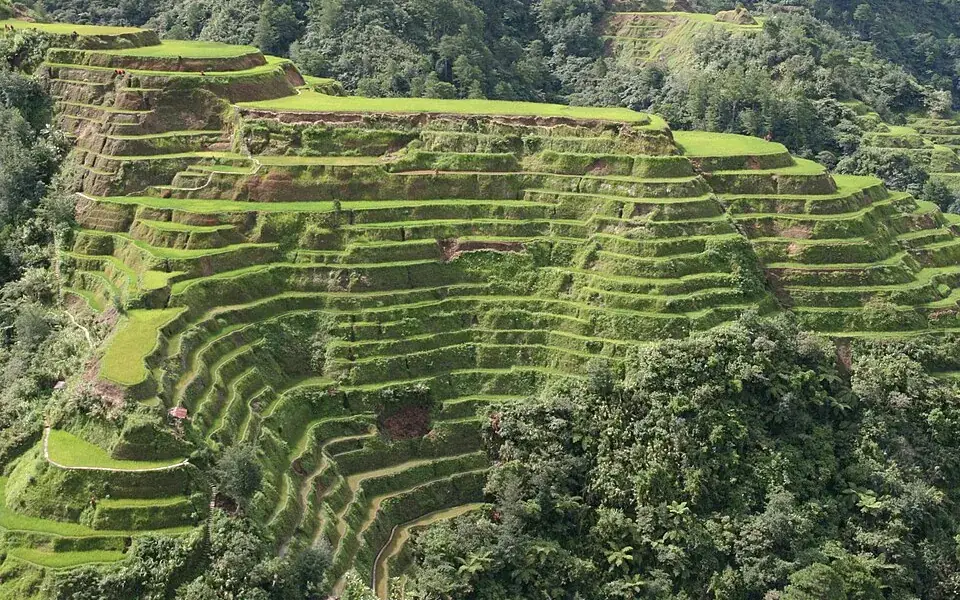
The Banaue Rice Terraces (Filipino: Hagdan-hagdang Palayan ng Banawe) are terraces that were carved into the mountains of Banaue, Ifugao, in the Philippines, by the ancestors of the Igorot people. The terraces were built with minimal equipment, largely by hand. The terraces are located approximately 1,500 meters (4,900 feet) above sea level. These are fed by an ancient irrigation system from the rainforests above the terraces.
The terrace system joins mountain water, retaining walls, and cultivated soil. Stone and rammed-earth walls hold the fields in place, while a main irrigation canal above a cluster directs water into the stepped landscape. Building and repairing these structures demanded practical skills in stonework, earthwork, and the control of water. The farmers' knowledge addressed a particular combination of steep terrain and soil conditions; terraces made wet-rice cultivation possible where level agricultural land was limited.
Rice, work, and ceremony
The terraces are found in the province of Ifugao and the Ifugao people have been its caretakers. Ifugao culture revolves around rice, the Black Rice kalinayan, and the culture engenders an elaborate array of celebrations linked with agricultural rites from rice cultivation to rice consumption. The harvest season generally calls for thanksgiving feasts, while the concluding harvest with rites called tango or tungul (a day of rest) which entail a strict taboo on any agricultural work. Bayah (rice wine), rice cakes, and betel nut are also consumed as part of the festivities.
Terrace farming formed part of a wider pattern of work in fields and forest lands. Ifugao farmers also tended root crops, fruit trees, vegetables, and edible shellfish. The landscape therefore supported more than a single harvest. Rice was a source of life and art, and the agricultural cycle linked the preparation of fields with celebrations, food, and social obligations. Caring for the terraces meant maintaining the channels and walls as well as planting crops.
An age debated through archaeology
Anthropologist Otley Beyer has estimated that the terraces are over 2000 years old, but several researchers dispute this and contend that they were built much later. Nevertheless, rice is an ancient ancestral crop of the Philippines, having been carried by Austronesian migrations into the islands since at least 1500 BCE (3500 years ago). In a 2018 archaeological study, Stephen Acabado challenged the conventional two-thousand-year chronology. Evidence from the Ifugao Archaeological Project placed a major expansion of terraced wet-rice cultivation around 1650 CE, which he connected with colonial pressure and political consolidation. This regional argument does not assign one construction date to every surviving terrace.
Heritage and continuing care
The Banaue Rice Terraces refer to the cluster close to the Banaue poblacion as seen from the viewpoint. Contrary to popular belief perpetrated by its inclusion on the twenty peso banknote, the Banaue Rice Terraces are not a UNESCO World Heritage Site. They were not included in the UNESCO inscription Rice Terraces of the Philippine Cordilleras due to the presence of numerous modern structures, making it score low in the integrity criterion of UNESCO. The five clusters inscribed as part of the Rice Terraces of the Philippine Cordilleras are Batad, Bangaan, Hungduan, Mayoyao Central and Nagacadan. Batad and Bangaan are under the jurisdiction of the Municipality of Banaue but are not called the Banaue Rice Terraces.
Preserving this landscape required attention to both physical structures and the community practices that kept them productive. UNESCO's assessment describes cooperative maintenance, forest watersheds, soil conservation, and farming knowledge as parts of the same system. Damage to water sources or walls could interrupt cultivation; a reduced agricultural workforce could also weaken the repeated labor that repair required. Conservation programs therefore included physical rehabilitation alongside efforts to support traditional practices, treating fields, villages, and forests as an interconnected cultural landscape.
The Banaue Rice Terraces were declared by the Philippine government as a National Cultural Treasure under Ifugao Rice Terraces through Presidential Decree No. 260 signed by President Ferdinand Marcos in 1973. The familiar Banaue roadside view and the formally listed terrace clusters should consequently be distinguished. Their different designations do not diminish the broader importance of Ifugao work, but they identify which particular landscapes received recognition and help keep discussions of their history and preservation geographically precise.