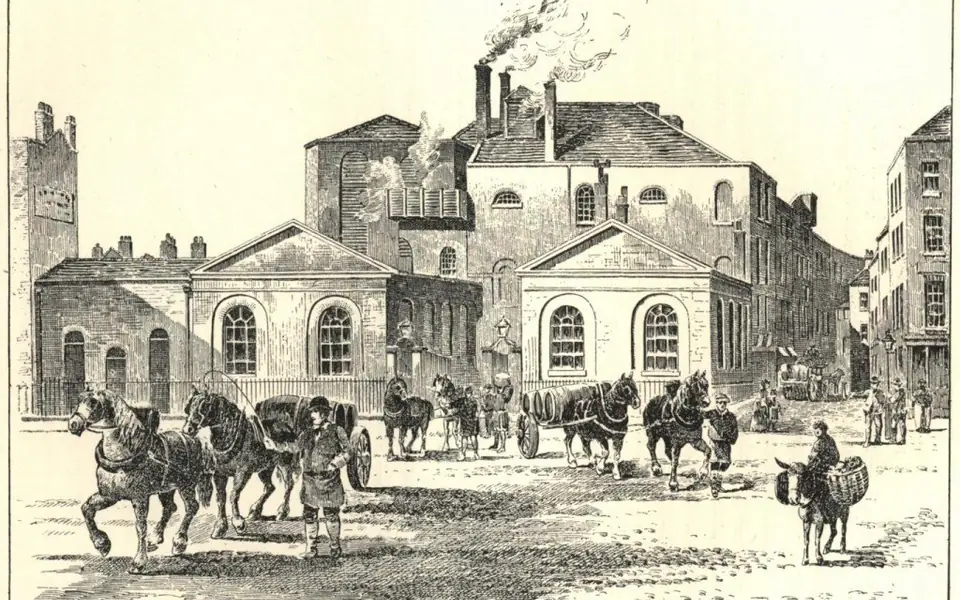
An everyday drink at industrial scale
On October 17, 1814, the contents of a brewery vat escaped into a London neighborhood with devastating force. The drink was porter, the dark beer produced in large quantities for the capital’s customers. At Meux’s Horse Shoe Brewery near Tottenham Court Road, storage on an industrial scale had concentrated a vast mass of liquid in one vessel. When that containment failed, the result was not a harmless puddle outside a public house. Beer broke through masonry and entered homes, turning a familiar product into a sudden threat to life.
London’s breweries were major urban businesses, and their huge vessels were part of the machinery required to supply an enormous market. Horse Shoe Brewery dated from the eighteenth century and operated among streets where people lived and worked. The accident therefore crossed the boundary between a factory and its neighbors almost immediately. The industrial story and the domestic story occupied the same ground. A worker could be performing a routine task at a nearby tavern while a quantity of beer far beyond anything a customer would see waited behind the brewery wall.
A failure that spread
The British Library’s account, drawn from contemporary newspaper evidence, records that the failed vat held 3,555 barrels. The shock brought down a substantial brewery wall and part of the roof. It also damaged the fitting of an adjoining vat, releasing more beer into the same flood. This sequence explains why the event was so destructive. The first failure did not remain confined to its own container; it compromised neighboring structures and equipment. Once liquid had room to move, its weight became force applied to buildings beyond the brewery.
At the Tavistock Arms, fourteen-year-old servant Eleanor Cooper was washing pots in the yard when the disaster struck. The publican, Richard Hawes, later described a crash, the destruction of the back of his premises, and beer pouring through the property and across the street. Cooper’s body was recovered from the rubble hours later. This testimony gives the flood a scale that a statistic alone cannot. A place associated with ordinary work and sociability had become a collapsed building, and a young employee had no opportunity to treat the torrent as entertainment.
The people in its path
Eight people died, including several young children. The documented victims also included Mary Mulvey and her three-year-old son Thomas Murry, four-year-old Hannah Banfield, and three-year-old Sarah Baten. Others were caught in nearby houses as the brewery’s contents broke into domestic space. The Library records a surviving girl who had been allowed outside to play, while members of her family were killed inside. Such accounts are a reminder that exposure depended on a person’s precise location at an unlucky moment, not on participation in the brewery’s business.
The coroner’s inquest followed quickly, on October 19. Its jury treated the deaths as accidental misfortune, rather than finding a person criminally responsible. The brewery continued operating after the disaster, eventually leaving a site that was demolished in 1922. An accident can therefore be both catastrophic for neighboring families and survivable for the enterprise at its center. That unequal aftermath is as much part of the history as the unusual substance in the flood. The damage was immediate; its human consequences continued after production could resume.
Remembering a disaster accurately
Later retellings often turn the event into a cheerful story of free drink or add a ninth death attributed to excessive drinking. Those additions should not displace the documented toll of eight. Contemporary evidence instead describes rescue, bereavement, severe injuries, and an inquest. The strange headline is memorable because beer seems so unlike a conventional hazard. But the mechanism was comprehensible: an enormous stored liquid supply escaped in a dense urban setting. The event belongs to the history of industrial accidents, even when its popular name makes it sound like a joke.
Looking at an old view of the brewery helps restore that setting. Buildings, carts, barrels, customers, and workers belonged to a functioning city rather than to a stage built for an improbable anecdote. The flood revealed how a routine manufacturing process could impose consequences beyond its walls. Its most useful surprise is that danger can depend on quantity and location as much as on the character of a material. Porter in a glass and porter stored by the thousands of barrels were the same drink, but they represented very different physical situations.