A marathon inside a world’s fair
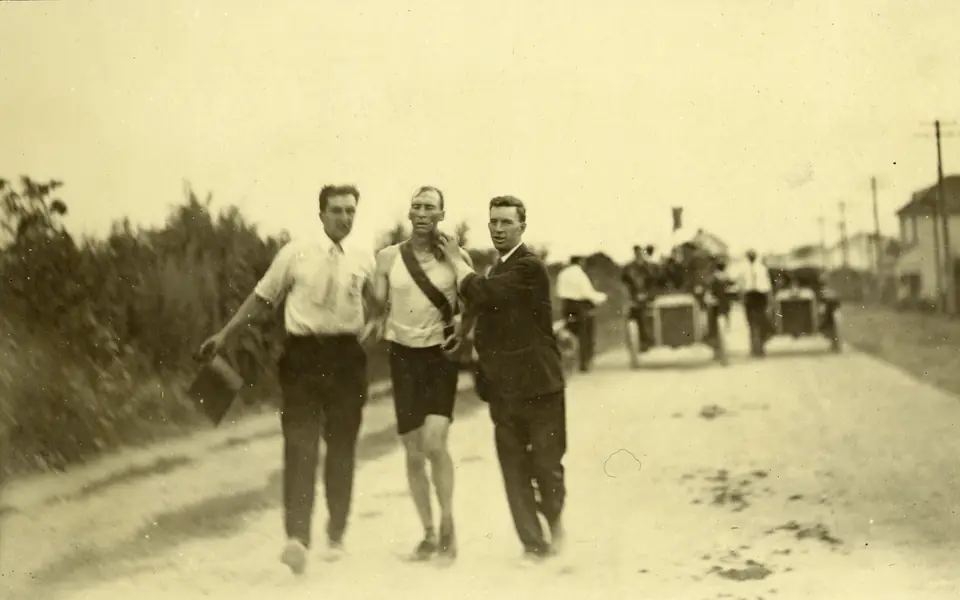
On August 30, 1904, marathon runners left Francis Field in St. Louis for a race that became famous for nearly everything except smooth organization. Thomas Hicks eventually received the victory, but another runner reached the stadium ahead of him after traveling part of the route in a car. The course covered roughly forty kilometres, shorter than the familiar modern marathon. The Olympic Games were being held alongside the Louisiana Purchase Exposition, a vast world's fair. Within that crowded setting, a prestigious test of endurance became an unusually revealing experiment in what an athletic event required.
The conditions placed runners in difficulty before any scandal developed. They started in the afternoon heat and followed dusty, hilly roads. Vehicles carrying officials and attendants traveled along the route, raising more dust around men already struggling to breathe. Water was scarce. The St. Louis County Library's account describes athletes leaving the stadium after preliminary laps, then encountering a course made harder by the accompanying traffic. The organization of the race therefore became part of the competition. Endurance alone could not separate an athlete's performance from the effects of road surfaces, heat, and the support available along the way.
An apparent winner and an automobile
Frederick Lorz provided the most memorable confusion. A New York bricklayer who trained outside his working hours, he had qualified for the Olympic trip through a shorter race. During the marathon he developed cramps and accepted a ride in an accompanying automobile. Later he resumed running and entered the stadium ahead of the remaining competitors. Spectators could see someone crossing the finish line; they could not see the journey that had brought him there. The apparent result depended on information held elsewhere along the course, making the event a demonstration of why observation at the finish was insufficient.
Once the ride became known, Lorz was disqualified. He maintained that his return to the stadium had been a joke rather than an attempt to keep an undeserved victory. That explanation did not undo the disruption. The Olympic Museum records a lifetime ban followed by reinstatement and a legitimate Boston Marathon victory in 1905. His later success makes the episode more interesting than a simple story of someone unable to run. An accomplished athlete could still take a shortcut, create confusion, and require officials to establish which result deserved recognition. The finish line needed a reliable account of the whole course.
A dangerous path to the recorded victory
Hicks's progress raised a different problem. His attendants gave him strychnine with egg whites, followed later by another dose and alcohol. Strychnine was used as a stimulant in that period, although it is a dangerous poison. The Olympic Museum describes the dehydrated runner staggering through the final stages and requiring several doctors afterward. There was no modern system of doping control to exclude him for taking it. Calling the mixture a colorful racing secret misses the central point: the people trying to sustain his performance were administering substances that could intensify the danger surrounding an exhausted competitor.
Hicks finished in three hours, twenty-eight minutes, and fifty-three seconds. The recorded victory was real, but it did not turn the undertaking into a model event. Fewer than half the starters finished. A historical study preserved by the LA84 Foundation describes the heat, limited water, difficult roads, and disputed assistance as interconnected failures. Accounts disagree over some details, including the exact number of starters, so the broad pattern is more dependable than an unnecessarily precise tally. The result tells us who was awarded first place; the surrounding evidence tells us how little that award says about the conditions of the race.
Reading the stories and the photographs
Other participants deserve attention beyond the best-known scandal. Cuban runner Félix Carvajal finished fourth. Len Tau and Jan Mashiani, two South African entrants associated with the world's fair, were among the first Black African competitors in the modern Olympics. Their participation took place within a fair that also displayed people through colonial and racial stereotypes. Later storytelling has often added or repeated picturesque details about clothing, food, and dogs. Those anecdotes require care: photographs and reports do not support every familiar version equally. Treating the runners as historical people means distinguishing documented participation from stories polished into entertainment.
A photograph by Jessie Tarbox Beals shows Hicks being sponged by attendants during the event. Preserved by the Missouri Historical Society and available through Wikimedia Commons, it places assistance at the center of the scene. The picture helps explain why this marathon remains useful history rather than merely a collection of absurd incidents. The boundaries between coaching, medical intervention, outside assistance, and fair competition were unsettled. The runners' ordeal illustrates how much depends on course preparation, reliable officiating, and practical care. A race is created by those arrangements as surely as it is completed by the people who run.