Pictures that invite a reading
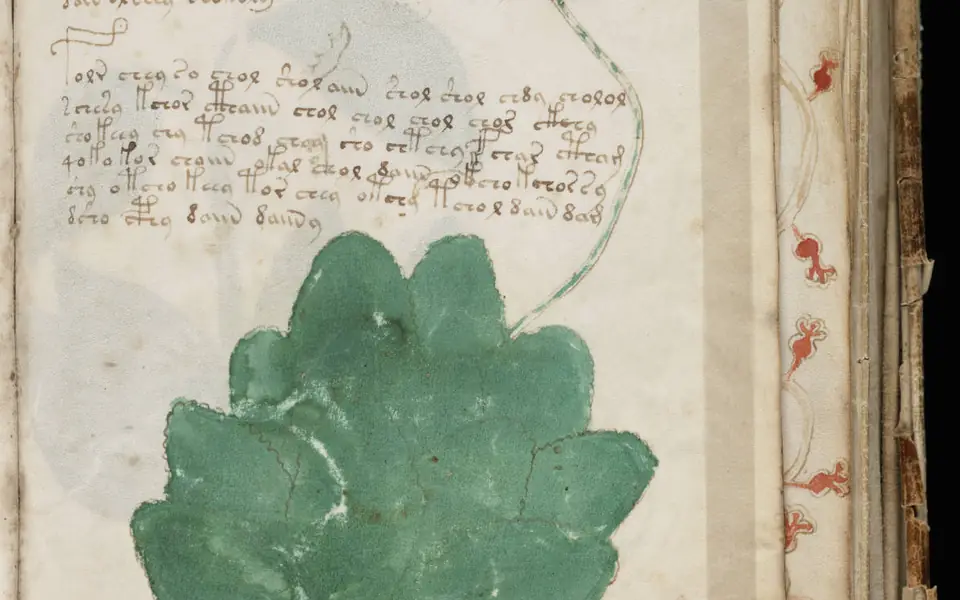
The Voynich manuscript looks invitingly organized. Lines of writing surround drawings of plants, circles of stars and groups of human figures. A reader might expect the pictures to unlock the words, or the repeated words to identify the pictures. Neither expectation has produced an accepted decipherment. The manuscript is held at Yale's Beinecke Rare Book and Manuscript Library as MS 408. Its familiar modern name comes from the bookseller Wilfrid Voynich, who purchased it in 1912, rather than from a known author or a title inside the book.
The illustrations offer categories before they offer explanations. Yale's catalogue describes botanical pages, astronomical or astrological diagrams, bathing figures and interconnected tubes, elaborate circular designs, pharmaceutical imagery, and a final section of continuous writing marked by small stars. Those labels organize what viewers can see; they do not establish precisely what the author meant. A plant-like drawing need not correspond neatly to an identifiable specimen, and a diagram of a body or a vessel does not tell us how the accompanying text should be read.
A physical book with a traceable journey
The book's structure is another source of evidence. It is a parchment codex with folded sheets gathered into sections, and some leaves open into unusually large foldouts. Other leaves have been lost. The catalogue records these gaps and the difficulty of numbering folded material consistently. This physical description matters because the surviving sequence may not preserve every part of the original work. A theory that depends on a perfectly complete book must confront the actual object: missing pages, complex folds and the history of its binding and handling.
Its ownership trail is more intelligible than its script. Records connect the manuscript with early modern European collectors and with Johannes Marcus Marci, who sent it to the Jesuit scholar Athanasius Kircher. Voynich bought it from a Jesuit collection near Rome in 1912. It later passed through Ethel Voynich and Anne Nill to the dealer H. P. Kraus, who donated it to Yale in 1969. Older associations with Roger Bacon and John Dee require caution; the library distinguishes documented history from speculation about famous possible owners or authors.
Materials and patterns
Laboratory work gives a different kind of access. McCrone Associates examined and sampled the book on January 14 and 15, 2009, at Yale's conservation laboratory. Such research treats a stroke of ink as a physical material before treating it as language. Independently, radiocarbon work places the parchment in the early fifteenth century, as the Arizona State Museum summarizes. Dating the support does not automatically identify when every mark was added. The important lesson is that material age, handwriting, ownership and meaning are separate questions requiring different kinds of evidence.
Research can progress without a translation. In a 2025 Yale discussion, linguist Claire Bowern explained that recurring word patterns can be studied even when their meanings remain unknown, and that paleographic work points to five people participating in the writing. That observation changes how one might imagine the book's production: a collaborative project becomes possible without revealing its subject. It also demonstrates the difference between a bounded finding about the manuscript and an ambitious claim to have solved all its mysteries. The former can be useful even while the latter remains unproven.
Reproducing an unresolved object
Reproducing the manuscript presents challenges of its own. For the Yale University Press facsimile, designers had to understand the sequence of photographed pages and the arrangement of complicated foldouts. Some of those expanded sections required handwork during production. A reproduction is therefore more than a stack of attractive images. Decisions about order, scale and folding influence how a reader experiences the object. Accurate digital scans and carefully made facsimiles also allow many people to examine features that would otherwise require handling a fragile original.
The manuscript's appeal rests partly in that coexistence of detail and uncertainty. We can trace later owners, inspect its physical organization, examine materials and compare written patterns, while still being unable to read its main text. Pictures and unusual letterforms make it tempting to propose a complete answer quickly. The evidence instead rewards questions that can be checked separately. The book remains mysterious, but its history is not an empty space: every documented transfer, missing leaf, tested sample and careful reproduction adds a part that can be understood.