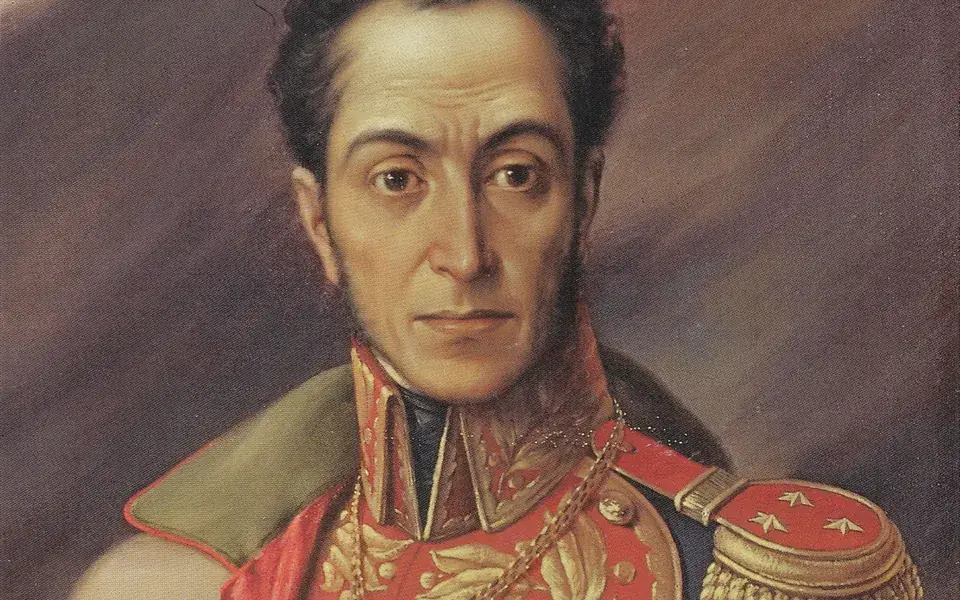
Simón José Antonio de la Santísima Trinidad Bolívar Palacios Ponte y Blanco (24 July 1783 – 17 December 1830) was a Venezuelan military officer and statesman who led what are currently the countries of Bolivia, Colombia, Ecuador, Panama, Peru, and Venezuela to independence from the Spanish Empire. He is known colloquially as El Libertador, "the Liberator," of America.
Early campaigns and setbacks
While Bolívar was in England, the Supreme Junta passed liberal economic reforms and began to hold elections for representatives to a congress to be held in Caracas. It had also alienated Caracas from the Venezuelan provinces of Coro, Maracaibo, and Guayana, which professed loyalty to the regency council, and began hostilities with them. Co-founding the Patriotic Society, a political organization advocating for independence from Spain, Bolívar and Miranda campaigned for and secured the latter's election to the congress. The congress first met on 2 March 1811 and declared its allegiance to Ferdinand VII. After it was discovered that one of the men leading the congress was a Spanish agent who had escaped with military documents, however, discourse – which Bolívar was prominent in – changed decidedly in favor of independence over 3 and 4 July.
Bolívar escaped La Guaira early on 31 July 1812 and rode to Caracas, where he hid from arrest in the home of Esteban Fernández de León, the Marquis de Casa León. Bolívar and Casa León convinced Francisco Iturbe, a friend of the Bolívar family and of Monteverde, to intercede on Bolívar's behalf and secure escape from Venezuela for him. Iturbe persuaded Monteverde to issue Bolívar a passport for his role in Miranda's arrest, and on 27 August he sailed for the island of Curaçao. He and his uncles Francisco and José Félix Ribas arrived on 1 September.
A new campaign across the mountains
Bolívar arrived in Kingston, Jamaica, on 14 May 1815 and, as in his earlier exile on Curaçao, ruminated on the fall of the Venezuelan and New Granadan republics. He wrote extensively, requesting assistance from Britain and corresponding with merchants based in the Caribbean. This culminated in September 1815 with the Jamaica Letter, in which Bolívar again laid out his ideology and vision of the future of the Americas. On 9 December, the Venezuelan pirate Renato Beluche brought Bolívar news from New Granada and asked him to join the Republican community in exile in Haiti.
Bolívar tentatively accepted and escaped assassination that night when his manservant mistakenly killed his paymaster as part of a Spanish plot. He left Jamaica eight days later, arrived in Les Cayes on 24 December, and on 2 January 1816 was introduced to Alexandre Pétion, President of the Republic of Haiti by a mutual friend. Bolívar and Pétion impressed and befriended each other and, after Bolívar pledged to free every slave in the areas he occupied, Pétion gave him money and military supplies.
Returning to Les Cayes, Bolívar held a conference with the Republican leaders in Haiti and was made supreme leader with Mariño as his chief of staff. The Republicans departed Les Cayes for Venezuela on 31 March 1816 and followed the Antilles eastward. After a delay to allow a lover of Bolívar's to join the fleet, it arrived on 2 May at Margarita Island, controlled by Republican commander Juan Bautista Arismendi.
Liberation and political fracture
The congress met in Angostura on 15 February 1819. There, Bolívar gave a speech in which he advocated for a centralized government modeled on the British government and racial equality, and relinquished civil authority to the congress. On 16 February, the congress elected Bolívar as president and Zea as vice president. On 27 February, Bolívar left Angostura to rejoin Páez in the west and resumed campaigning against Morillo, albeit ineffectively.
In May, as the annual wet season was beginning in the Llanos, Bolívar met with his officers and revealed his intention to invade and liberate New Granada from Royalist occupation, which he had prepared for by sending Santander to build up Republican forces in Casanare Province in August 1818. After the Battle of Carabobo, Bolívar turned his attention south, to Pasto, Colombia; Quito and the Free Province of Guayaquil, Ecuador; and the Viceroyalty of Peru.
Pasto and Quito were Royalist strongholds, while Guayaquil had declared its independence on 9 October 1820 and had been garrisoned by Sucre on Bolívar's orders in January 1821. Panama declared its independence on 28 November 1821 and joined Colombia. Peru had been invaded by a Republican army led by Argentine general José de San Martín, who had liberated Chile and Peru, and Bolívar feared San Martín would absorb Ecuador into Peru. In October 1821, after congress empowered him to secure Ecuador for Colombia, Bolívar assembled an army in Bogotá that departed on 13 December 1821.