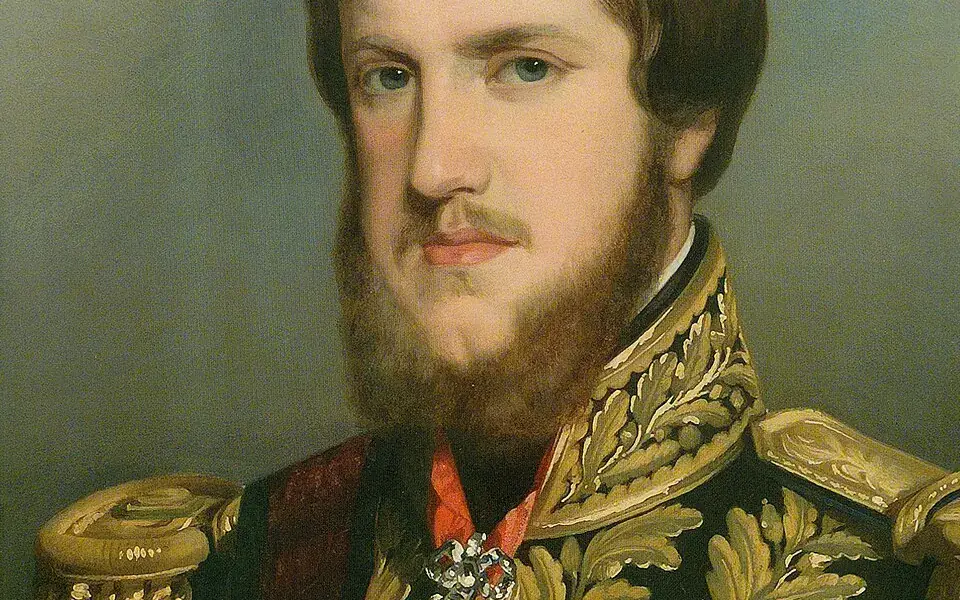
Dom Pedro II (Pedro de Alcântara João Carlos Leopoldo Salvador Bibiano Francisco Xavier de Paula Leocádio Miguel Gabriel Rafael Gonzaga; 2 December 1825 – 5 December 1891), known as "the Magnanimous" (Portuguese: O Magnânimo), was the second and final emperor of the Empire of Brazil. He reigned from 1831 until his deposition in the military coup of 1889, presiding over the longest and most stable reign in Brazilian history.
A young emperor establishes authority
Upon leaving the country, Emperor Pedro I selected three people to take charge of his son and remaining daughters. The first was José Bonifácio de Andrada, his friend and an influential leader during Brazilian independence, who was appointed guardian. The second was Mariana de Verna, who had held the post of aia (governess) since the birth of Pedro II. As a child, the then-Prince Imperial called her "Dadama", as he could not pronounce the word dama (Lady) correctly.
Pedro II regarded her as his surrogate mother and would continue to call her by her nickname well into adulthood out of affection. The third person was Rafael, an Afro-Brazilian veteran of the Cisplatine War. Removal of the factious regency brought stability to the government. Pedro II was seen nationwide as a legitimate source of authority, whose position placed him above partisanship and petty disputes. He was, however, still young as well as shy and insecure.
Behind the scenes, a group of high-ranking palace servants and notable politicians led by Aureliano Coutinho (later Viscount of Sepetiba) became known as the "Courtier Faction" as they established influence over the young Emperor. Some were very close to him, such as Mariana de Verna and Steward Paulo Barbosa da Silva. Pedro II was deftly used by the Courtiers against their actual or suspected foes. The Brazilian government secured the hand of Princess Teresa Cristina of the Kingdom of the Two Sicilies.
Learning, science, and public life
At the beginning of the 1850s, Brazil enjoyed internal stability and economic prosperity. Under the prime ministry of Honório Hermeto Carneiro Leão (then-Viscount and later Marquis of Paraná) the Emperor advanced his own ambitious program: the conciliação (conciliation) and melhoramentos (material developments). Pedro II's reforms aimed to promote less political partisanship, and forward infrastructure and economic development. The nation was being interconnected through railroad, electrical telegraph, and steamship lines, uniting it into a single entity.
The general opinion, both at home and abroad, was that these accomplishments had been possible due to Brazil's "governance as a monarchy and the character of Pedro II". Pedro II was neither a British-style figurehead nor an autocrat in the manner of Russian czars. Subjects which interested Pedro II were wide-ranging, including anthropology, history, geography, geology, medicine, law, religious studies, philosophy, painting, sculpture, theater, music, chemistry, physics, astronomy, poetry, and technology among others. By the end of his reign, there were three libraries in São Cristóvão palace containing more than 60,000 books.
A passion for linguistics prompted him throughout his life to study new languages, and he was able to speak and write not only Portuguese but also Latin, French, German, English, Italian, Spanish, Greek, Arabic, Hebrew, Sanskrit, Chinese, Occitan, and Tupi. He became the first Brazilian photographer when he acquired a daguerreotype camera in March 1840. He set up one laboratory in São Cristóvão devoted to photography and another to chemistry and physics.
Abolition and the end of the monarchy
In the 1870s, progress was made in both social and political spheres as segments of society benefited from the reforms and shared in the increasing prosperity. Brazil's international reputation for political stability and investment potential greatly improved. The Empire was seen as a modern and progressive nation unequaled, with the exception of the United States, in the Americas. The economy began growing rapidly and immigration flourished. Railroad, shipping and other modernization projects were adopted.
With "slavery destined for extinction and other reforms projected, the prospects for 'moral and material advances' seemed vast." In 1870, few Brazilians opposed slavery and even fewer openly condemned it. Pedro II, who did not own slaves, was one of the few who did oppose slavery. By June 1887, the Emperor's health had considerably worsened, and his personal doctors suggested going to Europe for medical treatment. While in Milan he passed two weeks between life and death, even being anointed.
While on a bed recovering, on 22 May 1888 he received news that slavery had been abolished in Brazil. With a weak voice and tears in his eyes, he said, "Great people! Great people!" Pedro II returned to Brazil and disembarked in Rio de Janeiro in August 1888.