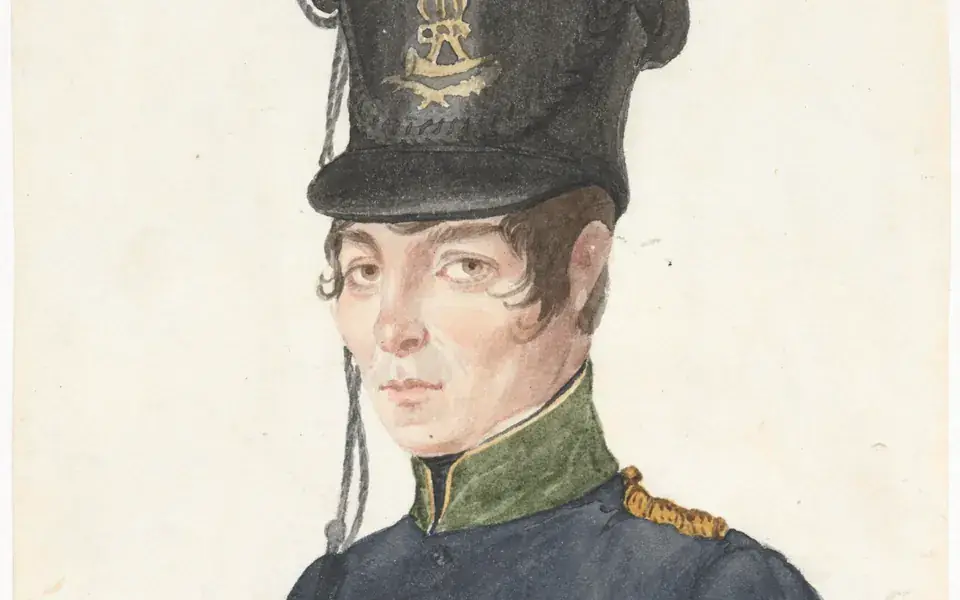
Maria Quitéria de Jesus (1792–1853) was a Brazilian soldier and national heroine. She served in the Brazilian War of Independence in 1822–24 dressed as a man. She was promoted to cadet and lieutenant and later decorated with the Imperial Order of the Cross. Quitéria has been called the "Brazilian Joan of Arc", and has become a legendary figure in Brazil. Quitéria was the first woman to serve in a military unit in the country.
Rural skills and family life
Maria Quitéria de Jesus was born in 1792, in Licurizeiro, in the parish of São José das Itaporocas (now located in Feira de Santana), Bahia. She was the eldest daughter of a farmer, Gonçalo Alves de Almeida, and his wife, Quitéria Maria de Jesus, who died when the young Maria Quitéria was just 10 years old. Her father would go on to remarry on two more occasions, once with Eugenia Maria dos Santos, and later to Rosa Maria de Brito. Although Maria received no formal education, she would have practiced the skills necessary to farming, such as riding, hunting, and using firearms—these skills would serve her in the military as well.
After her time serving in the war, Quitéria married Gabriel Pereira Brito (who was a former lover of hers) and had one daughter with him, named Luisa. Near the end of her life, the widowed Maria Quitéria was nearly blind, and in 1853 she died in relative obscurity and poverty near Salvador. Her remains were placed in the ossuary of the Church of the Blessed Sacrament of Saint Anne (Portuguese: Igreja do Santíssimo Sacramento e Sant'Ana), in the neighborhood of Nazaré in Salvador. It was not until years later that her legacy was revived.
Military service in Bahia
Quitéria is known as one of the three Bahia women fighters against the Portuguese along with Maria Filipa de Oliveira (died 1873) and Sister Joana Angélica (1761-1822). Against her father's will, an unmarried Maria Quitéria enlisted in the Parakeet Battalion, division of the Brazilian Army, as a man, in October 1822. Until June 1823, she fought in several battles against the Portuguese in Bahia, where she lived.
Maria Quitéria's father outed her as a woman after he discovered her enlistment—but because of her skill in battle, she was allowed to continue to fight. She was promoted to cadet in July 1823, and then to lieutenant in August, where she was received and decorated by the Emperor. Detailed accounts of her life are scarce. The historian Aristides Augusto Milton later praised her courage and honesty, drawing attention to the weapons skills and discipline that helped persuade officers to retain her.
English traveler Maria Graham also recorded Quitéria in her Journal of a Voyage to Brazil. Graham portrayed her as lively and perceptive and suggested that education could have developed her abilities further. Such notices are valuable because detailed accounts of Quitéria’s own life are scarce; they also show how contemporaries perceived a woman whose military career challenged expectations.
Remembering a woman soldier
After her death, Maria Quitéria was memorialized nationally in a number of ways. In 1953, one hundred years after her death, a bronze medal was issued by the military bearing Maria Quitéria's likeness. It is called the "Medal of Maria Quitéria" and was issued to both civilians and military personnel for valuable contributions to military efforts. By presidential decree in 1996, Maria Quitéria was proclaimed Patron of the Corps of Support Staff Officers of the Brazilian Army.
The best-known painting of Maria Quitéria is a work by Italian painter Domenico Failutti from 1920 titled Portrait of Maria Quitéria de Jesus Medeiros (Portuguese: Retrato de Maria Quitéria de Jesus Medeiros). She is depicted standing alone, holding a rifle and wearing the uniform of a Brazilian lieutenant. The work can be found in the Museu Paulista at the University of São Paulo.