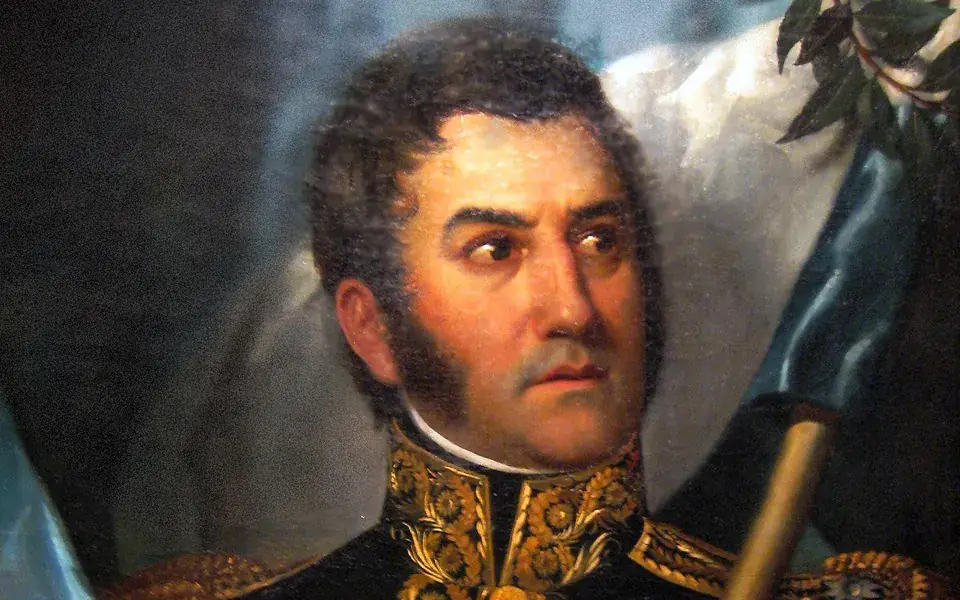
José Francisco de San Martín y Matorras (25 February 1778 – 17 August 1850), nicknamed "the Liberator of Argentina, Chile and Peru", was an Argentine general and the primary leader of the southern and central parts of South America's successful struggle for independence from the Spanish Empire who served as the Protector of Peru. Born in Yapeyú, Corrientes, in modern-day Argentina, he left the Viceroyalty of the Río de la Plata at the early age of seven to study in Málaga, Spain.
Preparing an army in Cuyo
The absolutist restoration in Spain and the growing influence of Artigas generated a political crisis in Buenos Aires, forcing Posadas to resign. Alvear became the new Supreme Director, but had to resign after three months. San Martín's plan was complicated as well by the Disaster of Rancagua, a royalist victory that restored absolutism in Chile, ending the Patria Vieja period. San Martín initially proposed a regular-sized army, simply to reinforce Chile, but changed to propose a larger one, to liberate the country from the occupation.
Chileans Bernardo O'Higgins, José Miguel Carrera, Luis Carrera and Manuel Rodríguez, the leaders of the deposed Chilean rule, sought refugee in Cuyo, along with their armies. O'Higgins and Rodríguez were well received, but the Carrera brothers intended to act as a government in exile. They ignored the local laws of Cuyo, and their soldiers committed acts of vandalism. San Martín imprisoned them and sent them to Buenos Aires. They proposed a plan to liberate Chile, different to the one outlined by San Martín, who rejected it as impractical.
The disagreement initiated a rivalry between the Carreras and San Martín. San Martín immediately began to organize the Army of the Andes. He drafted all the citizens who could bear arms and all the slaves from ages 16 to 30, requested reinforcements to Buenos Aires, and reorganized the economy for war production.
The crossing and the campaign in Chile
Although the Congress of Tucumán had already formalized the flag of Argentina, the Army of the Andes did not use it, choosing a banner with two columns, light blue and white, and a coat of arms roughly similar to the Coat of arms of Argentina. The army did not use the flag of Argentina because it was not exclusively an Argentine army. Contrary to the common understanding, the crossing of the Andes was not the first time that a military expedition crossed the mountain range.
The columns that crossed the Andes began to take military actions. The column in the north led by Cabot defeated the royalists in Salala, seized Coquimbo and then Copiapó. In the south, Ramón Freire captured Talca. Las Heras routed royalist outposts in Juncalito and Potrerillos. Bernardo O'Higgins, who came from Los Patos pass, defeated the royalists at Las Coimas. This allowed the main columns to gather at Aconcagua valley, meeting at the slopes of Chacabuco. San Martín made a brief reconnaissance of the royalist army, and noticed several flaws in their organization.
Feeling secure of victory, he claimed that "Osorio is clumsier than I thought. Today's triumph is ours. The sun as witness!". The battle began at 11:00 am. The patriot artillery on the right fired on the royalist infantry on the left. Manuel Escalada led mounted grenadiers to capture the royalist artillery, turning them against their owners.
The expedition to Peru
Peruvian viceroy Joaquín de la Pezuela had instructions from Spain to negotiate with the patriots. Under an armistice the opponents celebrated a meeting in Miraflores. The viceroy's deputies proposed to adopt the liberal Spanish constitution if San Martín left the country, but the patriots requested instead that Spain grant the independence of Peru. The negotiations did not bear fruit. San Martín isolated Lima from the surrounding countryside, and sent Juan Antonio Álvarez de Arenales to promote rebellions among the natives.
As hostilities renewed, San Martín organized several guerrilla groups in the countryside, and laid siege to Lima, but did not force his entry, as he did not want to appear as a conqueror to the local population. However, De la Serna suddenly left the city with his army, for unknown reasons. San Martín called for an open cabildo to discuss the independence of the country, which was agreed.
With this approval, the authority in Lima, the support of the northern provinces and the port of El Callao under siege, San Martín declared the independence of Peru on 28 July 1821. San Martín thought that if he joined forces with Bolívar he would be able to defeat the remnant royalist forces in Peru. Both liberators would meet in Quito, so San Martín appointed Torre Tagle to manage the government during his absence. Bolívar was unable to meet San Martín at the arranged date, so San Martín returned to Lima, but still left Tagle in government.