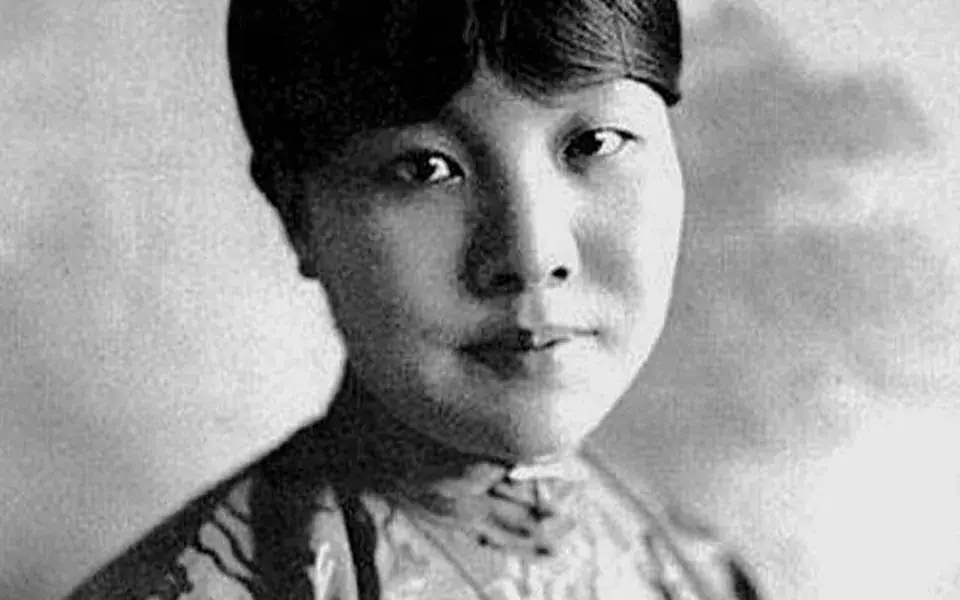
Bing Xin's Letters to Young Readers uses letters and dispatches to describe travel and daily experiences, addressing young readers on themes such as nature and family affection.
The epistolary form gives the prose the tone of direct conversation. Its circulation was also connected to modern periodicals, children's reading, and the environment of new literature.
Life
Bing Xin was born in Fuzhou, Fujian, moved to Shanghai with her family when she was seven months old, and moved again to the coastal port city of Yantai, Shandong when she was four. These moves had a crucial influence on Bing Xin's personality and philosophy of love and beauty, as the vastness and beauty of the sea greatly expanded and refined young Bing Xin's mind and heart. It was also in Yantai that Bing Xin first began to read the classics of Chinese literature, such as Romance of the Three Kingdoms and Water Margin, when she was just seven.
Bing Xin entered Fuzhou Women's Normal School and started preparatory study in 1911. In 1913, Bing Xin moved to Beijing. She entered the science department of North China Union Women's University and began to learn to become a doctor. Influences by the May Fourth Movement and the New Culture Movement, Bing Xin transferred to the Department of Literature. The May Fourth Movement in 1919 inspired and elevated Bing Xin's patriotism to new high levels, starting her writing career as she wrote for a school newspaper at Yanjing University where she was enrolled as a student and published her first novel. While at Yanjing in 1921, Bing Xin was baptized a Christian, but was throughout her life generally indifferent to Christian rituals.
Bing Xin graduated from Yanjing University in 1923 with a bachelor's degree, and went to the United States to study at Wellesley College, earning a master's degree at Wellesley in literature in 1926. Before and after studying abroad, she wrote prose about her journeys while traveling in foreign countries and sent them back to China for publication. The collection was To Young Readers, which was an early work of Chinese children's literature. She then returned to Yanjing University to teach until 1936.
In 1929, she married Wu Wenzao, an anthropologist and her good friend when they were studying in the United States. Together, Bing Xin and her husband visited different intellectual circles around the world, communicating with other intellectuals such as Virginia Woolf.
During the Second Sino-Japanese War, she wrote guanyu nüren (About Women) under the pen name Nan Shi (Mr. Man) in Chongqing, and actively engaged in creation and cultural salvation activities in Kunming, Chongqing and other places. Her 1943 My Standards for a Wife satirized the misogyny of the Republic of China era.
After war period, Bing Xin worked at the Department of New Chinese Literature at the University of Tokyo, and taught the history of Chinese new literature from 1949 to 1951, and published some short articles in local newspapers.
Later in her life, Bing Xin taught in Japan for a short period and stimulated more cultural communications between China and the other parts of the world as a traveling Chinese writer. In literature, Bing Xin founded the "Bing Xin Style" as a new literary style. She contributed a lot to children's literature in China (her writings were incorporated into children's textbooks), and also undertook various translation tasks, including translating the works of Indian literary figure Rabindranath Tagore.
Because of the translation of Kahlil Gibran's The Prophet, Sand and Foam, Rabindranath Tagore's Gitanjali, The Gardener and other works, she was awarded the National Order of the Cedar by the president of the Republic of Lebanon in 1995. Tagore's prose poems inspired Bing Xin. She wrote the influential prose letters To the Little Readers, which was the best example. Affected by Tagore's pantheism, Bing Xin's creation moves towards the chant of tender love. With Tagore's influence, Bing Xin also created Fanxing and Chunshui. Bing Xin said, when she wrote Fanxing (A Maze of Stars) and Chunshui (Spring Water), she was not writing poems. She was just influenced by Tagore's Stray Birds and wrote these "fragmented thoughts" in a few words in her notebook then collected into a collection.