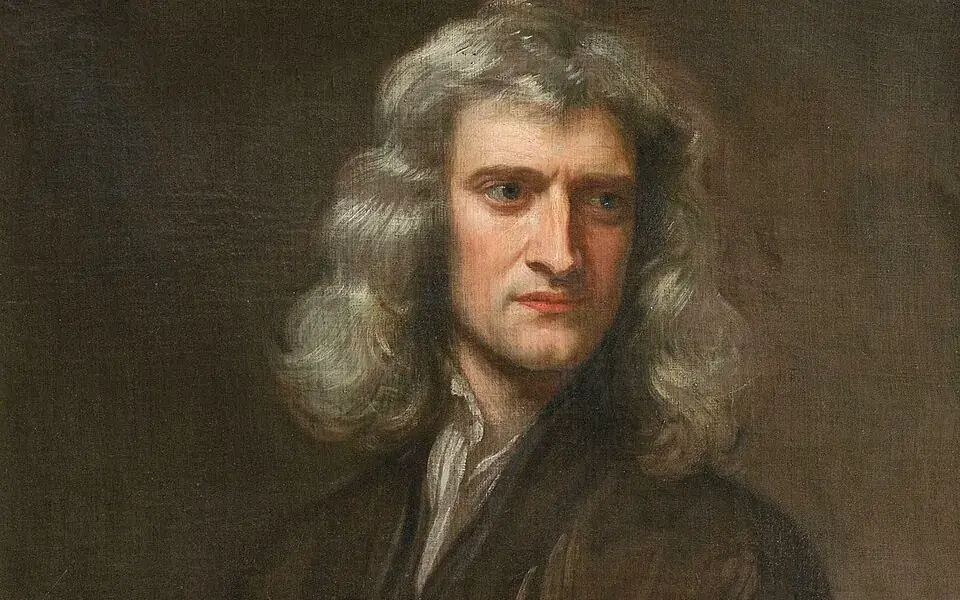
Newton's Mathematical Principles of Natural Philosophy set out laws of motion and universal gravitation, using mathematics to explain connections between terrestrial objects and celestial motion.
The work was published in 1687. The apple story became widely known later, but the theory emerged from sustained calculation, observation, and earlier researchers' work.
Historical context
Philosophiæ Naturalis Principia Mathematica (English: The Mathematical Principles of Natural Philosophy), often called simply the Principia, is a book by Sir Isaac Newton that expounds Newton's laws of motion and his law of universal gravitation.
The Principia is written in Latin and comprises three volumes, and was authorized (imprimatur) by Samuel Pepys, then-president of the Royal Society on 5 July 1686 and first published in 1687. After annotating and correcting his personal copy of the first edition, Newton published two further editions, one of 1713 with errors in the 1687 version corrected, and another, improved one of 1726.
The Principia forms a mathematical foundation for the theory of classical mechanics, and is generally considered to be one of the most important works in the history of science. It has been referred to as "the greatest scientific work in history" and "the supreme expression in human thought of the mind's ability to hold the universe fixed as an object of contemplation".
Recent research has challenged the long-held view that the Principia had only a limited initial readership, suggesting that its early influence on Enlightenment science was substantially greater than previously recognized.
In formulating his physical laws, Newton developed and used mathematical methods now included in the field of calculus, expressing them in the form of geometric propositions about "vanishingly small" shapes. In a revised conclusion to the Principia, Newton emphasized the empirical nature of the work with the expression Hypotheses non fingo ("I frame/feign no hypotheses"). Among other achievements, Newton provides an explanation for Johannes Kepler's laws of planetary motion, which Kepler had obtained empirically.
Expressed aim and topics covered
... Rational Mechanics will be the sciences of motion resulting from any forces whatsoever, and of the forces required to produce any motion, accurately proposed and demonstrated... And therefore we offer this work as mathematical principles of his philosophy. For all the difficulty of philosophy seems to consist in this—from the phenomena of motions to investigate the forces of Nature, and then from these forces to demonstrate the other phenomena...
Newton situates himself within the contemporary scientific movement which had "omit substantial forms and the occult qualities" and instead endeavoured to explain the world by empirical investigation and outlining of empirical regularities.
The Principia deals primarily with massive bodies in motion, initially under a variety of conditions and hypothetical laws of force in both non-resisting and resisting media, thus offering criteria to decide, by observations, which laws of force are operating in phenomena that may be observed. It attempts to cover hypothetical or possible motions both of celestial bodies and of terrestrial projectiles. It explores difficult problems of motions perturbed by multiple attractive forces. Its third and final book deals with the interpretation of observations about the movements of planets and their satellites.
The opening sections of the Principia contain, in revised and extended form, nearly all of the content of Newton's 1684 tract De motu corporum in gyrum.
The author and historical setting
Sir Isaac Newton (4 January 1643 – 31 March 1727) was an English polymath who was a mathematician, physicist, astronomer, alchemist, theologian, historian and inventor. He was a key figure in the Scientific Revolution and the Enlightenment that followed. His book Philosophiæ Naturalis Principia Mathematica (Mathematical Principles of Natural Philosophy), first published in 1687, achieved the first great unification in physics and established classical mechanics. Newton also made seminal contributions to optics, and shares credit with the German mathematician Gottfried Wilhelm Leibniz for formulating infinitesimal calculus, although he developed calculus years before Leibniz. Newton contributed to and refined the scientific method, and his work is considered the most influential in bringing forth modern science.