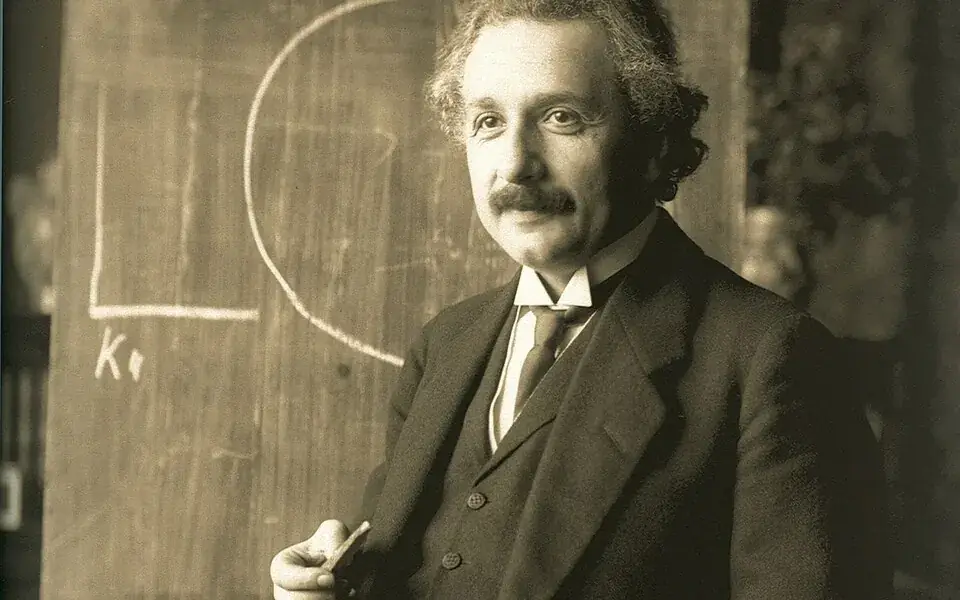
Einstein received the 1921 Nobel Prize in Physics. The official recognition emphasized, among other contributions, his explanation of the photoelectric effect, rather than directly rewarding general relativity.
The idea of light quanta helped explain how illumination affects electrons. A Nobel Prize citation does not represent the whole of a scientist's achievements.
20th century
In 1902, Lenard observed that the energy of individual emitted electrons was independent of the applied light intensity. This appeared to be at odds with Maxwell's wave theory of light, which predicted that the electron energy would be proportional to the intensity of the radiation.
Lenard observed the variation in electron energy with light frequency using a powerful electric arc lamp which enabled him to investigate large changes in intensity. However, Lenard's results were qualitative rather than quantitative because of the difficulty in performing the experiments: the experiments needed to be done on freshly cut metal so that the pure metal was observed, but it oxidized in a matter of minutes even in the partial vacuums he used. The current emitted by the surface was determined by the light's intensity, or brightness: doubling the intensity of the light doubled the number of electrons emitted from the surface.
Initial investigation of the photoelectric effect in gasses by Lenard were followed up by J. J. Thomson and then more decisively by Frederic Palmer Jr. The gas photoemission was studied and showed very different characteristics than those at first attributed to it by Lenard.
In 1900, while studying black-body radiation, the German physicist Max Planck suggested in his "On the Law of Distribution of Energy in the Normal Spectrum" paper that the energy carried by electromagnetic waves could only be released in packets of energy. In 1905, Albert Einstein published a paper advancing the hypothesis that light energy is carried in discrete quantized packets to explain experimental data from the photoelectric effect. Einstein theorized that the energy in each quantum of light was equal to the frequency of light multiplied by a constant, later called the Planck constant. A photon above a threshold frequency has the required energy to eject a single electron, creating the observed effect. This was a step in the development of quantum mechanics. In 1914, Robert A.
Millikan's highly accurate measurements of the Planck constant from the photoelectric effect supported Einstein's model, even though a corpuscular theory of light was for Millikan, at the time, "quite unthinkable". Einstein was awarded the 1921 Nobel Prize in Physics for "his discovery of the law of the photoelectric effect", and Millikan was awarded the Nobel Prize in 1923 for "his work on the elementary charge of electricity and on the photoelectric effect". In quantum perturbation theory of atoms and solids acted upon by electromagnetic radiation, the photoelectric effect is still commonly analyzed in terms of waves; the two approaches are equivalent because photon or wave absorption can only happen between quantized energy levels whose energy difference is that of the energy of photon.
Albert Einstein's mathematical description of how the photoelectric effect was caused by absorption of quanta of light was in one of his Annus Mirabilis papers, named "On a Heuristic Viewpoint Concerning the Production and Transformation of Light". The paper proposed a simple description of energy quanta, and showed how they explained the blackbody radiation spectrum. His explanation in terms of absorption of discrete quanta of light agreed with experimental results. It explained why the energy of photoelectrons was not dependent on incident light intensity. This was a theoretical leap, but the concept was strongly resisted at first because it contradicted the wave theory of light that followed naturally from James Clerk Maxwell's equations of electromagnetism, and more generally, the assumption of infinite divisibility of energy in physical systems.